ESG Investing: Sustainable Finance, Green Bonds, and Impact Measurement
ESG investing depends on disclosure, scenarios, and valuation — not good intentions. Read how the pieces connect and where the evidence is still weak.
ESG investing is often presented as a moral choice expressed through a portfolio. That framing hides the more practical question: what information would an investor need for environmental or social factors to affect a valuation, and is that information available and comparable? The honest answer is that the disclosure infrastructure is improving, the scenario tools are useful but uncertain, and the link to returns is contested.
Direct answer: ESG investing integrates environmental, social, and governance information into investment decisions. The useful instruments are disclosure standards — the IFRS Foundation's ISSB develops "IFRS Sustainability Disclosure Standards" — climate scenarios from bodies such as the NGFS, and ordinary valuation discipline.
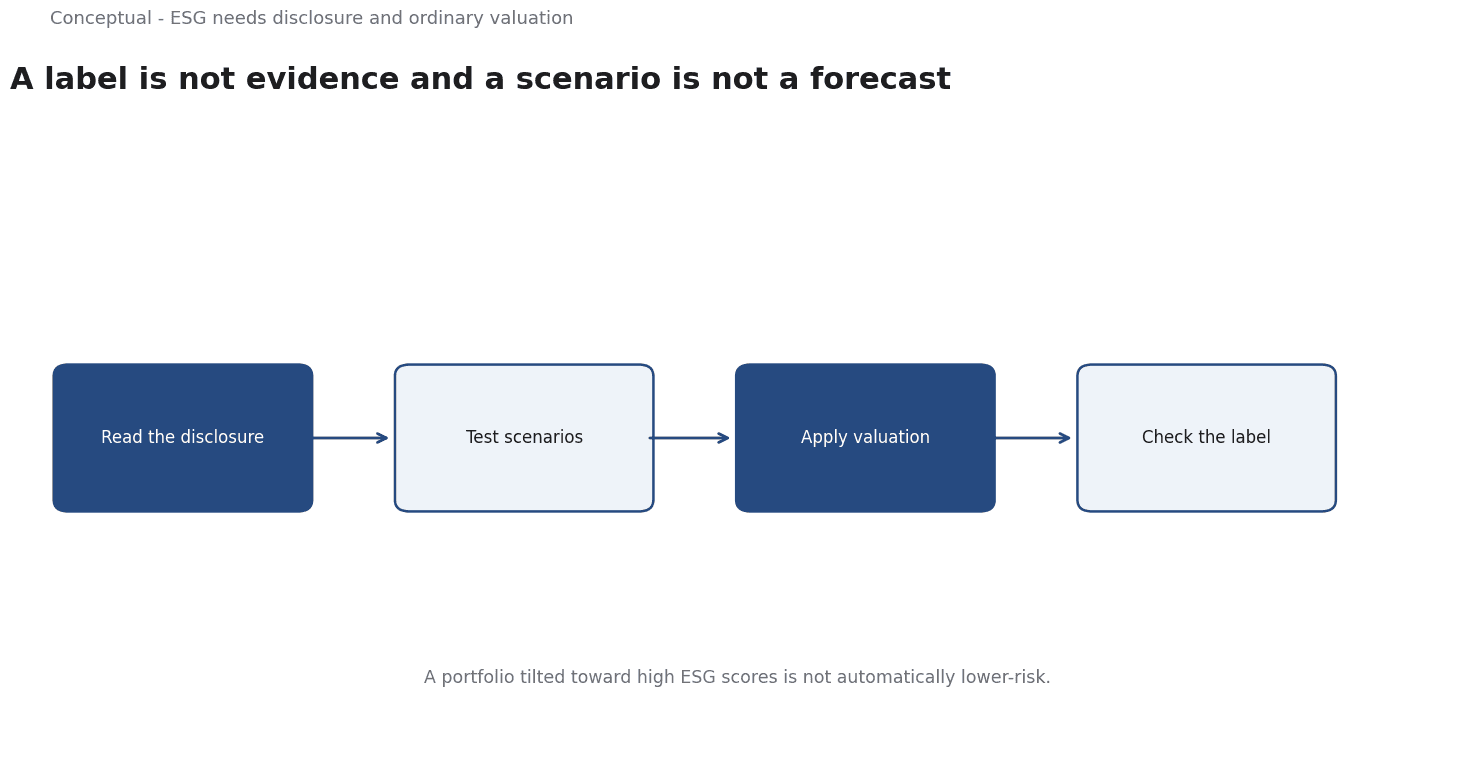
The boundary: a label is not evidence, a scenario is not a forecast, and a portfolio tilted toward high ESG scores is not automatically lower-risk or higher-return.
The information problem
Investors cannot price what companies do not disclose in a comparable form. Historically, sustainability reporting varied so widely that two companies in the same sector could report on different boundaries, metrics, and time periods.
The IFRS Foundation was established as "a not-for-profit, public interest organisation" developing "high-quality, understandable, enforceable and globally accepted accounting and sustainability disclosure standards". It operates through two boards: the IASB, whose accounting standards are "in effect, a global accounting language" used in "more than 140 jurisdictions", and the International Sustainability Standards Board (ISSB), which develops the sustainability disclosure standards.
The significance is structural. When a standard setter with a global footprint defines what must be reported and how, comparisons become possible and ESG data stops being a marketing exercise. It does not make the data true — reported figures still need verification — but it makes checking possible.
A practical caution: the existence of a standard does not mean every company has adopted it, and disclosures may be at different levels of maturity. A score built from inconsistent inputs is a number with false precision.
Scenarios: what the NGFS contributes
The Network for Central Banks and Supervisors for Greening the Financial System (NGFS) describes itself as a group of central banks and supervisors working, on a voluntary basis, to "share best practices and contribute to the development of environment and climate risk management in the financial sector and to mobilise mainstream finance to support the transition toward a sustainable economy".
Its scenarios are used to explore how climate policy and physical risks might affect financial systems. Their value is not prediction but structuring uncertainty: a transition scenario with early, strong policy implies different sector-level effects from one with delayed, abrupt action.
This is where ESG analysis becomes ordinary financial analysis. A scenario gives you a set of assumptions about carbon prices, energy costs, and demand shifts. Those assumptions become inputs to a company's revenue and cost structure. The result is a range of valuations, not a verdict.
A worked example of a carbon-price scenario
The following numbers are hypothetical and illustrative. Suppose a cement producer emits 1 million tonnes of CO₂ annually, and a transition scenario implies a carbon price of 80 per tonne by 2030, up from an effective 20 today.
- Current annual carbon cost: 1,000,000 × 20 = 20 million.
- Scenario carbon cost: 1,000,000 × 80 = 80 million.
- Incremental annual cost: 60 million.
If the company's current operating margin is 150 million on revenue of 1.5 billion, the incremental cost absorbs 40% of operating profit unless it is passed through to customers or reduced through abatement.
Three responses change the conclusion:
- Pass-through. If competitors face the same price and the market tolerates a higher price, revenue can rise enough to offset the cost. The question is pricing power, which is a normal competitive-analysis question.
- Abatement. If the company can cut emissions by 30% at a capital cost of 90 million, the new carbon cost is 56 million and the incremental burden falls to 36 million annually. The investment becomes attractive if it pays back within the relevant horizon.
- Stranded assets. If a plant becomes uneconomic before the end of its accounting life, the write-down can exceed the annual carbon cost by an order of magnitude.
The point is that "ESG risk" here is not a moral category. It is a set of assumptions about costs, pricing power, and capital expenditure — the same variables Aswath Damodaran's valuation framework treats explicitly. A scenario that cannot be translated into these inputs is not decision-useful.
Green bonds and the label problem
A green bond is a bond whose proceeds are earmarked for environmental projects. The mechanism is a use-of-proceeds commitment, not a different kind of credit risk: the issuer's ability to pay still matters, and the label does not remove default risk.
Two questions decide whether the label adds information:
- Is the use of proceeds defined and reported? Without tracking, the label is a claim rather than a constraint.
- Is the incremental impact measurable? A project that would have happened anyway has no additional environmental effect, even if it is financed by a green bond.
This is the hardest part of impact measurement. Attribution — whether the financing caused the outcome — requires a counterfactual, the same problem that makes marketing attribution hard. Reporting the amount financed is easy; reporting what would otherwise have happened is not.
What the evidence does not establish
Three qualifications are essential.
Correlation is not causation. Companies with high ESG scores may be better managed, less leveraged, or larger, and those characteristics — not the score — may explain any return difference. A study that does not control for them has not isolated an ESG effect.
Ratings disagree. Different providers weight factors differently and often produce low correlations for the same company. That is a measurement problem, not a matter of opinion, and it limits the usefulness of a single score.
Scenario outputs are conditional. The NGFS scenarios are designed to explore possibilities, not to assign probabilities to outcomes.
The strongest counterargument to ESG integration — that a fund should optimise risk and return and leave values to the investor — deserves a fair hearing. It is correct that a portfolio tilt is a poor vehicle for most social goals.
It does not follow that environmental and governance information is irrelevant to cash flows; for some sectors it is plainly material.
The two claims are often conflated.
A decision test
- Ask what specific information is being used and whether it is reported under a comparable standard.
- Translate the ESG factor into a cash-flow input — cost, revenue, capital expenditure, or risk of write-down.
- Use scenarios as ranges with stated assumptions, not point forecasts.
- Separate a green label from credit quality and from additionality of impact.
- Demand attribution evidence for any impact claim.
- Check whether the stated goal is financial or values-based and choose an instrument that fits it.
For the valuation framework that turns these assumptions into cash flows, see Corporate Finance Essentials; for adjacent risk analysis, see Why Cybersecurity Is Becoming a Business Priority.
References & Further Reading
- IFRS Foundation, 2026. IFRS Sustainability Standards Navigator — The disclosure standards that make ESG metrics comparable.
- NGFS, 2026. Network for Greening the Financial System — The standard climate scenarios used for financial risk analysis.
- Aswath Damodaran, 2026. Damodaran Online: Home Page for Aswath Damodaran — Publicly maintained datasets for industry averages, WACC, and valuation.