Entrepreneurship Metrics that Matter
A bounded guide to the small set of numbers that reveal whether a young venture is functioning: cash flow, contribution margin, and runway rather than vanity signals.
Early-stage ventures are often measured with numbers that feel like progress but do not predict survival. Founder dashboards fill with sign-ups, page views, and press mentions, while cash and the economics of each sale sit in a spreadsheet nobody reviews. A venture can therefore report growth right up to the moment it runs out of money.
Direct answer: The metrics that matter for a young venture are a short set tied to survival: net cash flow, runway against cash on hand, and contribution margin per unit of sale. Sign-ups and traffic are leading indicators that matter only when they convert into these three.
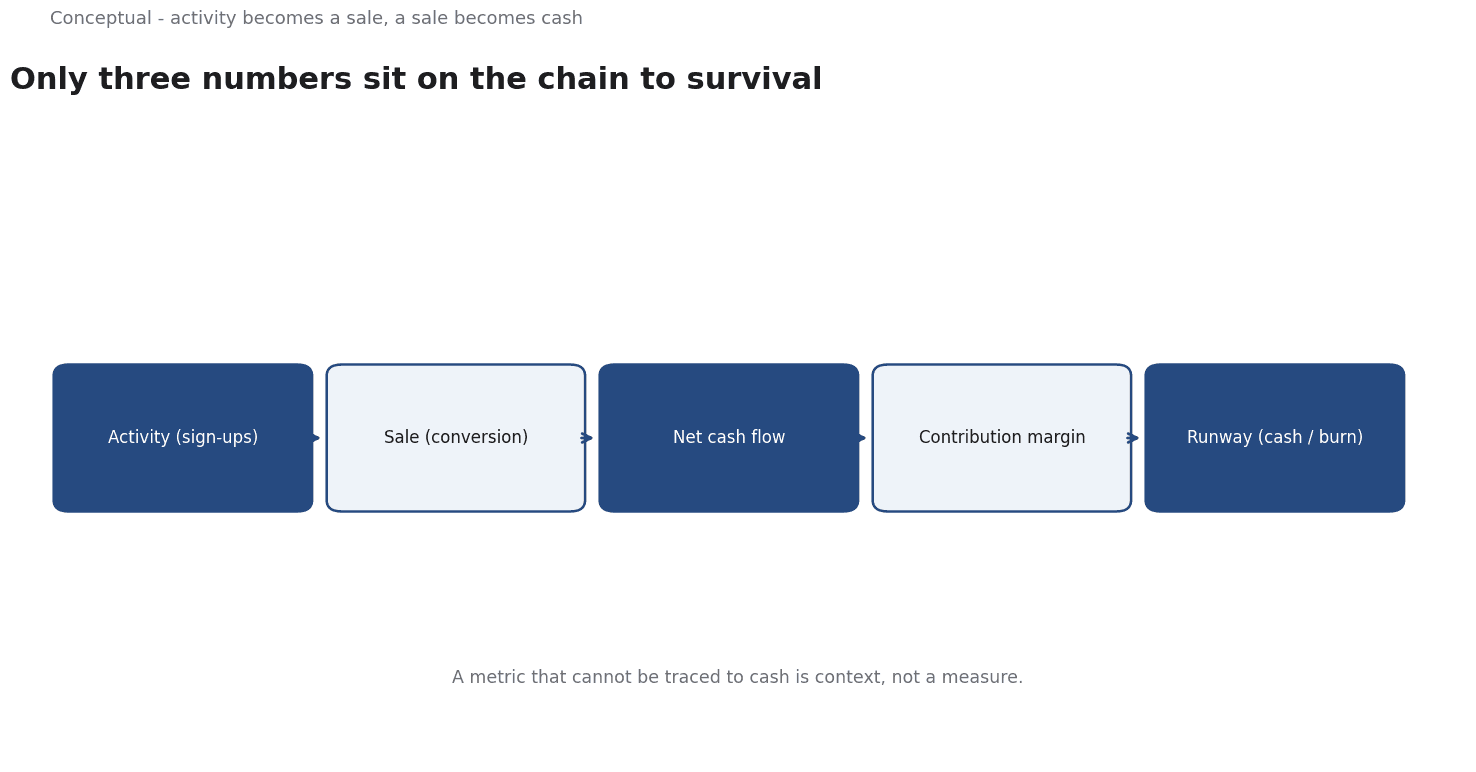
Any metric that cannot be traced to cash or to unit economics should be treated as context, not as a measure of the business.
Delta: This article adds a bounded selection rule beyond the sources: it maps the entrepreneurship and cash flow concepts to the specific decision of which three numbers a founder reviews each week, with claim status made explicit.
The mechanism
The Wikipedia entry on entrepreneurship describes the entrepreneur as a person who organises resources and assumes risk in pursuit of value. That framing has a practical consequence for measurement: if the defining act is taking risk to create value, then the metrics should test whether the risk is being repaid, not merely whether activity is occurring. Sign-ups, impressions, and press coverage are all forms of activity. None of them demonstrates that a customer paid more to acquire and serve than the business received. A measurement system built around the risk-and-value definition therefore starts with money changing hands, not with attention.
The Wikipedia entry on cash flow distinguishes the movement of money into and out of a business from the recognition of revenue. For a young venture this distinction is decisive, because a company can report growing sales while its operating cash flow is negative. Revenue is recorded when a sale is made; cash arrives when the customer actually pays, and costs often leave the account earlier. A founder who watches only the income statement will miss the gap between the two. The operating cash flow figure closes that gap by showing whether the core business is funding itself or consuming the founder's capital.
The third concept is the economics of a single sale. If each unit sold contributes less than it costs to acquire and deliver the customer, then more sales accelerate losses rather than fixing them. A venture can therefore grow its way into insolvency, which is why contribution margin and acquisition cost belong beside cash flow on the short list. Together these three numbers form a chain: activity becomes a sale, a sale becomes cash, and cash either accumulates or drains. The metrics that matter are the ones that sit at the links in that chain, because each one can be acted on before the damage appears in the bank balance.
A worked example
The following is hypothetical and illustrative. A software venture sells a subscription for fifty dollars a month and spends thirty dollars to acquire each customer. It counts 2,000 trial sign-ups in a month and reports this as growth, but only 200 convert, producing 10,000 dollars of monthly revenue against 6,000 dollars of acquisition cost. Three checks settle which numbers matter. First, net cash flow: after payroll and hosting, the venture may still burn cash despite the revenue. Second, contribution margin per customer: twenty dollars before fixed costs, thin enough that a small rise in acquisition cost erases it. Third, runway: cash on hand divided by the monthly burn. If that quotient is under twelve months, the growth headline is irrelevant and the founder must cut cost or raise capital before the runway closes. The activity metric, 2,000 sign-ups, never enters the decision; only the conversion, the margin, and the burn do.
Evidence status
| Claim | Status | Source | Verified | Recheck when |
|---|---|---|---|---|
| Cash flow tracks money movement, not recognised revenue | source-reported | Wikipedia (Cash flow) | 2026-11-18 | if cash-flow accounting standards change |
| Entrepreneurship involves organising resources and assuming risk | source-reported | Wikipedia (Entrepreneurship) | 2026-11-18 | if the working definition is revised |
| A short list of cash and unit metrics is most useful for a young venture | inferred | Derived from the sources | 2026-11-18 | if new evidence links other metrics to survival |
The table separates what the sources state from what this article concludes. The two source-reported rows are definitional and relatively stable. The inferred row is a judgement about which definitions are useful to a founder, so it should be revisited if new evidence connects a different metric to venture survival. Until then it is a working rule, not a finding.
What it cannot do
These metrics cannot see the future. Cash flow and contribution margin describe what has already happened, so they confirm a problem only after it has begun. A founder who waits for the numbers to turn negative is already late, because collecting cash, renegotiating costs, and raising capital all take months. The short list is therefore a detection tool, not an early-warning system. It tells you that the venture is bleeding, but not where the wound will open next. For that, the founder still needs leading indicators such as pipeline quality and customer retention, which are harder to measure and sit outside the strict cash-and-margin frame.
The discipline has a hidden cost. Producing a reliable cash flow figure each week requires that invoices, payments, and payroll be recorded on time and reconciled. For a small team that means hours of administrative work and sometimes a part-time bookkeeper. The numbers are only as good as the data entering them, so a founder who wants the short list to be trustworthy must first invest in basic financial hygiene. That investment is real and it competes with product work. A venture may rationally decide that the overhead is not worth it in the first months, accepting weaker visibility in exchange for speed.
The metrics also fail when the underlying strategy is wrong. Healthy cash flow and a positive contribution margin confirm that the current operation is sustainable; they say nothing about whether the operation is worth sustaining. A venture can sell a product that nobody truly needs, collect cash for a while, and still collapse when the market realises it. The short list measures efficiency within a strategy, not the validity of the strategy itself.
There are boundaries where the list should not be applied. A pre-revenue research venture has no unit economics to measure, so cash burn against milestones is the only sensible figure. A mission-driven organisation may deliberately run at a loss because survival is not its governing objective. In both cases, importing the survival-focused short list distorts decisions by treating a chosen trade-off as a failure. The metrics are appropriate when the goal is a self-sustaining commercial venture and misleading when the goal is different.
Finally, the list needs review. As a venture scales, the metrics that matter shift: early on it is runway and margin, later it is retention and the cost of growth at volume. A founder who freezes the short list at the stage where it was useful will eventually be measuring the wrong thing. The discipline is to revisit the choice periodically and ask whether each number still connects to cash or unit economics. When it stops doing so, it should be replaced rather than defended.
The counterargument that founders should track everything is fair for diagnosis and incomplete for decisions.
A broad dashboard helps you notice patterns, but a decision needs a short list; too many metrics dilute attention and hide the three that actually determine survival.
A decision test
- Define what the venture is trying to prove this quarter.
- List every metric currently reviewed and label each as activity, cash, or unit economics.
- Remove any metric that cannot be traced to cash or to a single sale.
- Compute net operating cash flow and contribution margin per customer.
- Calculate runway from cash on hand and monthly burn.
- Set a threshold for each of the three numbers that triggers action.
- Review the list monthly and retire any metric that no longer connects to cash.
A decision test like this is useful only if the thresholds are set in advance. Deciding what counts as a dangerous burn rate after the fact invites rationalisation. Write the thresholds down, assign an owner to each, and treat a breached threshold as a prompt to act rather than a topic for the next meeting.
For further reading, see Understanding Unit Economics.
References & Further Reading
- Wikipedia contributors, 2026. Entrepreneurship - Wikipedia — The process of starting and growing a business with limited resources.
- Wikipedia contributors, 2026. Cash flow statement - Wikipedia — Operating, investing and financing activities, and why net income and cash flow differ.