Equity Dilution for Small Teams
A capitalization table shows who owns what after each round. See how new investment changes existing stakes, what the model leaves out, and which decisions it can support.
Small teams often treat a capitalization table as a record of ownership that only matters at a funding event. In practice the table is a model with assumptions baked into it, and the assumptions decide how much founders and early employees keep after each round. The problem is that dilution is felt as a surprise when the mechanics that produced it were never made explicit. Understanding the table before the round is the difference between a decision and a confirmation.
Direct answer: A capitalization table lists the equity holders, instruments, and ownership percentages of a company. Dilution occurs when new shares are issued and existing holders keep their share count but lose percentage ownership. The table describes the arithmetic of that change; it does not decide whether the round was a good trade.
Delta: This article adds a decision-focused reading beyond the two sources: it maps the table's entries to specific founder choices under uncertainty, with claim status made explicit rather than left implicit.
The mechanism
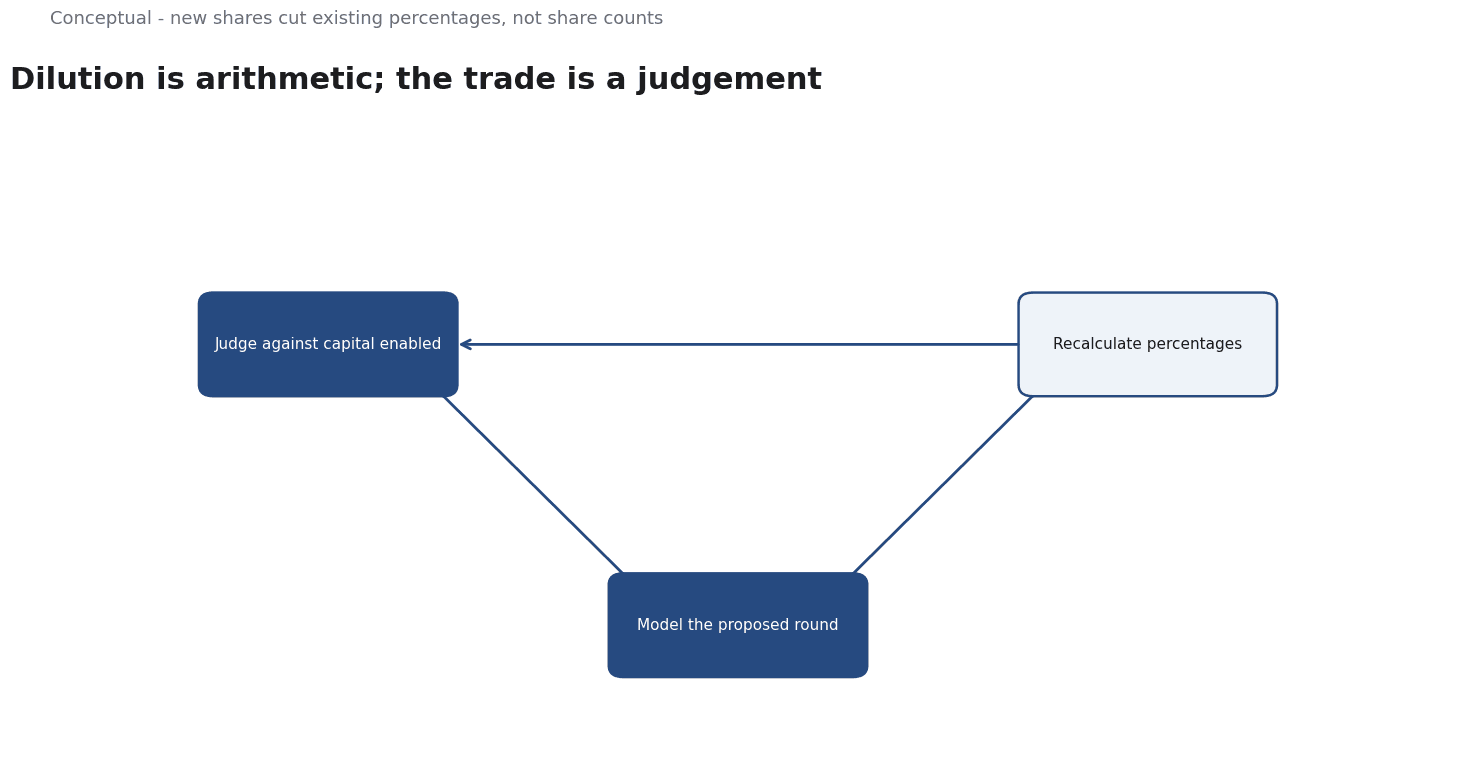
The Wikipedia entry on capitalization tables describes them as a record of a company's equity ownership, showing the different classes of shares and instruments such as options and warrants, and expressing each holder's stake as a number of shares and a percentage. The table's usefulness is that it converts a set of separate agreements into one view of who owns what. The practical consequence is that any new issuance can be modelled before it happens: add the new shares, recalculate the percentages, and the effect on each existing holder becomes visible.
The Wikipedia entry on entrepreneurship frames the founder's task as building and scaling a venture under uncertainty, with financing as one of the central choices. That context matters because a cap table is not a neutral fact. It reflects decisions about how much equity to sell, which instruments to use, and how much to reserve for future employees. Founders who treat the table as an accounting artifact miss that it is a record of the value they have chosen to part with in exchange for capital and other resources.
Read together, the sources describe a loop of modelling and judgement. The table shows the mechanical effect of a proposed round, and entrepreneurship provides the reason to accept or reject that effect. New shares always reduce the percentages of existing holders, but the trade can still be rational if the capital increases the value of the smaller stake by more than the dilution reduces it. The table cannot tell you whether that will happen; it only makes the size of the sacrifice legible so the bet can be evaluated.
That ordering has a direct consequence for how a small team should use the model. Before a round, the relevant question is not only what percentage the founders will hold afterward but what assumptions about valuation and future financing produce that number. A round that looks modest in percentage terms can be costly if it carries a low valuation, and an apparently large dilution can be acceptable if the capital unlocks a much larger outcome. The table is the instrument that lets those scenarios be compared rather than guessed at.
A worked example
The following is hypothetical and illustrative. A small team plans to raise a round and wants to know how the deal affects founder ownership and the option pool for future hires. There is no claim here about any real company or outcome.
Three checks structure the analysis. First, are all instruments represented on the table, including outstanding options, warrants, and any convertible instruments, so that the percentages are based on the correct total? Missing instruments make the dilution figure wrong. Second, is the comparison fully diluted rather than only on issued shares, so that the option pool is counted consistently before and after the round? Third, is the trade evaluated against an assumption about what the capital enables, rather than treating the percentage alone as the verdict? A smaller stake of a larger company can still be the better outcome.
The outcome is bounded. The model shows a specific, conditional change in ownership under stated assumptions, and the team records the decision with those assumptions attached. It does not claim the round succeeded or that the dilution was justified by results; it claims only that the trade was made with its mechanics visible.
Evidence status
| Claim | Status | Source | Verified | Recheck when |
|---|---|---|---|---|
| A capitalization table records equity ownership, share classes, and instruments with share counts and percentages. | source-reported | Wikipedia, Capitalization table | 2026-11-18 | The standard definition or instrument coverage changes. |
| Entrepreneurship involves building and scaling a venture under uncertainty, with financing as a central choice. | source-reported | Wikipedia, Entrepreneurship | 2026-11-18 | The framing of the financing decision changes in the source. |
| A cap table shows the arithmetic of dilution but cannot by itself judge whether a round is a good trade. | inferred | Derived from the sources | 2026-11-18 | A model is introduced that directly evaluates deal quality. |
The first two rows restate the sources; the third is a reasoned distinction between what the table records and what a founder must decide. Marking that difference prevents a tool's output from being mistaken for a verdict. The recheck conditions remind a reviewer that definitions evolve and that the interpretation should be revisited when the underlying material changes.
What it cannot do
A capitalization table cannot tell a founder whether a round is a good deal.
It produces percentages from inputs, and the quality of the trade depends on questions the table does not ask: what the capital will be used for, whether the valuation is fair, what rights and preferences come with the new shares, and what future rounds are likely. A clean table can sit alongside a poor decision, because the arithmetic is correct even when the assumptions behind it are wrong. Treating the output as a verdict is the central misuse.
It carries a hidden cost and several sources of error. Keeping the table accurate requires recording every issuance, option grant, exercise, and conversion, which a small team may neglect until a financing or exit forces a reconstruction. That reconstruction is expensive and error-prone. The model is also sensitive to basis: a percentage calculated on issued shares differs from one calculated on a fully diluted basis, and a missing instrument quietly shifts every holder's stake. Small teams often discover these gaps late, when fixing them is hardest.
A table can display percentages to several decimal places while resting on an incomplete inventory of instruments or an outdated valuation. A related failure is ignoring the terms attached to shares. Liquidation preferences, anti-dilution provisions, and voting rights can matter more to economic outcome than the headline percentage, yet they are invisible in a simple ownership view. A founder who watches only the ownership column can miss the provisions that determine what the stake is actually worth.
The boundary is that this is a model of ownership arithmetic, not a substitute for legal, tax, or valuation advice. It describes equity structure but not the enforceability of agreements, the tax consequences of an instrument, or the market value of the company. It is also forward-looking only to the extent of the scenarios a team enters; unmodelled future rounds and option pool expansions are absent by definition. A beginner who expects the table to predict an outcome is asking it a question it cannot answer.
Finally, the model needs review. Every new grant, conversion, or round changes the picture, so a table that was accurate last quarter can be stale now. A responsible use records the date and assumptions, states which claims are reported and which are inferred, and revisits the model whenever the equity structure changes. That habit keeps the table a decision aid rather than a stale snapshot presented as current fact.
The counterargument that the cap table is just a record is fair for its bookkeeping role and incomplete for the judgement its numbers are meant to inform.
A decision test
- State the financing decision the table is meant to inform before editing it.
- Confirm that every instrument, including options and convertibles, is represented.
- Decide whether the comparison uses issued or fully dilutive shares and apply it consistently.
- Model the proposed round and recalculate each holder's percentage from the same total.
- Read the terms attached to the new shares, not just the ownership column.
- Evaluate the dilution against an explicit assumption about what the capital enables.
- Record the date, the assumptions, and the reported versus inferred claims, then set a review point.
None of these steps removes the uncertainty of financing. They make the sacrifice visible so the bet can be judged on its terms. A team that can reconstruct why it accepted a given dilution is better placed to explain that decision later, and to learn from it rather than merely record it.
For further reading, see Decision Memos That Survive Review.
References & Further Reading
- Wikipedia contributors, 2026. Capitalization table - Wikipedia — Ownership and security records of a company.
- Wikipedia contributors, 2026. Entrepreneurship - Wikipedia — The process of starting and growing a business with limited resources.