Equity Financing Pitfalls
Equity buys cash without repayment, which makes its cost easy to miss. Read the real trade-offs, a worked example, and what to check before a round.
Equity financing is often described as the opposite of debt: no repayment, no interest, just dilution. That framing misses the cost. Selling ownership changes control, sets expectations for the next round, and creates a valuation that future financings will be measured against. The cash is free; the ownership is not.
Direct answer: Raise equity when the capital funds a specific learning goal and the terms preserve enough ownership and control to reach the next stage. The equity-finance overview provides the instrument's context, and investor education treats ownership as a claim with risk. The boundary: a round cannot create product-market fit, which the startup-validation article treats as the prior question, and the valuation is conditional, as the startup-valuation article explains for estimates.
The pitfalls
Dilution without a plan. A round that funds activity without a milestone leaves the company smaller in ownership and no closer to the next round, as Cap Table Mechanics: Equity, Options, and Dilution explains for cumulative dilution, as the burn-rate article treats runway as a deadline.
Terms beyond price. Liquidation preferences, board rights, and protective provisions change control, which the term-sheet article argues for reading as the substance of a deal, as the governance checklist treats authority as a real distribution.
A valuation that becomes an anchor. A high round sets an expectation for the next one, which the startup-valuation article treats as a conditional estimate, and a down round can be costly, as the anti-dilution discussion in the term-sheet article explains.
Investor fit. Capital comes with expectations and often with help, which the venture-debt and founder-led-sales articles treat as part of the operating environment, as the negotiation article advises for aligned parties.
Three consequences follow. The use of funds should be explicit, which the 13-week cash-flow article requires for an operating view. The ownership effect should be modelled, as Cap Table Mechanics: Equity, Options, and Dilution advises. And the decision should be recorded with the assumptions, as the decision-memo article requires.
A worked example
The following is hypothetical and illustrative. A company raises 5 million at a 20 million pre-money valuation, selling 20% of the company.
Three checks decide whether the round is sensible. First, what milestone does the cash fund, as the startup-validation article asks for a testable goal? If the answer is eighteen months to a larger round, the assumption should be evidenced, as the valuation article advises. Second, what is the cumulative ownership after the round, as the cap-table article models for founders and employees? Third, what do the terms do to control, as Term Sheet Basics: What Founders Should Read Twice requires for preferences and board seats?
Three conclusions follow. The dilution is acceptable only if the milestone is plausible, which the burn-rate article implies for a longer runway. Terms may matter more than price, as Term Sheet Basics: What Founders Should Read Twice argues. And the result should be recorded with the assumption, as the decision-memo article requires for a consequential choice.
The cost after the round
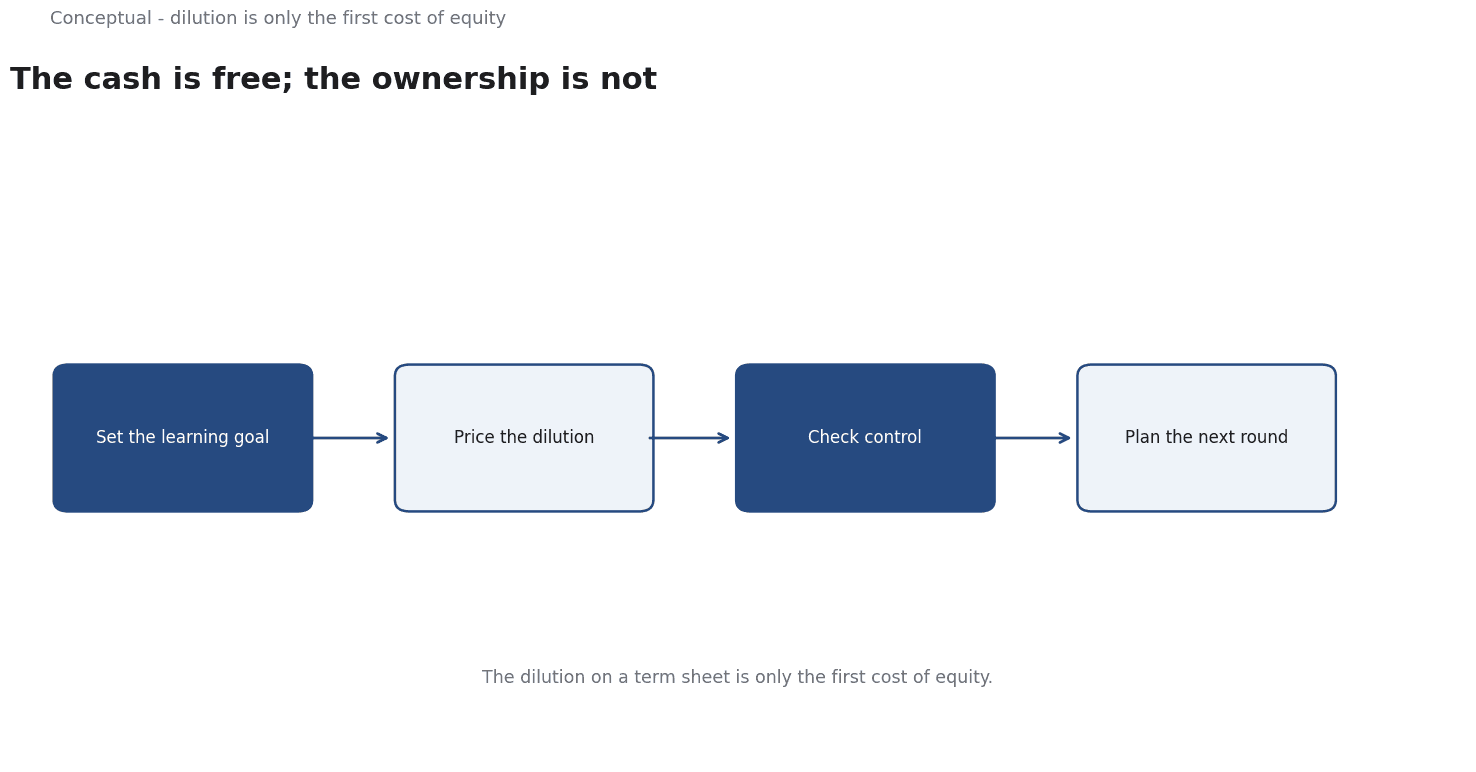
The dilution on a term sheet is only the first cost of equity.
New investors often bring reporting expectations, board seats, and a view on how capital should be deployed, which the term-sheet article treats as control terms with real consequences, as the governance checklist requires an accountable owner for any ongoing obligation.
The next round also prices this one. A valuation that was generous at the time becomes an anchor, and a flat or lower next round can trigger anti-dilution provisions or simply damage morale, as Term Sheet Basics: What Founders Should Read Twice explains for down-round mechanics, as the startup-valuation article treats each round as a conditional estimate. This is why the milestone matters more than the headline number, which the burn-rate article frames as time to learn, not comfort.
Finally, equity cannot be reused casually. Each round narrows the founders' ownership and changes the cap table for everyone who joins later, as the cap-table article models for cumulative dilution, as the technical-debt article warns about complexity that accumulates without decision. The decision should therefore be recorded with the milestone and the terms, as the decision-memo article requires for consequential choices.
What equity financing cannot do
It cannot fix a weak business, which the value-proposition article treats as the buyer's real evaluation. It cannot remove risk, which investor education states explicitly. And it is not free of obligations — governance and reporting expectations come with the capital, as Term Sheet Basics: What Founders Should Read Twice treats control terms as real, as the governance checklist requires an accountable owner.
The counterargument that dilution does not matter if the company grows is true in one direction and ignores the cost of giving away too much early, which the cap-table article shows for cumulative ownership.
A decision test
- State the milestone the round must fund, as the startup-validation article advises.
- Model dilution with the cap table, as Cap Table Mechanics: Equity, Options, and Dilution requires.
- Read terms beyond price, as Term Sheet Basics: What Founders Should Read Twice warns.
- Check the valuation assumption against evidence, as the valuation article advises.
- Assess investor fit, as the negotiation article recommends.
- Compare with debt and other options, as the venture-debt article advises.
- Record the decision and the assumption, as the decision-memo article requires.
For the ownership model, see Cap Table Mechanics; for the terms, see Term Sheet Basics.
References & Further Reading
- Wikipedia contributors, 2026. Equity (finance) - Wikipedia — Ownership interest and the context of equity financing.
- U.S. Securities and Exchange Commission (Investor.gov), 2026. Introduction to Investing — Primary regulator guidance on market mechanics and investor protection.