Term Sheet Basics: What Founders Should Read Twice
A term sheet is a negotiation, not a formality. Read the clauses that decide control and payout, a worked example, and why price is not the whole deal.
A term sheet is a short document that sets the terms of an investment before the legal paperwork is prepared. Founders often focus on the headline valuation and skim the rest, which is a mistake: the clauses that follow determine who controls the company and who gets paid first in a sale. The price is one term among many.
Direct answer: Read the liquidation preference, participation rights, anti-dilution terms, board composition, and protective provisions before celebrating the valuation. Investor education covers these as features of investment products, and the cap-table article explains how they translate into ownership. The boundary: this is educational orientation, not legal advice — the language and its consequences are jurisdiction-specific, and qualified counsel should review any actual document, as the copyright article treats current law as requiring a dated check.
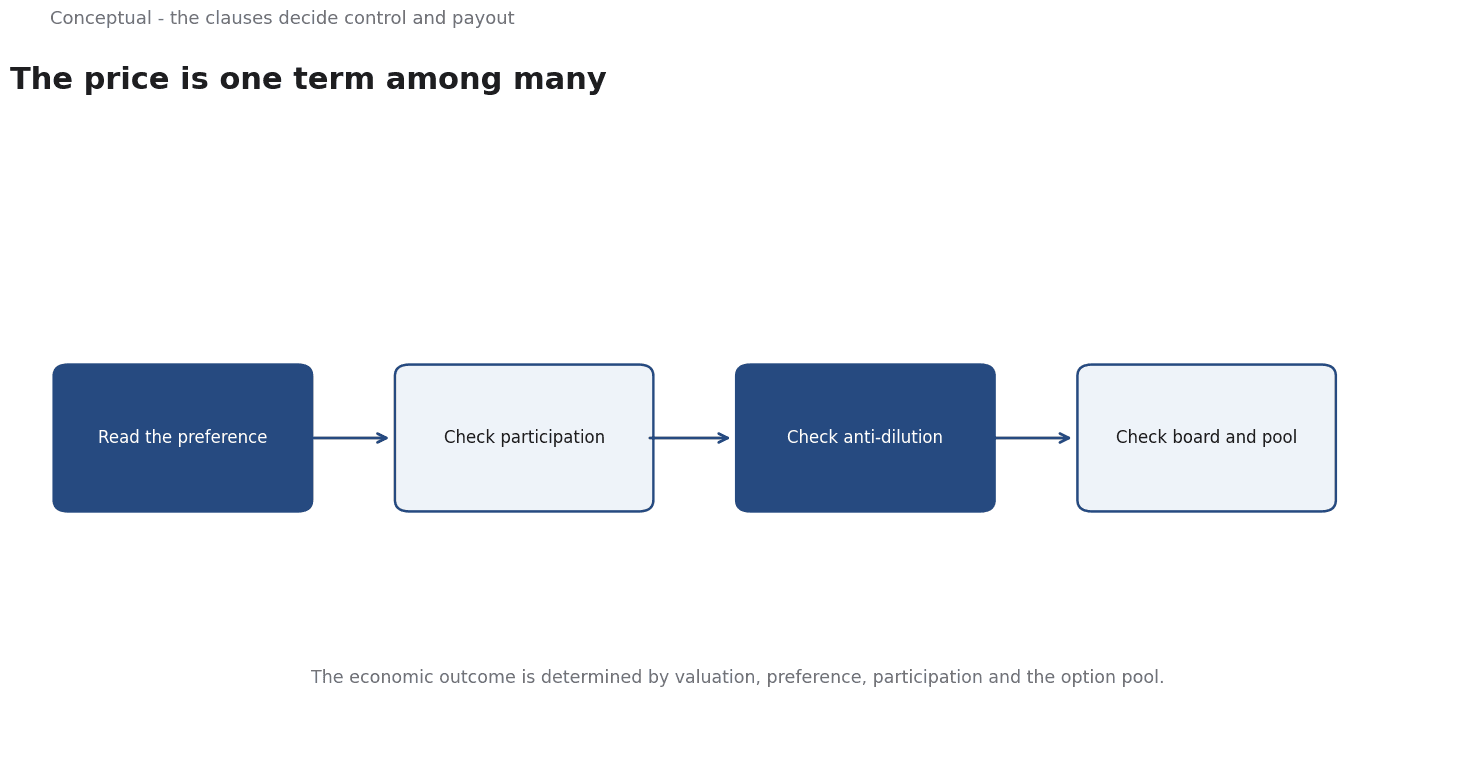
The clauses that matter
Liquidation preference decides who is paid first when the company is sold. A 1x preference on 5 million means the investor receives 5 million before common shareholders see anything, which can turn a modest exit into a zero for founders, as the startup-valuation article explains for proceeds.
Participation determines whether the investor also shares in the remaining proceeds after the preference. Participating preferred can be paid twice, which the cap-table article models for ownership effects.
Anti-dilution provisions adjust the investor's conversion price if a later round is priced lower, shifting more ownership to them, as the SAFE article describes for conversion mechanics.
Board and protective provisions decide who approves major decisions. A clause giving an investor veto over a sale or a new financing is a control right, not a financial term, which the governance checklist treats as an accountability question.
A worked example
The following is hypothetical and illustrative. A company sells for 30 million. Investors hold 40% with a 1x liquidation preference on 10 million and full participation.
The investors first receive 10 million. Of the remaining 20 million, they receive their 40% share — 8 million — because they participate. Total investor proceeds are 18 million, leaving 12 million for everyone else. Without participation, the investors would choose the greater of the preference or their 40% of proceeds: 12 million from the equity share versus 10 million from the preference, so 12 million, leaving 18 million for the rest. The difference of 6 million is created by one clause, which the valuation article treats as a material term.
Three checks decide whether the term is acceptable. First, what happens at a low exit — say 12 million, where the preference consumes most of the proceeds, as the scenario-analysis article recommends modelling across outcomes. Second, does participation survive a conversion to common shares, which the cap-table article treats as a structural change? Third, what is the investor's board and veto power, which the governance checklist treats as control rather than price?
Why price is not the whole deal
The economic outcome, however, is determined by the combination of valuation, liquidation preference, participation, and the option pool.
A higher valuation with a participating preference can pay founders less in a modest sale than a lower valuation with clean common-equity terms, as the worked example shows. The cap-table article explains why these elements have to be modelled together rather than read separately.
Control terms deserve the same attention. A board seat, a veto over new financing, or a protective provision over a sale changes what the founder can decide after the round, which the governance checklist treats as a real distribution of authority. These clauses are often shorter than the financial terms and easy to skim, but they shape the company's decisions for years, as the corporate-governance literature on board composition would predict.
Finally, a term sheet is a negotiation document, not a final contract. Its purpose is to establish agreement on the main points before legal work begins, which means ambiguity is normal and should be resolved before signing, as the negotiation article recommends for any consequential agreement. The discipline is to list every term that could change the outcome, model it, and record the reasoning, as the decision-memo article requires for consequential choices.
What a term sheet cannot do
It cannot create the value it divides; that comes from the business, as the unit-economics article argues. It cannot guarantee the round closes, which depends on diligence and market conditions, as the financing article treats as a dependency. And it cannot be judged by valuation alone, which the worked example shows can cost millions through a single clause.
Terms written at the first round determine ownership through every subsequent round, as Cap Table Mechanics: Equity, Options, and Dilution explains for cumulative dilution.
The counterargument that founders should not worry about terms until the company is large is backwards.
A decision test
- Read the liquidation preference and model a low exit, as the scenario-analysis article recommends.
- Check whether preferred is participating.
- Read the anti-dilution clause and model a down round.
- Identify board seats and veto rights.
- Model proceeds at several exit values with the cap table.
- Compare the whole package, not only valuation, as the negotiation article advises.
- Obtain qualified legal review and record the date of the check.
For the instruments, see SAFE Notes; for the ownership model, see Cap Table Mechanics.
References & Further Reading
- U.S. Securities and Exchange Commission (Investor.gov), 2026. Introduction to Investing — Primary regulator guidance on market mechanics and investor protection.
- Aswath Damodaran, 2026. Damodaran Online: Home Page for Aswath Damodaran — Publicly maintained datasets for industry averages, WACC, and valuation.