Executive Communication: The Five-Minute Update
A short update is a test of thinking. Read what to include, a worked structure, and why the recommendation comes before the history.
An executive update that takes fifteen minutes to say what could be said in five is not thorough; it is unfiltered. The constraint of a short slot is useful because it forces a decision about what matters. The goal is not to compress a long report but to give a decision-maker the state, the change, and the ask in a form they can act on.
Direct answer: A five-minute update leads with the decision or status, then the evidence, then the specific ask, and leaves detail for questions. The decision-memo article argues for the same ordering on paper, and Porter's strategy work is a reminder to frame the update around the choice that matters rather than an activity list. The boundary: brevity cannot manufacture certainty — uncertainty must be stated — and no format guarantees that a decision gets made, which the publication standard says about content claims generally.
The discipline behind the brevity
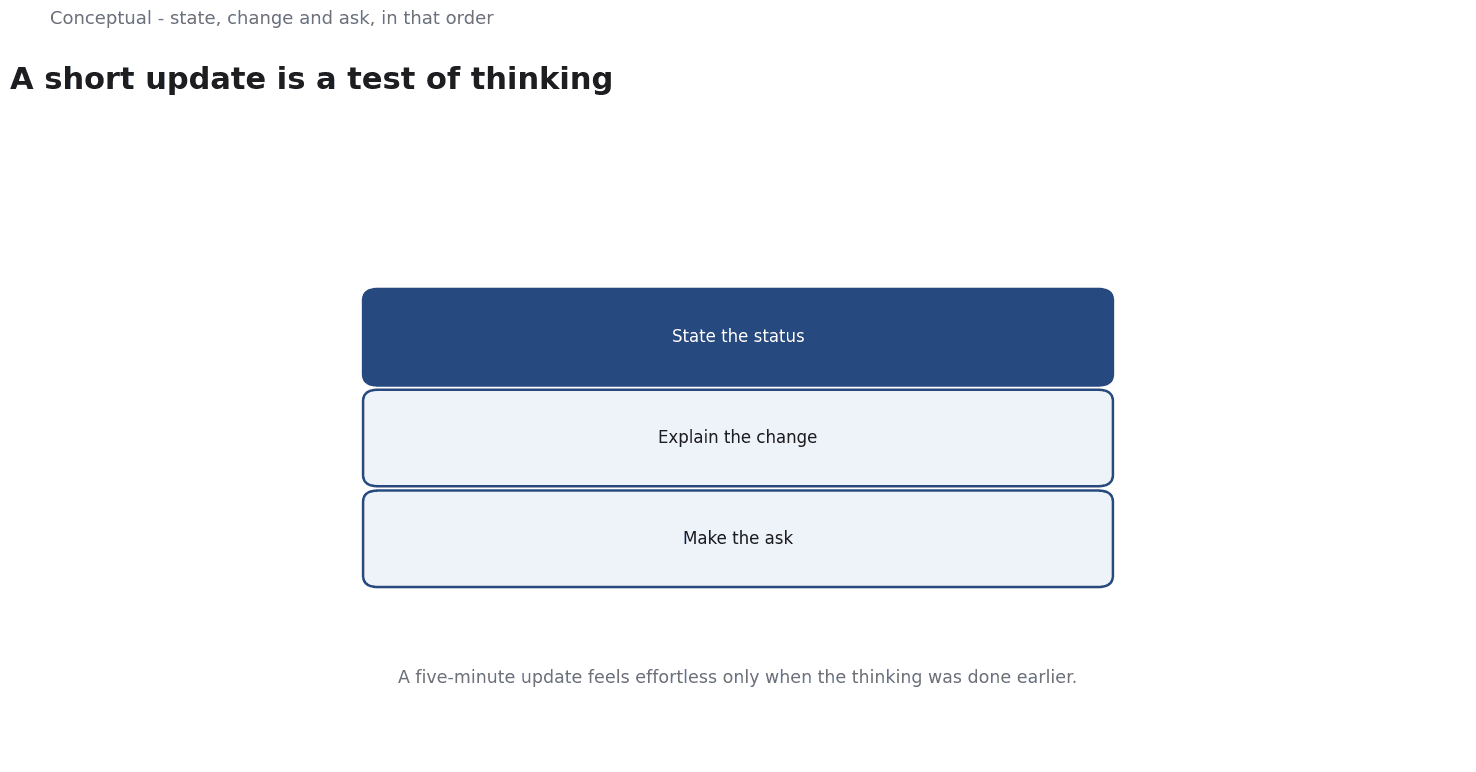
A five-minute update feels effortless only when the thinking was done earlier.
The speaker has already decided which metric matters, which change is real, and which decision is needed, which is why the slot can be short. An unprepared update offloads that work onto the listener, who must reconstruct the decision from a narrative. The decision-memo article argues for the same discipline on paper because it forces the writer to separate facts from interpretation before anyone reads them.
This is also why the update should carry a recommendation rather than a menu. A decision-maker can reject a recommendation, which is fast, whereas choosing among unranked options requires work the speaker should have done. The ranking must be honest about uncertainty: a recommendation stated as certainty when the evidence is thin is a failure of the same kind as an unsupported claim in any analysis, which the risk-assessment article treats as a residual risk to be named.
Finally, the update is a record. What was said, what was decided, and what was promised should be captured, because the next meeting will be judged against it, as Decision Memos That Survive Review requires for any consequential decision.
What five minutes contains
The state. One sentence on where things stand, with the metric and its date, as the data-governance article requires for any relied-upon number.
The change. What moved since the last update, and why. A list of activities is not a change; a shift in a metric or a risk is, which the monitoring article treats as the signal worth reporting.
The decision. The specific choice needed, who owns it, and by when, which the decision-memo article requires for a record that changes something.
The uncertainty. What is not known and what would change the recommendation, as the risk-assessment article argues for honest residual risk.
Three consequences follow. Detail belongs in an appendix, not the slot. A reviewer who wants the history can ask, which is faster than making everyone sit through it. And the update should be the same whether delivered in writing or aloud, as the marketing-communications article argues for consistency across channels.
A worked example
The following is hypothetical and illustrative. A program lead has five minutes with an executive.
The weak version spends three minutes on meetings held and work in progress, then says the launch is "mostly on track". The strong version says: "Launch is at risk by two weeks; the blocker is a vendor dependency confirmed on Tuesday; I need a decision today on whether to reduce scope or move the date, with a recommendation to reduce scope." It then gives the two numbers behind the risk and names the uncertainty — the vendor has not confirmed a revised date.
Three checks decide whether it worked. First, did the executive make a decision or ask a question that could have been answered in the update, which the design-brief article treats as a sign of an incomplete specification? Second, did the recorded decision match what was said, as Decision Memos That Survive Review requires for a reliable record? Third, did the team acting on it understand what changed, which the internal-communications article treats as the point of a shared frame?
What a short update cannot do
It cannot replace the underlying work. A polished summary of a program with no evidence is a performance, as the evaluation article warns about metrics without substance. It cannot resolve a disagreement about facts; that needs the source, which the reduce-hallucinations article treats as the proper control. And it cannot be delivered without preparation: five minutes that took thirty seconds to assemble is usually five minutes of noise, which the technical-writing article argues against in documentation.
The counterargument that executives want all the details is rarely true.
They want access to detail, which an appendix provides, and a decision in the slot, which the memo structure supports.
A decision test
- State the status with a dated metric.
- State what changed since the last update.
- Name the decision, the owner, and the deadline.
- Give a recommendation with the evidence behind it.
- State what is unknown and what would change it.
- Keep history in an appendix.
- Record the outcome, as Decision Memos That Survive Review requires.
For the written form, see Decision Memos; for the operating cadence, see Observability.
References & Further Reading
- Michael E. Porter, 1996. What Is Strategy? — The differentiation-versus-cost argument behind competitive-advantage analysis.
- Wikipedia contributors, 2026. Communication skills - Wikipedia — Context for concise, structured reporting and communication.