Financial Crises: Systemic Risk, Contagion, and Lessons from History
Crises are not the sum of individual failures. Read how leverage, liquidity, and interconnectedness turn losses into a system-wide event.
A financial crisis looks like many bad decisions arriving at once, and that description is accurate at the level of individuals while missing the thing that makes it a crisis. The system has properties — leverage, maturity mismatch, common exposures, and network connections — that convert a manageable loss somewhere into a cascade that nobody intended.
Direct answer: Systemic risk arises when the failure of one institution or market impairs the functioning of the whole system. The BIS describes its purpose as supporting central banks' "pursuit of monetary and financial stability through international cooperation", and its research addresses the policy issues of interest to central banks and supervisors — because stability is a property of the system, not of any single balance sheet. The mechanisms are consistent across episodes: leverage amplifies losses, short-term funding meets long-term assets, common exposures make institutions fail together, and falling prices force selling that pushes prices lower.
Why an individual failure is not enough
A single bank failing in a well-structured system is a manageable event: depositors are protected, assets are sold in an orderly way, and the loss is absorbed. A crisis happens when several things are true at once.
Leverage means a small fall in asset values wipes out equity. A firm funded with 95% debt loses 20% of its equity when assets fall by 1%, which removes the cushion that would have absorbed the next fall.
Maturity mismatch means an institution funds long-term assets with short-term borrowing. This can work indefinitely in calm markets and fails when lenders refuse to roll over, because the assets cannot be sold quickly at their accounting value.
Common exposures mean institutions that appear independent are holding the same risk. When that risk moves, they all lose at once, and the assumption that one can buy assets from another in distress disappears exactly when it is needed.
Connectivity transmits the shock: interbank exposures, payment systems, and derivative counterparties mean that a loss in one place becomes a claim on others.
These properties are measurable, and they are why supervisors focus on the system rather than only on individual institutions.
The dynamics of a cascade
The sequence in most crises follows a recognisable shape, even though the triggering asset differs.
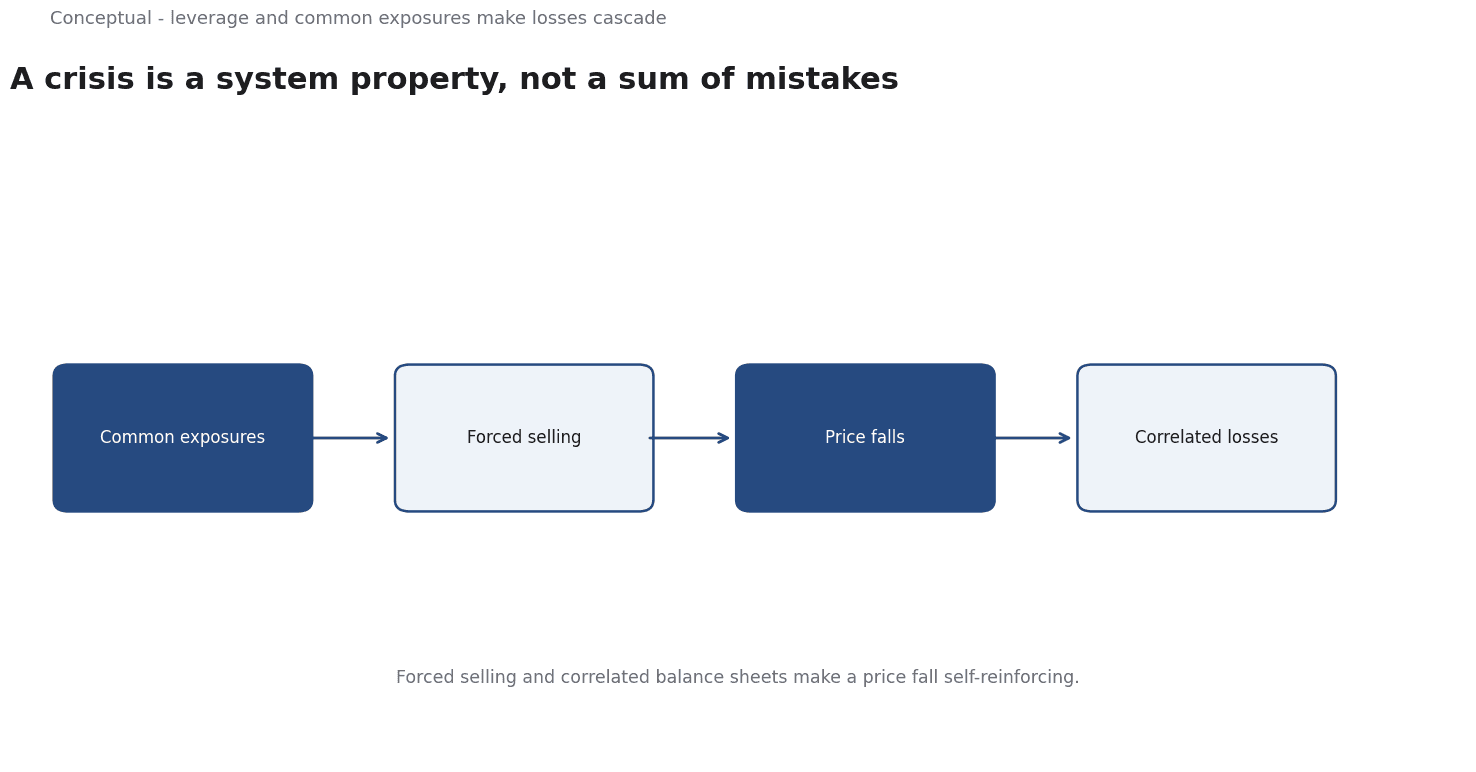
First, an apparent improvement in conditions encourages leverage and weaker underwriting. Risk looks low because recent data was calm, and the institutions that are most aggressive gain market share. Second, a shock arrives — a price fall, a default, a withdrawal of funding. Third, forced selling begins: a firm that must meet a margin call or redeem depositors sells assets regardless of price. Fourth, falling prices impair other institutions' balance sheets, which triggers more selling. Fifth, liquidity disappears precisely when it is most needed, because the parties who would normally provide it face their own constraints or fear adverse selection.
This is the mechanism behind "contagion": not a disease spreading without cause, but a chain of balance-sheet and incentive responses to the same shock. The BIS's work on financial stability and the Basel Process exists because these dynamics cross institutional and national boundaries.
The lesson is not that prices falling is dangerous in itself.
It is that forced selling and correlated balance sheets make a price fall self-reinforcing.
A worked balance-sheet example
The amplification is easier to see with numbers. Consider an institution with 100 in assets funded by 95 in short-term debt and 5 in equity.
- A 2% fall in asset values removes 2 from equity, leaving 3 — a 40% reduction in the cushion from a small price move.
- A 5% fall removes 5 and eliminates equity entirely. The institution is insolvent at market values even though most of its assets still exist.
- If lenders decline to roll over the 95 of short-term debt, the institution must sell assets. Selling 95 of assets into a falling market pushes prices down further, which reduces the value of the remaining assets and weakens other holders of the same assets.
The same shock in an institution funded with 50 of equity would leave it with 45 after a 5% fall — uncomfortable but not fatal, and with no forced sale. The difference is not the quality of the assets or the skill of the managers; it is the funding structure.
Two details make the example realistic. First, the short-term funding is often rolled over daily or weekly, so the decision to withdraw can be made by many small lenders acting independently, each rationally protecting itself. Second, the assets that must be sold are often the same ones other institutions hold, which is why one firm's forced sale becomes another firm's loss.
This is the mechanism behind the policy focus on capital and liquidity standards. Capital absorbs losses without a sale; liquidity prevents a forced sale when funding disappears. They address different failure modes, which is why both are regulated.
The policy dilemma: stability versus moral hazard
If authorities always protect creditors and depositors, market participants have less reason to monitor risk, and leverage returns. If they never intervene, a failure can cascade through payment and funding systems and damage parties who took no risk at all.
This is the central dilemma of crisis management, and it has no clean resolution. The practical response has been to distinguish:
- Liquidity support against good collateral, aimed at keeping markets functioning rather than rescuing a specific firm's solvency.
- Resolution regimes that close a failed institution in an orderly way, protecting critical functions while imposing losses on shareholders and certain creditors.
- Ex-ante regulation — capital, liquidity, stress testing — that reduces the probability of needing an intervention at all.
The BIS's role in supporting standard setting through the Basel Process is part of the third category. It is also the least visible: a crisis avoided produces no dramatic event to explain the value of the rules, which is why the case for them has to be made with the mechanisms rather than with hindsight.
What the official data can and cannot show
The Federal Reserve's monetary policy reporting and the BIS's statistics provide the observable inputs — credit growth, interest rates, leverage, funding conditions, and cross-border exposures. The Bureau of Labor Statistics publishes labour-market data that shows the real-economy consequences once a crisis has begun.
Two limits matter.
The data is revised. Initial estimates of output, employment and credit are updated, so a narrative built on first prints may be describing a number that later changes. Record the vintage.
The aggregate hides composition. A stable headline credit figure can conceal a rapid expansion in one sector, and a stable average leverage ratio can conceal a few institutions that are far above it. Systemic risk lives in the tail, which is why supervisors look at distributions rather than averages.
The practical implication for a business is that the official statistics tell you the environment, not your own exposure. A company should ask how its funding, its customers, and its suppliers would behave under stress, rather than infer safety from an aggregate indicator.
What history teaches, and what it does not
Financial innovation, new instruments, and new participants can change the plumbing without changing the mechanics of leverage and liquidity.
Three lessons transfer well:
- Liquidity is not the same as solvency. An institution can be solvent at long-run values and fail because it cannot meet a payment today.
- Correlations rise in stress. Diversification that works in calm markets often fails when everything moves together, and the assets that were supposed to be uncorrelated are revealed to share a hidden factor.
- The response matters. The cost of a crisis depends on whether authorities can lend against good collateral, protect payment systems, and resolve failed institutions without a fire sale. This is why central banks maintain liquidity facilities and why resolution regimes exist.
What history does not provide is a timetable. The same structural conditions can persist for years before an event triggers them, and a model that predicts a crisis on the basis of leverage alone will be wrong most of the time. The useful output is a set of vulnerabilities to monitor, not a date.
A practical assessment
- List the leverage in the system you depend on — your own, your customers', and your suppliers'.
- Check maturity profiles where you have access to them. Short-term funding of long-term commitments is the classic fault line.
- Identify common exposures across your counterparties. Who fails together?
- Ask what must be sold under stress, by whom, and what that selling would do to prices.
- Distinguish liquidity support from solvency support when reading policy responses. They have different consequences.
- Record the vintage of every official figure used in the assessment.
- Plan for funding markets closing, not just for prices falling. The two require different responses.
For the policy framework, see Central Banking; for the market mechanics these crises operate through, see Stock Market Fundamentals.
A counterargument
A reasonable critic could argue that the article's system-first framing overstates how mechanical crises are and understates the institutional and policy choices that decide outcomes. The article itself concedes that structural conditions can persist for years and that a leverage-only model is wrong most of the time, which means the same vulnerabilities produce a crisis in one episode and not in another. What separates those cases is whether authorities can lend against good collateral and resolve failures without a fire sale - the policy dilemma the article raises but treats as unresolved. A focus on balance-sheet mechanics can make a crisis look inevitable when the central-bank work it cites is precisely about choices that remain available.
The framework identifies vulnerabilities well; it is weaker at explaining why some are triggered and others are not.
References & Further Reading
- Bank for International Settlements, 2026. Statistics | Bank for International Settlements — The BIS assessment of financial-market structure and systemic vulnerabilities.
- European Central Bank, 2026. Evaluating our strategy — Primary material on the inflation-targeting framework.
- U.S. Bureau of Labor Statistics, 2026. Schedule of Selected Releases — Official release dates matter for any backtest that uses macro data.