Stock Market Fundamentals: Valuation, Indices, and Market Mechanics
A share is a claim on a business, not a ticker. Read how markets price it, what an index actually measures, and where the mechanics distort the signal.
Most people meet the stock market through a price chart and a ticker, so it is easy to think of it as a machine that produces prices. It is better understood as a mechanism for transferring ownership of businesses and for funding them, with a pricing process attached. The price is an output of that mechanism, and the mechanism has properties — liquidity, index construction, disclosure rules, settlement — that shape the price in ways no company's fundamentals explain.
Direct answer: A stock is a security representing an ownership claim in a company. The SEC's own investor guidance puts it plainly: "Stocks are a type of security" also called "equities", and "companies issue stock to get money for various things, which may include paying off debt, launching new products, expanding into new markets or regions, enlarging facilities or building new ones". Common stock "entitles owners to vote at shareholder meetings and receive dividends". Valuation is the process of deciding what that claim is worth; an index is a constructed basket that measures part of the market rather than the whole; and the mechanics of trading and index construction determine how closely either one corresponds to the underlying businesses.
What you actually own
A share is a residual claim. Creditors and employees are paid before shareholders, and what remains belongs to the owners. That ordering explains more about stock risk than any chart: equity is volatile because it absorbs the variability that fixed claims do not.
The SEC's list of what companies do with the proceeds — repay debt, launch products, expand — is also a reminder that buying stock in the secondary market does not normally give the company money. It transfers ownership from one investor to another; the company received its cash at issuance.
Ownership carries rights — voting, dividends where declared, information through disclosure — and those rights are worth different amounts in different governance structures. A share with weak voting rights and no dividend is a different security from one with strong rights, even when both are called common stock.
How a price gets made
A quoted price is the last price at which buyer and seller agreed, and the agreement happens at the margin. A tiny fraction of a company's shares may change hands in a day, so the price is set by the people trading that small fraction — not by a vote of all owners.
That has a counter-intuitive consequence. A company can be worth a great deal while the price of its stock is determined by a small, possibly unrepresentative set of trades, and a modest shift in demand for those shares can move the quoted market capitalisation by billions.
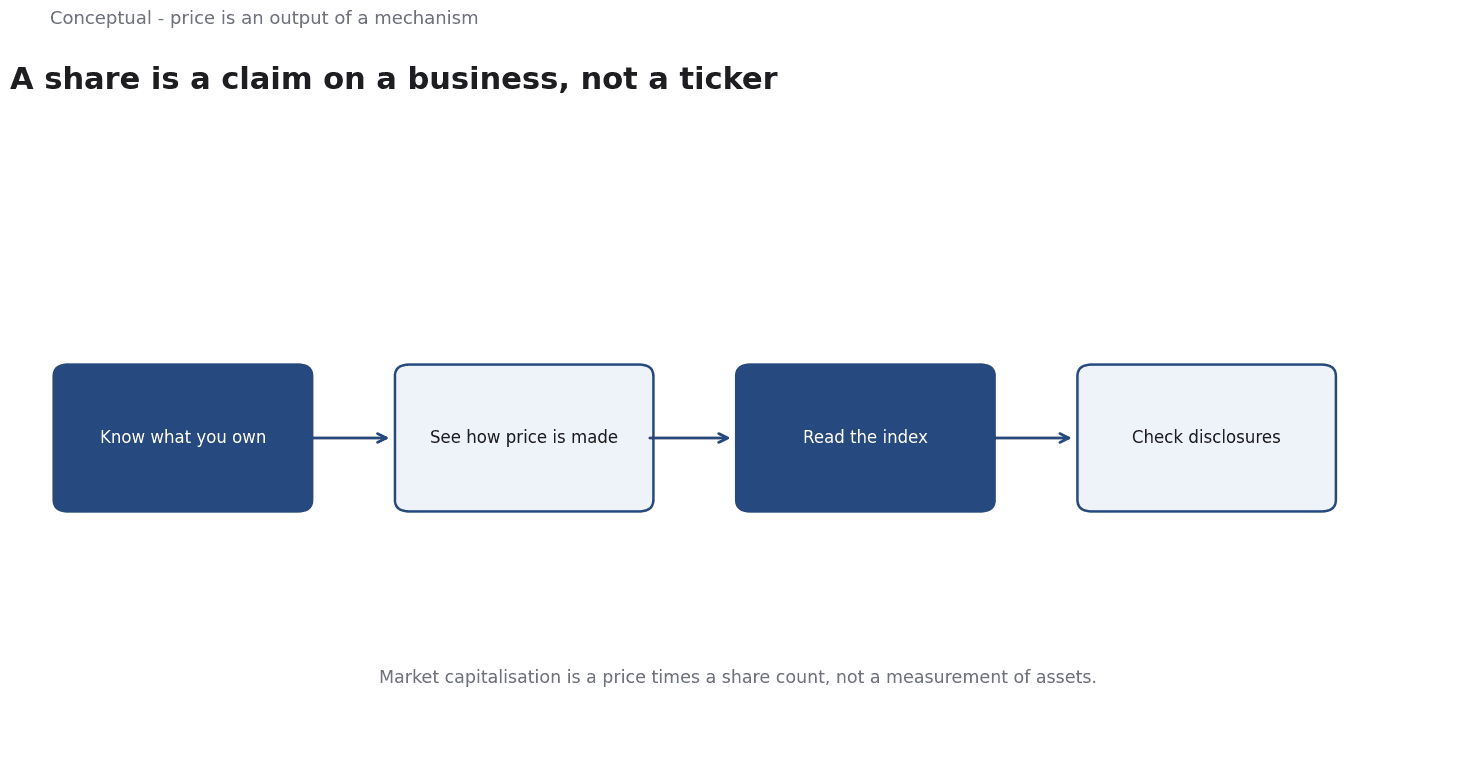
Market capitalisation is a price times a share count; it is not a measurement of the company's assets or its value to customers.
Liquidity — how easily shares can be traded without moving the price — is therefore part of what you are buying. Two companies with identical fundamentals can be different investments if one has deep trading and the other does not.
Valuation is a claim about the future
The price of a share reflects expectations about future cash flows, discounted for time and risk. That sentence is simple and almost impossible to apply precisely, which is why valuation is a discipline of assumptions rather than arithmetic.
The discounted cash flow approach asks what cash the business will generate and what that stream is worth today. The discount rate depends on the risk-free rate — observable on a specific date in the Federal Reserve's H.15 release, which reports "Selected Interest Rates" including Treasury yields and federal funds — plus a premium for the risk of the equity. The cash flows are forecasts, and the forecast is where most of the error lives.
Multiples are the practical shortcut: compare a company's price to earnings, sales, or book value against similar companies. They are easier to communicate and easier to abuse, because "similar" is a judgement and the multiple embeds the market's current mood about the sector. A company trading at a high multiple because the market is optimistic about its industry is not necessarily expensive relative to its own future.
Both methods depend on the same underlying discipline: state the assumption, check its sensitivity, and separate a valuation conclusion from a business judgement. A DCF that flips its answer when the discount rate moves by one point has told you something useful — that the decision is about rates, not about the company.
What an index measures
An index is a constructed basket, and the construction matters. A price-weighted index gives more influence to high-priced shares regardless of company size. A market-capitalisation-weighted index gives more influence to large companies, which means it automatically tilts toward whatever is already expensive. An equal-weighted index gives each constituent the same influence, which requires more rebalancing.
The practical consequences are easy to miss:
- A cap-weighted index is a momentum mechanism. As a company's price rises, its weight rises, so the index buys more of what has already gone up. This is not a flaw in the arithmetic; it is a consequence of the weighting rule.
- An index is not the market. It includes what its rule includes. A "technology index" defined by sector classification will omit companies whose technology is embedded in another sector, and will include firms whose business has changed since they were classified.
- Index membership changes create mechanical demand. When a company is added, funds tracking the index must buy it. That demand is unrelated to the company's fundamentals, and a price move around an index review may be a mechanical effect rather than new information.
For an investor, the question is not "is the index up?" but "what does this index's rule own, and does that match what I intended to own?"
The disclosure layer
Public companies publish because the law requires it, and those filings are the closest thing to primary evidence about a business. The SEC's investor education material exists precisely because these documents are difficult for non-specialists; it is a reasonable starting point for understanding what a filing is and is not.
A filing is not a neutral description. It is a legal document written by the company, reviewed under rules, and shaped by incentives — to present the business favourably, to meet expectations, and to disclose what must be disclosed. Reading it well means distinguishing the audited numbers from the management commentary, and distinguishing both from the narrative in an earnings call.
H.15 is the complementary primary source for the rate environment that prices all of these claims. Its long history also carries a useful lesson about data itself: the 30-year Treasury constant maturity series was discontinued in 2002 and reintroduced in 2006, and the release notes explain how a factor was published to estimate the 30-year rate in the interim. Even the risk-free benchmark has a revision history, and any long-run comparison that ignores it is comparing two different series.
A decision sequence for an investor
- State what the share represents — the ownership rights, the claim on cash flows, and the voting position.
- Check the price against a stated assumption, not against a chart. Write down which forecast or multiple you are using.
- Run the sensitivity. Which single assumption changes the conclusion?
- Identify the index or comparison set you are using, and name its weighting rule.
- Read the primary filing, separating audited figures from commentary.
- Date the rate input from the current H.15 release and note any series changes.
- Distinguish business outcomes from price outcomes. A good company can be a bad investment at the wrong price, and a mediocre company can be a good one at the right price.
For the valuation mechanics, see Corporate Finance Essentials; for how rates reach the sector, see Interest Rates and Their Effect on Technology Companies.
A worked example
The following is hypothetical and illustrative. An investor is comparing two shares in the same sector and wants to know whether a high multiple reflects a business or the market's mood. Check one states the valuation assumption explicitly: a discounted cash flow whose discount rate is dated from the current H.15 release, including the Treasury yield, and a sensitivity run that shows whether the conclusion flips when that rate moves by one point. Check two names the comparison set and its weighting rule, asking whether a cap-weighted index is simply buying more of what has already risen and whether an index addition would create mechanical demand unrelated to the business. Check three reads the primary filing, separating audited figures from management commentary, and anchors the multiple against maintained sector datasets rather than a narrative. The outcome is bounded: if the DCF answer reverses on a one-point rate change, the decision is about rates and not the company, so the investor falls back to the sensitivity result rather than claiming a valuation conclusion.
A counterargument
A critic would say the article overcorrects against the naive chart-reading it opens with. By stressing that the quoted price is set at the margin and that index membership creates mechanical demand, it can imply the price is largely an artefact of trading rules, when the SEC's own investor guidance presents the market chiefly as a way for companies to raise money and for investors to hold a claim on that business. The valuation section's own remedy - state the assumption, test sensitivity, read the primary filing - presupposes that fundamentals discipline the conclusion; otherwise the exercise would be pure narrative. Damodaran's maintained datasets, cited in the references, exist to anchor multiples and discount rates in observable data rather than mood.
The mechanisms described are real, but they shape a signal that is still about the underlying business.
References & Further Reading
- U.S. Securities and Exchange Commission (Investor.gov), 2026. Introduction to Investing — Primary regulator guidance on market mechanics and investor protection.
- Aswath Damodaran, 2026. Damodaran Online: Home Page for Aswath Damodaran — Publicly maintained datasets for industry averages, WACC, and valuation.
- FINRA, 2026. Introduction to Investing (SEC Investor.gov) — Regulator explanation of market mechanics, bonds, and investor protection.