Central Banking: Monetary Policy, Inflation Targeting, and Financial Stability
A central bank sets the price of money and manages the system that transmits it. Read the mechanism, the target, and what it cannot do.
Central banks are often described as the institutions that "set interest rates", which is true in the same way that a conductor "waves a baton". The interesting question is what the rate change does, how it reaches the economy, and what the institution is responsible for when the transmission fails. The answer determines what a business or an investor should actually watch.
Direct answer: A central bank influences financing conditions through its policy rates and its balance sheet, with the aim of keeping inflation low, stable and predictable. The ECB states that "price stability is best maintained by aiming for 2% inflation over the medium term" and that its "primary monetary policy instrument is the setting of ECB policy rates, which influence financing conditions and economic developments". The institution is also responsible for financial stability — the BIS supports central banks' "pursuit of monetary and financial stability through international cooperation". The limits matter as much as the powers: a central bank can influence demand and the price of money, but it cannot create productive capacity, fix a supply shock, or prevent every financial failure.
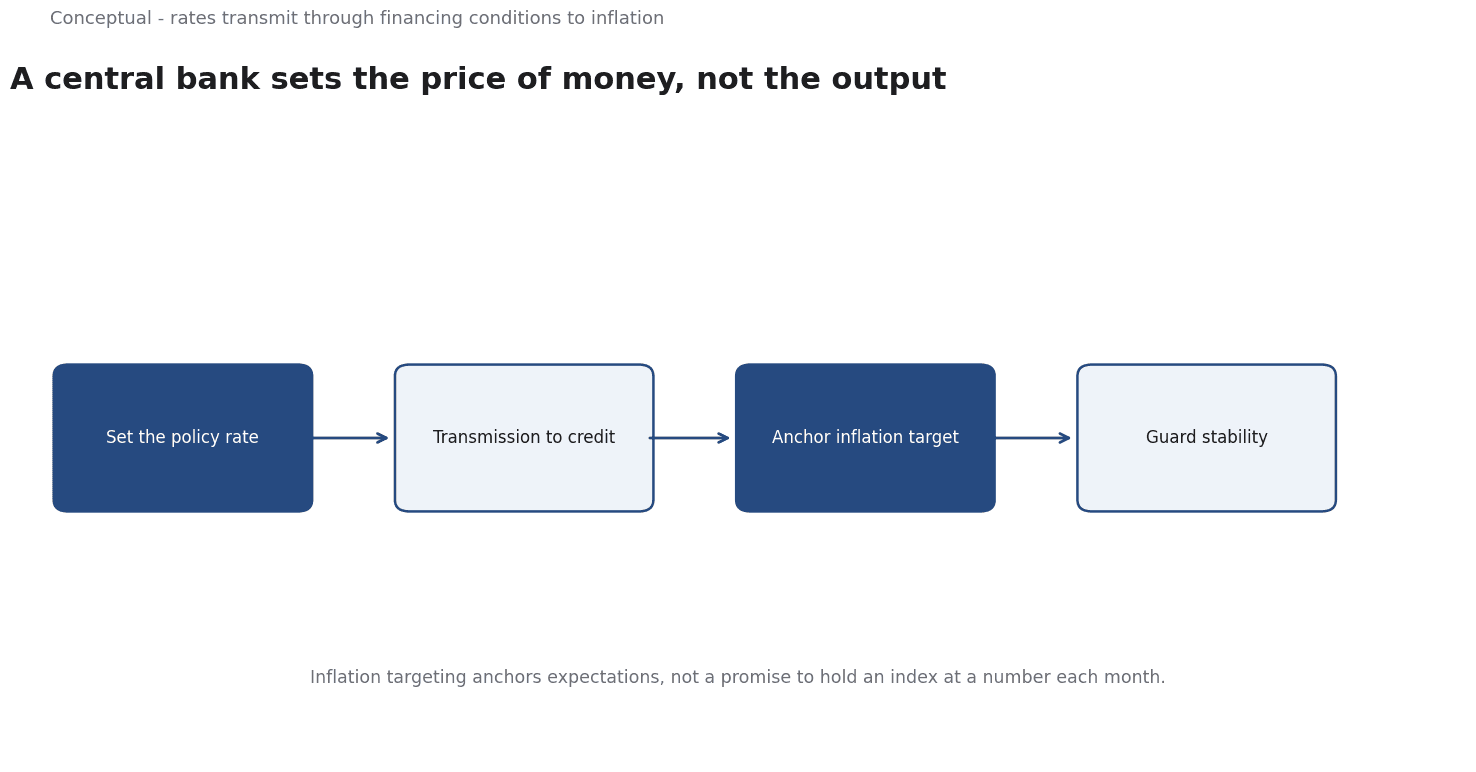
What the target actually is
Inflation targeting is a framework for anchoring expectations, not a promise to hold a measured index at a number each month.
The ECB's explanation is unusually clear: the goal is to keep inflation "low, stable and predictable", and the institution seeks to "anchor inflation expectations and influence the 'temperature' of the economy, making sure the conditions are just right — not too hot, and not too cold".
Three parts of that sentence carry the mechanism:
- Expectations matter because wages and prices are set in advance. If firms and workers expect 2% inflation, they build it into decisions, and the outcome becomes self-reinforcing. The target is therefore partly a communication device.
- "Medium term" acknowledges that monetary policy works with long and variable lags. A rate change today affects spending and investment over quarters, not weeks, and the institution cannot fine-tune a monthly figure.
- Price stability is a means, not the final objective. It creates the conditions in which households and firms can make long-term decisions without a changing price level distorting them.
The Federal Reserve has its own framework and its own published materials — the Federal Open Market Committee, "Monetary Policy Principles and Practice", the Monetary Policy Report and the Beige Book — and the two institutions are not identical.
The transmission mechanism
A policy rate change reaches the economy through several channels, and they operate on different timescales:
The interest-rate channel. Policy rates influence the rates households and firms pay on loans, which changes the attractiveness of spending now versus later. A higher rate raises the cost of financing a house, a factory, or an acquisition, and demand falls.
The asset-price channel. Higher rates raise discount rates, which lowers the present value of future cash flows and tends to reduce the prices of long-duration assets. This is the mechanism that makes technology equities particularly rate-sensitive.
The exchange-rate channel. Higher rates can attract capital and appreciation, which changes the price of imports and exports and therefore inflation.
The credit channel. Banks and lenders respond to the rate environment and to their own balance sheets. If they tighten lending standards, the same policy rate has a larger effect than the standard model predicts. This channel is why "the rate went up" and "credit became available" are not the same story.
The BIS's work on financial structure matters here because the transmission depends on the system through which it passes. If banks are weak, if firms are highly levered, or if funding markets are stressed, the same policy action produces a different outcome. The BIS hosts committees engaged in standard setting and the pursuit of financial stability through the Basel Process — an acknowledgement that the plumbing is part of monetary policy's effectiveness.
The tools are more than one rate
The "policy rate" is a shorthand for a set of instruments, and the distinction matters when reading a decision.
Open market operations change the supply of reserves in the banking system by buying or selling government securities. The Federal Reserve's own description of its balance sheet developments is published alongside its policy reports, which is a reminder that the size and composition of the balance sheet is itself a policy variable, not an accounting detail.
Interest on reserves sets a floor under short-term rates in systems where banks can hold deposits at the central bank. When that rate changes, the incentive to lend into the market changes, and the transmission to other short rates depends on this plumbing.
Reserve requirements and liquidity facilities shape how much banks can lend and what they can do when funding is stressed. The BIS's work on the Basel Process is relevant here: capital and liquidity standards change the way the banking system responds to a monetary impulse.
Forward guidance is the use of communication about the likely future path of rates to influence long-term financing conditions today. It is a tool precisely because markets set long rates on expectations; a statement about the future is a policy action. Its limitation is credibility — guidance that is repeatedly contradicted by decisions loses its effect.
Quantitative easing and balance-sheet policies work by changing the supply of longer-duration assets available to the market, pushing down term premiums when short rates cannot fall further. They are harder to reverse than a rate change, which is why the exit from them is a separate policy problem.
For a business reader, the practical consequence is that "the central bank changed rates" is an incomplete description of a decision. The rate, the guidance, and the balance sheet can move in different directions, and each reaches the economy through a different channel. A company whose costs depend on long-term borrowing is more exposed to guidance and asset purchases than to the current policy rate; one that relies on short-term working-capital credit is exposed to the opposite.
The dual problem: price stability and financial stability
A central bank can keep inflation near target while the financial system accumulates risk, and the 2008 crisis made that distinction painfully visible. Low rates for a long period encourage leverage and search for yield; rising asset prices improve collateral and further loosen credit; the system looks stable right up to the moment it is not.
This is the financial-stability problem, and it is not solved by the inflation target. It requires separate tools — macroprudential regulation, capital requirements, stress testing, and liquidity facilities — and it creates a genuine policy tension. Raising rates to cool credit may also slow the economy and push inflation below target; keeping them low to support demand may inflate an asset bubble.
The honest position is that the institution faces a trade-off rather than a single objective function, and that the trade-off is political as well as technical. This is why central-bank independence is contested and why the mandates differ across jurisdictions.
What monetary policy cannot do
Three limits deserve to be stated plainly, because much public commentary treats the central bank as more powerful than it is.
It cannot fix a supply shock. If energy prices rise because of a physical constraint, higher rates reduce demand and therefore the second-round effects on wages and expectations, but they do not produce more energy. The policy response to supply-driven inflation is about preventing it from becoming embedded, not about reversing the initial shock.
It cannot create productive capacity. Investment, technology, and labour supply determine the economy's ability to produce. Monetary policy can influence the timing of investment through financing costs; it cannot make a business worthwhile.
It cannot prevent every failure. Financial-stability tools reduce the probability and cost of crises, but leveraging the system is a choice made by firms and households, and some failures are the price of allowing risk-taking at all. The BIS's mandate to support stability is not a guarantee of it.
Reading the central bank without forecasting it
For a business or an investor, the useful output is a set of conditions rather than a prediction of the next decision.
- Read the framework and the mandate, because institutions differ. The ECB's 2% medium-term target and the Fed's framework are not interchangeable.
- Track the published rate series — H.15 in the US — with its release date, and note the vintage.
- Watch the qualitative reports such as the Beige Book for early signs of demand shifting before the hard data arrives.
- Separate the price effect from the credit effect. If lending standards tighten, the same policy rate is more restrictive.
- Watch financial-stability indicators — credit growth, leverage, funding conditions — separately from inflation. The two can point in opposite directions.
- Do not build the plan on a forecast of the next meeting. Build scenarios with triggers and wait for the published decision.
For how rates reach a valuation, see Interest Rates and Their Effect on Technology Companies; for the broader macro context, see Macroeconomics for Business Leaders.
A counterargument
The article's tidy separation of price stability and financial stability as two objectives in tension is more settled than the sources it cites. The ECB's strategy review is explicit that price stability is the primary objective, with other considerations subordinate to it; presenting the two as a symmetric "dual problem" blurs a mandate hierarchy that is itself politically contested. More fundamentally, the whole framework rests on anchoring expectations, yet the materials cited - the ECB review, BIS statistics, and FRED series such as H.15 - measure inflation and rates, not expectations directly. The article notes that guidance depends on credibility, but credibility is only observable after it is tested. A critic would say the transmission channels are described too mechanically: the BIS's own work on financial structure shows that a policy impulse produces different outcomes depending on bank health and leverage.
The mechanism is real; the claim that a business reader can read conditions off it is more optimistic.
References & Further Reading
- European Central Bank, 2026. Evaluating our strategy — Primary material on the inflation-targeting framework.
- Bank for International Settlements, 2026. Statistics | Bank for International Settlements — The BIS assessment of financial-market structure and systemic vulnerabilities.
- Federal Reserve Bank of St. Louis, 2026. FRED economic data — The primary time-series database used for macro indicators.