FlashAttention for Small Teams
FlashAttention is mostly a serving-stack decision, not a project to implement. Read what changes, a worked example, and what to measure.
Small teams rarely implement FlashAttention themselves, which is a good thing. It is a low-level attention algorithm that matters through the serving framework a team chooses, and the practical decision is whether the stack includes it and whether the workload benefits. Treating it as a project to hand-write is a mistake, as the build-versus-buy article argues for software capabilities generally.
Direct answer: FlashAttention computes exact attention with fewer memory reads and lower peak memory, which matters for long sequences and prefill. The paper is the primary source, and the serving-frameworks article explains how IO-aware techniques reach an application through infrastructure. The boundary: it does not change model capability, does not remove the KV cache, and its benefit depends on sequence length and hardware, as the KV-cache article explains for the separate memory consumer.
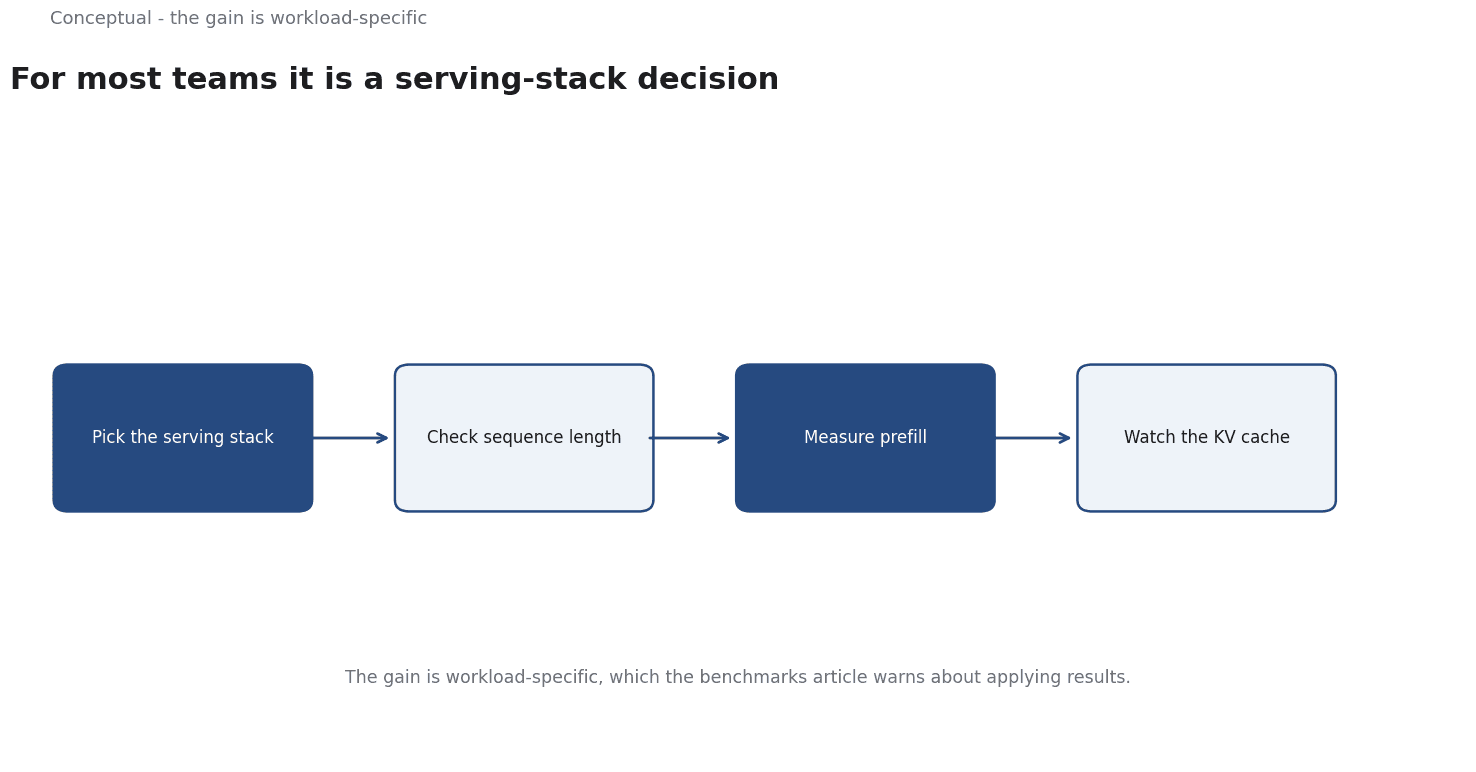
The framework decision in practice
For most teams, the choice is not whether to use FlashAttention but which serving stack to adopt.
A framework that includes IO-aware attention and continuous batching gives the benefit without a custom kernel, which the serving-frameworks article explains for how infrastructure techniques reach an application. The evaluation should therefore compare frameworks on the team's workload, as the benchmarks article advises for results that transfer to a specific setup.
The comparison should include the parts that do not change. Model weights and the KV cache still determine whether a model fits in memory, as the KV-cache article explains for generation, and prompt caching addresses a different cost, as the prompt-caching article describes. A framework that speeds attention but leaves the team unable to serve the desired concurrency is not a solution, which the GPU article treats as a capacity question.
Finally, the gain should be reported honestly. A throughput improvement at a fixed latency target is a measurable result, which the batching-economics article specifies, while a benchmark from another hardware setup is a claim, as the benchmarks article warns about context. The distinction is the same one the publication standard requires for all performance statements.
What it changes
Memory traffic. The algorithm tiles attention so the full score matrix is never written to high-bandwidth memory, which the paper describes as IO awareness. For long sequences this is the difference between a matrix that fits and one that does not, as FlashAttention and Attention Variants: What They Actually Optimize explains for the memory problem.
Speed. Fewer memory round trips can speed up attention even though the arithmetic is unchanged, as the paper reports.
No output change. It computes the same function up to numerical differences, which is why it belongs in the serving layer, as Serving Frameworks: What vLLM-Style Batching Changes describes. A team should not expect a quality improvement from enabling it, which the evaluation article treats as a separate measurement.
Three consequences follow. The practical choice is a framework that supports IO-aware attention, as Serving Frameworks: What vLLM-Style Batching Changes recommends. The workload should have sequences long enough for the gain to matter, which the long-context article treats as a trade-off. And memory planning must still account for the KV cache, as the KV-cache article explains for generation.
A worked example
The following is hypothetical and illustrative. A team serves a model with 4,000-token prompts on a GPU with limited memory and sees slow prefill.
Three checks decide whether FlashAttention helps. First, does the serving stack use an IO-aware attention implementation, which the serving-frameworks article asks for in a self-hosted setup? If not, upgrading the framework is the change, not writing a kernel. Second, is the bottleneck memory or compute, which the GPU article requires for diagnosing performance? A memory-bound workload is where the algorithm pays. Third, does throughput improve at the same latency target, which the batching-economics article specifies as the right measure?
Three conclusions follow. The gain comes from the framework, which the serving article explains. The KV cache remains a separate constraint during generation, as the KV-cache article warns. And the result should be measured on the team's own traffic, as the benchmarks article advises for any performance claim.
What it cannot do
It cannot make a model fit if the weights and KV cache exceed memory, which the GPU article treats as a capacity problem. It does not shorten context or reduce the cost of long prompts, as the prompt-caching article explains for a different mechanism. And it does not guarantee a speedup on short sequences, which the paper's scope makes clear, as the benchmarks article warns about generalising results.
The counterargument that a small team should ignore low-level attention entirely is fair for most applications and wrong about the choice of serving framework, which the serving article treats as a decision with real throughput consequences.
A decision test
- Identify whether you self-host and which framework you use, as Serving Frameworks: What vLLM-Style Batching Changes advises.
- Check that the stack supports IO-aware attention.
- Confirm the workload's sequence length makes the gain relevant.
- Distinguish memory from compute as the bottleneck, as the GPU article requires.
- Measure throughput at a fixed latency target, as the batching-economics article specifies.
- Remember the KV cache remains, as the KV-cache article warns.
- Re-test after a model or hardware change, as the monitoring article advises.
For the mechanism, see FlashAttention and Attention Variants; for the serving layer, see Serving Frameworks.
References & Further Reading
- Tri Dao et al., 2022. FlashAttention: Fast and Memory-Efficient Exact Attention with IO-Awareness — IO-aware exact attention that avoids materialising the full attention matrix in memory.
- Ashish Vaswani et al., 2017. Attention Is All You Need — The transformer architecture that the NLP and LLM sections build on.