Freemium Conversion: Where the Free Boundary Should Sit
The free tier must give enough value to attract and leave enough value to pay for. Read how to find that boundary with a worked example.
Freemium fails in two opposite ways. Give away too little and nobody sees the value; give away too much and nobody pays. The boundary is not a feature list chosen for symmetry — it is a placement of value that makes the paid tier the obvious next step for a user who has already benefited.
Direct answer:
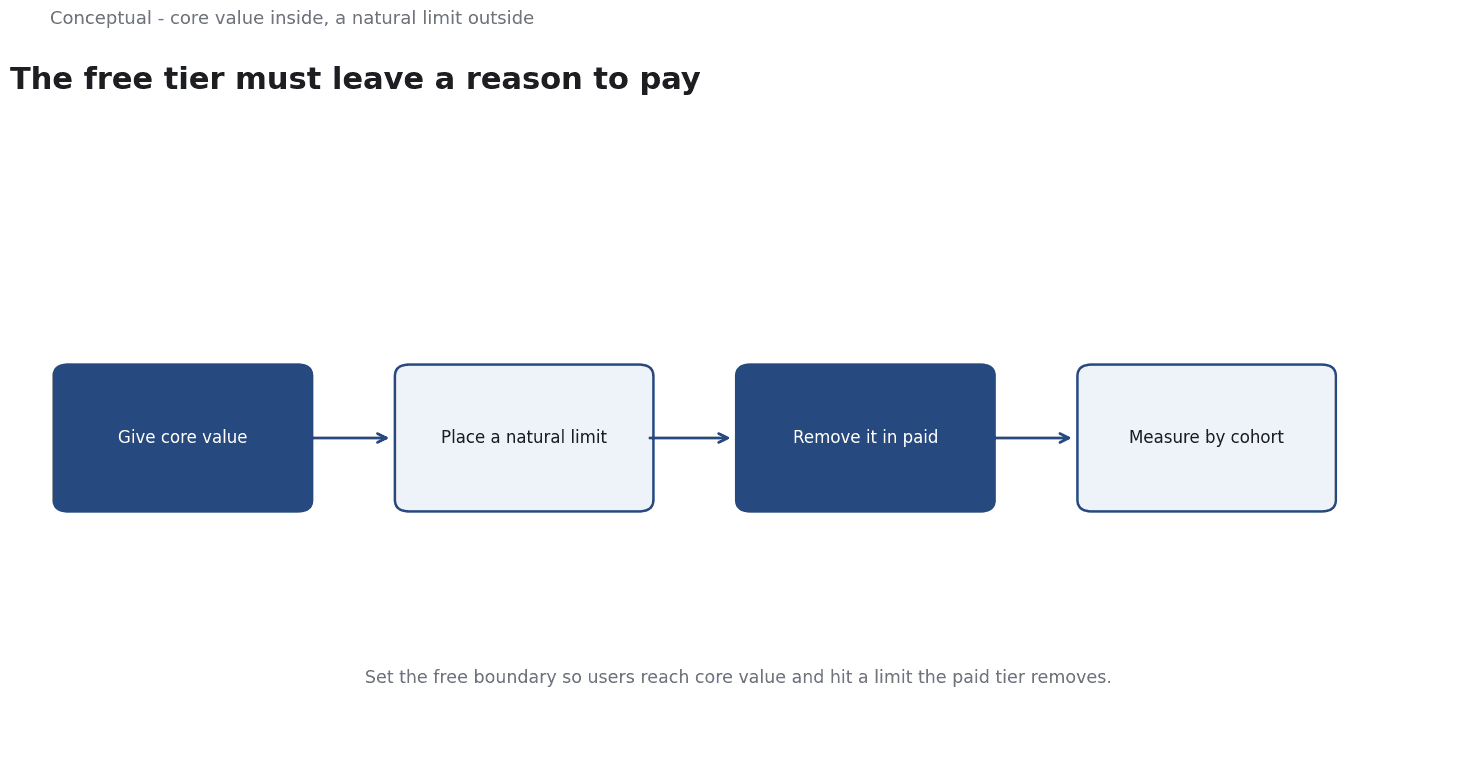
Set the free boundary so users can reach the core value and hit a natural limit that the paid tier removes, then measure conversion and retention by cohort.
The pricing-strategy article explains the value basis, and the investor-education material is a reminder that free usage is not revenue. The boundary: a free tier with no conversion path is a cost centre, and a boundary chosen only to force payment frustrates users before they see value, as the trial-design article argues for a genuine first experience.
Where to place the boundary
Usage limits. A cap on volume or seats lets a user reach value and then encounter a real constraint, which the unit-economics article treats as a natural expansion point.
Feature boundaries. Advanced capabilities that matter after the first success — reporting, integration, collaboration — suit a paid tier, as the product-marketing article recommends for staged value.
Time boundaries. A free period with full access, which the trial-design article covers as a distinct model.
Three consequences follow:
- The free tier must deliver value on its own, which the content-marketing article argues for value before asks.
- The limit must be understandable before it is hit, as the pricing-page article requires for clarity.
- The paid step must be proportional to the value gained, which the upgrade path in the customer-success article describes.
A worked example
The following is hypothetical and illustrative.
A tool offers a free tier with unlimited projects but three reports, and a paid tier at 20 a month with unlimited reports. Three checks:
- Time to value. Do free users create a project and see a result in the first session, as the activation metrics in the funnel article measure? If not, the boundary is too restrictive at the top.
- Conversion trigger. Do users hit the three-report limit at a moment when reports are valuable, as the trial-design article frames the right ask? A limit hit on day one is premature.
- Unit economics. Does the share of free users who convert at 20 cover the cost of serving the rest, as the unit-economics article computes for CAC and margin? A 2% conversion may or may not be enough depending on support costs.
Three conclusions follow:
- The boundary is a hypothesis tested by cohort conversion, as the A/B testing article requires for reliable results.
- The limit must align with value, not with an arbitrary feature split, as Pricing Strategy: How to Charge What Your Product Is Worth argues.
- Free users are a cost, which the cost estimator article quantifies for any large volume of non-paying activity.
The free boundary is not a one-time decision. As the product changes, the capability that once justified payment can become routine, and a boundary that converted well a year ago may now either block value or give away too much. Teams that treat the boundary as a living parameter — with a cohort-based conversion metric and a scheduled review tied to product changes — keep the model working.
The economics of a large free base
A free tier is a population the business serves without direct revenue, and that population has a real cost. Infrastructure, support, and the engineering attention spent on free-user issues all consume capacity that could go elsewhere. The cloud-cost article explains how to attribute such spend to a workload, and the unit-economics article provides the framework for asking whether the paying fraction covers the whole base.
A conversion rate that looks healthy in isolation can be uneconomic once these costs are counted honestly.
The other side of the calculation is the role free users play in acquisition. Some become paying customers, some refer others, and some contribute content, reviews, or data that improves the product. The referral article treats word of mouth as a channel with its own conditions, and the advocacy article explains why a free user who talks about the product is an asset. These benefits are real and difficult to measure, which is why they should be named as assumptions rather than folded into a confident forecast of lifetime value.
The right way to hold these two sides together is a cohort view. Track, for each signup cohort, the share that converts, the time it takes, the support cost incurred before conversion, and the referral activity of those who never convert. The retention article explains why cohort analysis beats a blended average, and the monitoring article covers the need to re-check when the product changes. A free tier that loses money on one cohort may still be the cheapest acquisition channel the business has; a blended ratio will not tell you which is true.
What freemium cannot do
It cannot create value. A free tier distributes value; it does not manufacture a reason to use the product, which the value-proposition article argues.
It is not free to operate. Support and infrastructure for non-paying users are real costs, as the cloud-cost article explains for any workload.
It does not suit every product. A narrow enterprise tool may convert better with a demo-led motion, as the founder-led-sales article describes for high-touch products.
The counterargument — that free users are a marketing channel — is fair when they refer others, which the referral article treats as a channel condition, and weak when they never convert or advocate.
A decision test
- Identify the moment of value users must reach for free, as the activation article recommends.
- Place a natural limit that the paid tier removes, as Pricing Strategy: How to Charge What Your Product Is Worth advises.
- Make the limit clear before it is hit, as the pricing-page article requires.
- Measure conversion by cohort, as the funnel article recommends.
- Check unit economics of the free base, as the unit-economics article computes.
- Watch support cost from non-paying users, as the cloud-cost article explains.
- Re-test the boundary after a product change, as the monitoring article advises.
For the pricing model, see Pricing Strategy; for the upgrade path, see Customer Success.
References & Further Reading
- Wikipedia contributors, 2026. Demand generation - Wikipedia — An overview of demand generation as a marketing discipline distinct from lead generation; secondary reference used with the lead-generation entry.
- U.S. Securities and Exchange Commission (Investor.gov), 2026. Introduction to Investing — Primary regulator guidance on market mechanics and investor protection.