EBITDA Explained: What It Measures and What It Hides
EBITDA is earnings before interest, tax, depreciation and amortisation. Read what removing those items clarifies — and what it conceals.
EBITDA appears in almost every investment pitch, and it is routinely used to make a business look better than its cash generation suggests. The metric is not fraudulent; it answers a specific question about operating performance before financing and accounting choices. The mistake is treating that question as the only one that matters.
Direct answer:
EBITDA is earnings before interest, taxes, depreciation, and amortisation — a measure of operating profit that excludes financing decisions, tax environments, and non-cash charges.
The financial-statement overview provides the context for where these items sit; Damodaran's valuation work is a useful reminder that cash flow, not accounting profit, ultimately determines value. The boundary: excluding depreciation hides the cost of maintaining the asset base, so EBITDA is a poor proxy for cash generation in capital-intensive businesses.
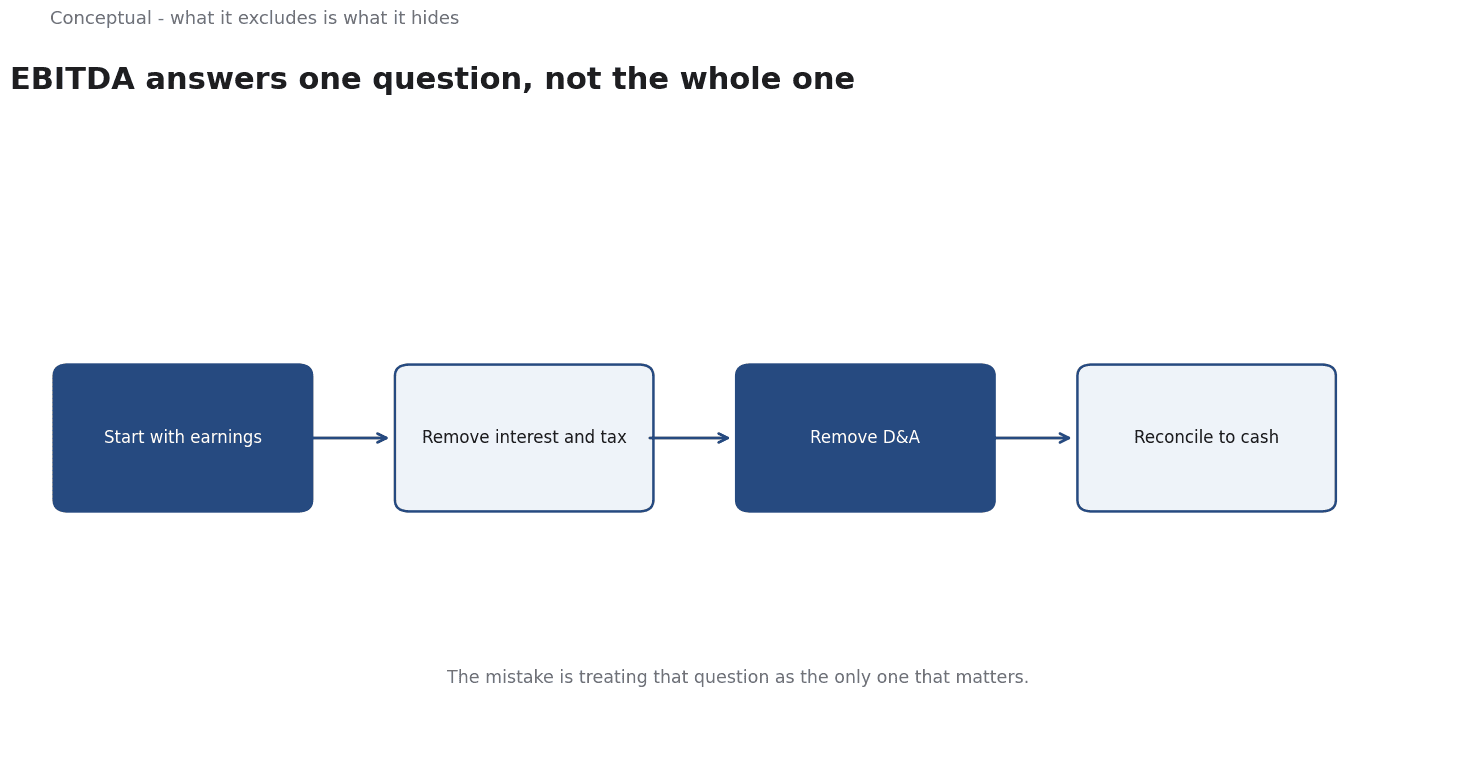
What it clarifies
Removing the four items serves three purposes:
Comparability across financing. Two companies with the same operations but different debt levels will report different net income. EBITDA removes interest so their operating performance can be compared.
Comparability across tax environments. Tax rates vary by jurisdiction and change over time. Excluding tax makes the operating comparison cleaner.
A focus on operating cash generation before capital structure. For a quick view of whether the core business produces earnings, EBITDA is useful, which is why it appears in lending covenants and transaction multiples.
Each of those is a legitimate analytical purpose.
What it hides
Depreciation is not free. It allocates the cost of assets over their useful lives. Excluding it makes a capital-intensive business look more profitable than one that needs little equipment, even if the latter generates more cash.
Working capital is invisible. A company can report growing EBITDA while cash is absorbed by receivables and inventory. The working-capital article shows how growth creates that gap.
Adjustments are negotiable. "Adjusted EBITDA" adds back costs the company considers one-off — restructuring, share-based compensation, litigation. Each adjustment is a judgement, and a generous set of adjustments can turn a loss into a profit on the slide.
A company with high maintenance capital expenditure and a long list of adjustments may be precisely the one whose EBITDA is least informative.
A worked example of the gap
The following numbers are hypothetical and illustrative.
A company reports:
- Operating profit: 8 million.
- Depreciation and amortisation: 6 million.
- EBITDA: 14 million.
- Interest: 3 million, tax: 1.25 million — net income 3.75 million.
Now consider two versions of the same business:
Asset-light version. Maintenance capital expenditure is 2 million a year. Free cash flow before working capital is roughly 8 + 6 − 2 − 3 − 1.25 = 7.75 million. EBITDA of 14 overstates the cash available by a wide margin.
Asset-heavy version. Maintenance capital expenditure is 7 million a year. The same EBITDA of 14 becomes cash flow near 2.75 million. The asset-heavy business looks identical on an EBITDA multiple and is materially different as an investment.
Three lessons follow:
- The same EBITDA can represent very different economics. The difference is the capital required to sustain the business.
- Depreciation is a proxy for that cost. Excluding it without considering maintenance capex removes the signal.
- Net income is not the answer either. It includes financing and tax choices. The right move is to look at several measures, not to choose one.
How to use it honestly
Report EBITDA alongside free cash flow. The gap between them is where the capital intensity lives. The free-cash-flow article works through the calculation.
List the adjustments. If a figure is "adjusted", every add-back should be visible with a reason. A long list is a prompt to investigate, not a reason to accept the number.
Compare within an industry. A multiple is meaningful against peers with similar capital structures and asset bases. Across industries, the same multiple can mean opposite things.
The counterargument — that EBITDA is a rough measure everyone understands — is fair for a first pass.
The error is stopping there, especially in a business where assets need replacing.
A decision test
- State the question EBITDA is being used to answer.
- Report it next to free cash flow and maintenance capex.
- List every adjustment with its reason.
- Compare within the same industry and asset profile.
- Check the working-capital trend separately.
- Treat a high multiple on EBITDA as a question about capital intensity.
- Do not use EBITDA as a substitute for cash generation.
For the statement context, see Reading Financial Statements; for the cash measure, see Free Cash Flow Explained.
References & Further Reading
- Wikipedia contributors, 2026. Financial statement - Wikipedia — An overview of the four financial statements and the purpose of each; a secondary reference used here with primary documents where available.
- Aswath Damodaran, 2026. Damodaran Online: Home Page for Aswath Damodaran — Publicly maintained datasets for industry averages, WACC, and valuation.