Reading Financial Statements Without an Accounting Background
Three statements answer three different questions. Read what each one shows, the accounting equation, and why profit is not cash.
A company can report record revenue and run out of cash. It can show a profit while its customers take months to pay. These are not contradictions; they are the result of reading one financial statement when the answer lived in another. The three core statements are not three views of the same number — they answer different questions.
Direct answer: The balance sheet shows what a company owns and owes at a point in time; the income statement shows revenue and expenses over a period; the cash flow statement shows where cash actually came from and went. The balance sheet must satisfy the accounting equation — assets equal liabilities plus equity. The boundary: these statements are prepared under accounting standards that recognise revenue and expenses on specific bases, so profit is a measured quantity, not a direct observation of money in the bank.
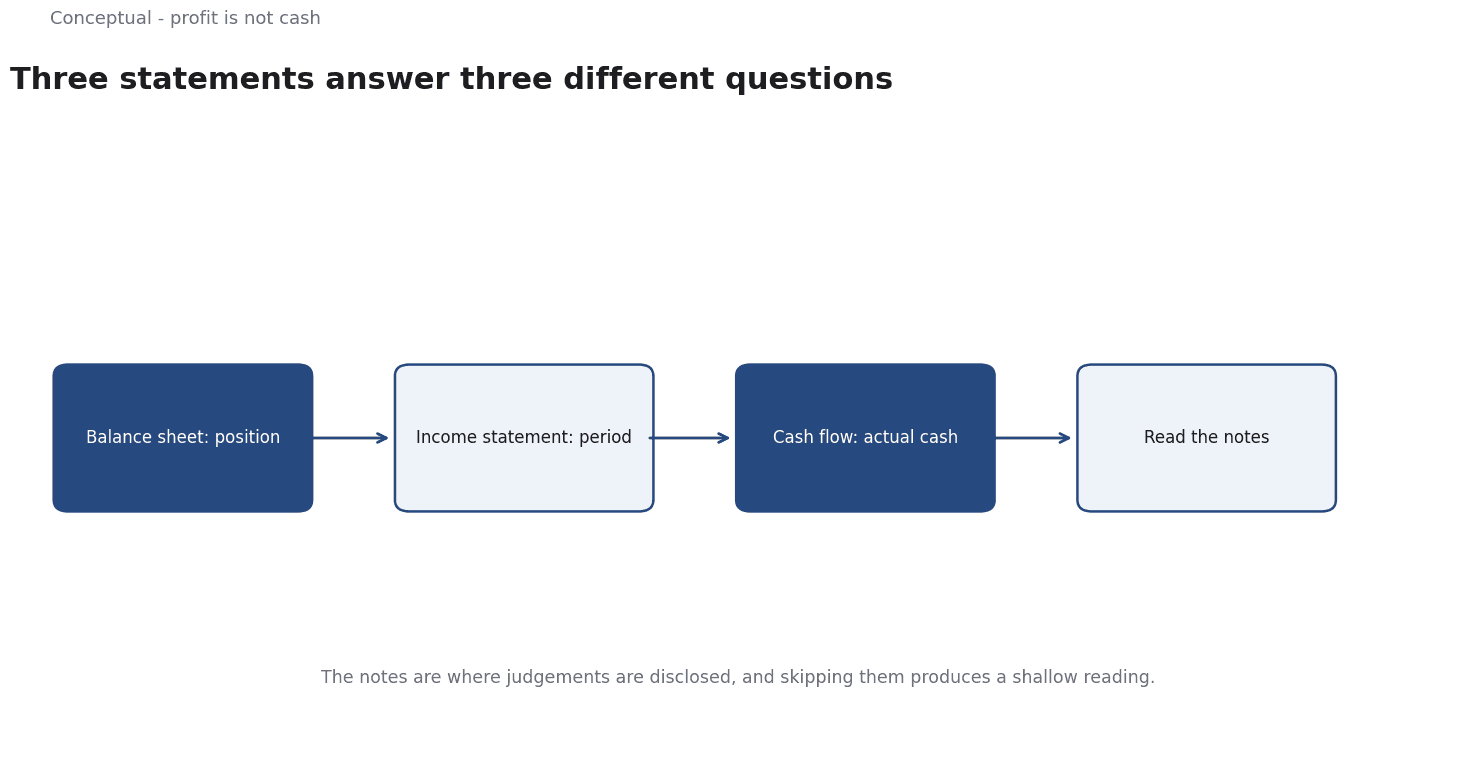
The three questions
Balance sheet — what is the position now? It lists assets, liabilities, and equity at a single date. The accounting equation is the constraint: everything the company owns is financed either by what it owes or by the owners' residual claim. A company with more liabilities than assets has negative equity; the equation still balances.
Income statement — how did the period perform? It shows revenue, expenses, and the resulting profit over a span — a quarter or a year. Revenue is not cash received. It is recognised under the applicable accounting standards when earned, which may be before or after payment.
Cash flow statement — where did the money actually move? It divides cash movements into operating, investing, and financing activities. This is the statement that explains the gap between reported profit and the bank balance: depreciation is an expense that involves no cash, while a loan repayment uses cash without being an expense.
The practical rule is to ask which question you are trying to answer before opening a statement. A question about solvency belongs on the balance sheet; one about profitability on the income statement; one about survival on the cash flow statement.
The links among them
The statements are not independent:
- Profit from the income statement flows into retained earnings, which is part of equity on the balance sheet.
- Cash generated or consumed appears on the cash flow statement and changes the cash asset on the balance sheet.
- An increase in receivables means revenue was recognised without cash arriving, which is why the cash flow statement adjusts profit for changes in working capital.
These links are why a reader should move between statements rather than treat each as a standalone score. A company whose profit is rising while operating cash flow falls is showing a specific warning sign: revenue is being recognised faster than customers are paying.
A worked example of profit versus cash
The following numbers are hypothetical and illustrative.
Suppose a business reports revenue of 1,000,000 for the year and expenses of 800,000, giving an accounting profit of 200,000. Its cash position tells a different story:
- Receivables increased by 300,000. Customers were invoiced but have not paid yet. Some of the reported revenue is not cash.
- Depreciation of 100,000 was included in expenses, but no cash left the business for it.
- Inventory increased by 80,000. Cash was spent buying stock that has not yet been sold, so it is not an expense this period.
- A loan repayment of 120,000 reduced cash but is a financing activity, not an expense.
Approximate operating cash flow from profit:
200,000 + 100,000 (add back depreciation) − 300,000 (receivables) − 80,000 (inventory) = −80,000
Operating activities consumed 80,000 of cash despite a 200,000 profit. Add the 120,000 loan repayment and cash fell by roughly 200,000 over the year.
The business is profitable on paper and burning cash in reality.
Three decisions change the reading:
- Check the collection terms. If the receivables are from customers who reliably pay in 60 days, the cash gap is timing, not distress. If they are disputed or aged, the revenue may never convert.
- Separate growth spending from operations. Building inventory for confirmed demand is different from accumulating unsold stock. The statement alone does not tell you which; the notes and management discussion do.
- Look at the financing section. A company funding operating losses with new borrowing is in a different position from one whose cash burn is covered by an existing reserve.
The point is not that profit is meaningless. It is that profit and cash answer different questions, and a decision about survival needs both.
Reading the notes without training
The notes are where the interesting qualifications live, and they are written in dense language. Four items are worth learning to find:
Revenue recognition policy. What has to happen before revenue is recorded — delivery, acceptance, a milestone? A company that recognises revenue earlier than its peers will look larger without selling more.
Receivable ageing. How much is outstanding beyond 30, 60, or 90 days? A growing total in the older buckets is a leading indicator of cash problems that the income statement will not show.
Debt terms and maturities. When must liabilities be repaid, and are there covenants? A company with comfortable equity but large near-term repayments faces a refinancing risk the balance sheet's totals hide.
Related-party transactions. Deals with owners, directors, or affiliated entities may not be at arm's length. They are disclosed because they change how much to trust the reported figures.
You do not need to be an accountant to read these sections. You need to know that they exist and that a headline number without its note is an incomplete claim.
What the statements do not tell you
Three limits matter.
They are prepared under standards. IFRS Accounting Standards and other frameworks define what counts as revenue, when it is recognised, and how assets are valued. Two companies using different bases — or the same basis with different judgements — are not perfectly comparable.
They are historical. A statement describes a period that has ended. Its usefulness lies in what it reveals about the structure of the business, not as a forecast. Trends across several periods are more informative than one snapshot.
They depend on estimates. Depreciation methods, useful lives, bad-debt provisions, and revenue recognition for long contracts involve judgement.
The counterargument — that non-specialists should not interpret statements at all — is too strong. A reader does not need to prepare a statement to ask the right questions of it.
What matters is knowing which question each statement answers and where the estimates sit.
A decision test
- Name your question — position, performance, or cash — before opening a statement.
- Check the balance sheet equation — assets should equal liabilities plus equity.
- Compare profit with operating cash flow; investigate a widening gap.
- Read the notes on revenue recognition, receivables, and provisions before drawing a conclusion.
- Compare several periods, not just one, to separate structure from timing.
- Ask which standards were used and whether comparability is affected.
- Treat a single ratio as a prompt to investigate, not a verdict.
For the valuation context, see Corporate Finance Essentials; for the broader capital picture, see Venture Capital and Private Equity.
References & Further Reading
- Wikipedia contributors, 2026. Financial statement - Wikipedia — An overview of the four financial statements and the purpose of each; a secondary reference used here with primary documents where available.
- Wikipedia contributors, 2026. Balance sheet - Wikipedia — The structure of assets, liabilities and equity, and the accounting equation that must balance.
- Wikipedia contributors, 2026. Income statement - Wikipedia — The structure of revenue, expenses and profit, and the difference between revenue and cash.
- Wikipedia contributors, 2026. Cash flow statement - Wikipedia — Operating, investing and financing activities, and why net income and cash flow differ.