Freelancing Pitfalls
Freelancers often confuse booked revenue with usable cash. See how cash flow timing and contractor structure create risk, with a worked example and limits.
A freelancer can finish a busy month with strong invoices and still miss a rent payment. The problem is not effort; it is that revenue and cash arrive on different clocks, and a contractor has no payroll to smooth the gap. Understanding where the gap comes from is the first step to managing it.
Direct answer: A freelancer is a self-employed contractor paid for defined work rather than a salary, while cash flow is the net movement of money into and out of a business over time. The two combine into a simple rule: track when money arrives, not just when it is earned. The sources define each concept; the rule is a synthesis.
Delta: This article adds a timing frame beyond the sources: it maps the contractor payment structure to a cash-flow decision, with claim status explicit.
The mechanism
Freelancing risk is mostly a timing problem disguised as an income problem.
The Wikipedia entry on freelancers describes a self-employed worker who sells services to clients, typically by project or contract, without a long-term employment relationship. The practical consequence is that income arrives in lumps tied to deliverables and acceptance, not as a steady pay cheque. There is no employer withholding tax, no paid leave, and no guarantee of the next contract.
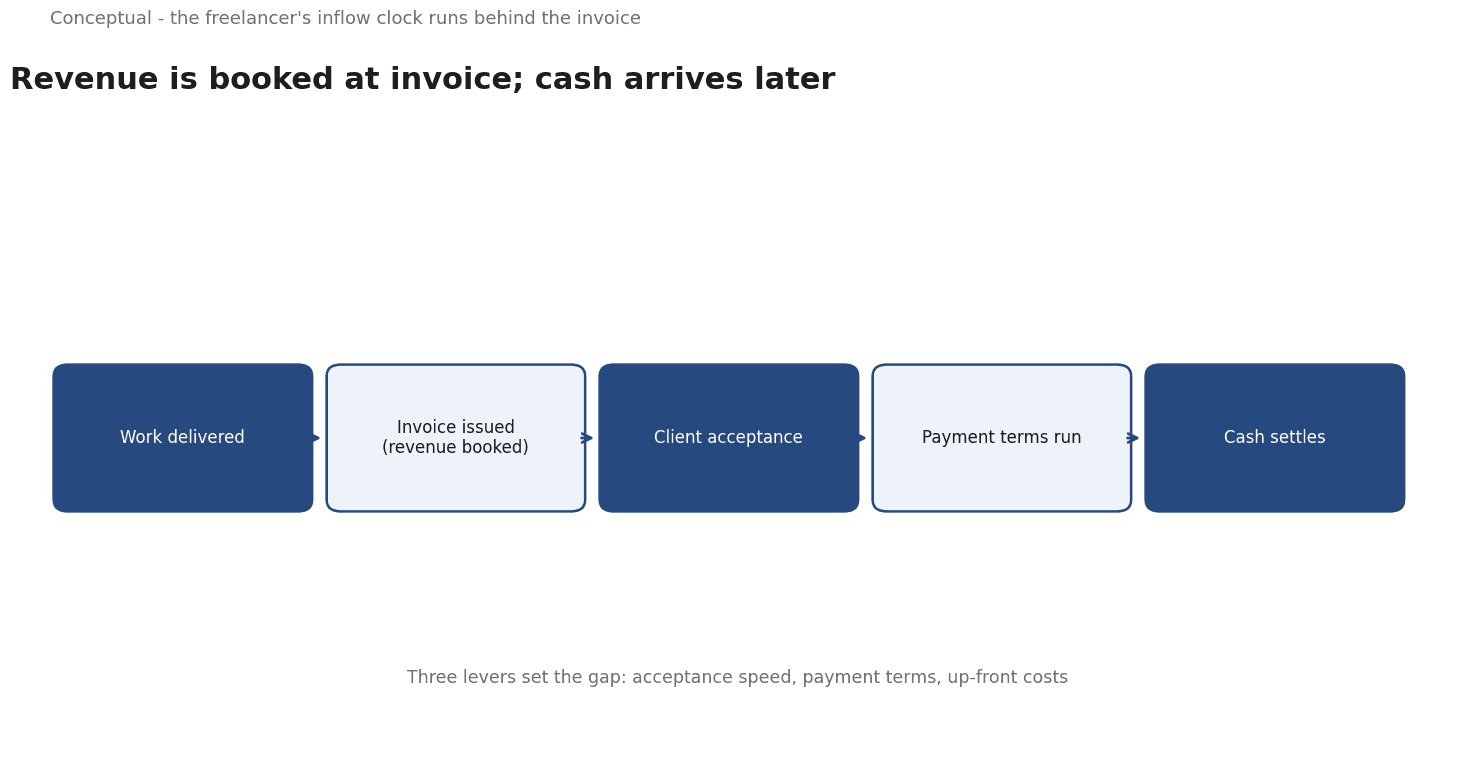
The cash flow entry defines cash flow as the net amount of money moving into and out of a business, and distinguishes it from profit or revenue. A freelancer can record revenue when an invoice is issued while the cash arrives weeks later, after client approval and payment terms. The practical consequence is that profitability on paper and the ability to pay bills this month are different questions.
The gap is governed by three levers: how quickly work is accepted, how long payment terms run, and how much expense must be paid up front. Each lever shifts the timing of inflows relative to outflows. A freelancer who shortens acceptance or pays expenses later reduces the gap; one who accepts long terms and funds costs personally widens it.
The mechanism becomes a decision loop: before taking work, estimate when cash will actually arrive and when costs must be paid, then compare. The comparison is only as good as the assumptions about client behaviour. The decision it supports is concrete: whether to accept a contract, what terms to negotiate, and how much reserve to hold.
A worked example
The following is hypothetical and illustrative. A freelancer is offered a project with a fee paid 60 days after delivery.
Three checks decide. First, when will the work be accepted and the invoice issued, since the payment clock starts there rather than at signing? Second, what costs must be paid before the fee arrives, and can they be deferred without damaging the work? Third, what reserve exists to cover personal fixed costs during the 60-day gap?
The outcome is a written decision with a condition: accept only if the reserve covers the gap and the client accepts a shorter term or a deposit; otherwise decline or reprice. The scenario is hypothetical; the method is the contribution.
Evidence status
| Claim | Status | Source | Verified | Recheck when |
|---|---|---|---|---|
| Freelancers are self-employed contract workers | source-reported | Wikipedia, Freelancer | 2026-11-18 | Definition changes |
| Cash flow is net money moving in and out | source-reported | Wikipedia, Cash flow | 2026-11-18 | Definition changes |
| Track settlement timing, not invoice date | inferred | Derived from the sources | 2026-11-18 | Payment terms shift |
The first two rows restate documented definitions. The third is a synthesis: the sources describe the concepts but do not prescribe a decision rule. Recheck it when a client changes payment terms or when a new income channel changes how quickly work is accepted, because then the timing assumption no longer holds.
What it cannot do
The frame cannot guarantee payment. It describes when money is expected to arrive, not whether the client will pay. A freelancer can model a 30-day term perfectly and still face a client who disputes the deliverable or simply pays late. The timing discipline reduces surprise but does not remove counterparty risk, which needs separate checks on the client's reliability.
The hidden cost is the reserve itself. Holding cash to cover a payment gap means money that is not invested or spent, and that has an opportunity cost. A freelancer who keeps a large reserve is insured against late payment but gives up return. The right size is a judgement about tolerance, not a number the sources can supply.
Booked work is a promise of future cash, not cash in hand. A freelancer who treats bookings as income will spend against money that has not arrived and can be caught short when one client slips. The failure is not a lack of demand but a mismatch between recognized work and settled cash.
The boundary is the individual. The cash flow concept comes from business finance, and a freelancer is both the business and the household. Taxes, retirement, and health costs blur the line between operating cash and personal cash. A frame that tracks only project inflows and outflows will miss obligations that land on the person, not the invoice.
The decision also needs review. Rates, terms, and client mix drift over time, and a rule that worked with one client may fail with another. Setting a recurring check, such as at each new contract, forces the freelancer to restate the timing assumptions. Without it, the reserve becomes a habit rather than a calculated buffer.
The counterargument that freelancing offers freedom is fair for autonomy over how work is done and incomplete where income is irregular.
The frame does not deny the freedom; it prices the timing risk that comes with it.
A decision test
- State when the work will be accepted and invoiced.
- State the client's payment term and the realistic settlement date.
- List the costs that must be paid before the fee arrives.
- Compare those dates and name the size of the gap.
- Check the reserve against personal fixed costs for that gap.
- Decide whether to accept, reprice, or request a deposit.
- Set a review date at the next contract or term change.
When settlement dates are written down and compared with costs, the decision to accept work becomes a calculation rather than a hope. When they are not, a busy month can still end in a cash shortage. The test exists to surface the gap before it becomes urgent.
For further reading, see Decision Memos That Survive Review.
References & Further Reading
- Wikipedia contributors, 2026. Freelancer - Wikipedia — Independent work and its trade-offs.
- Wikipedia contributors, 2026. Cash flow statement - Wikipedia — Operating, investing and financing activities, and why net income and cash flow differ.