Franchising for Small Teams
Franchising sells a repeatable system, not a brand name. Read what transfers, a worked review, and why a manual is not a business.
Franchising is often presented as a way to grow without capital, which overlooks the work of building a system someone else can run. The franchising entry describes the relationship between franchisor and franchisee, as the small-business-financing entry covers internal funding, as Content Operations in Practice treats documented process as the substance, as Understanding Unit Economics: CAC, LTV, Churn, and Contribution Margin requires for contribution, as the legal article requires a dated check.
Direct answer:
Franchise only when the operating system is repeatable and supported, with economics that work for both sides.
Wikipedia's franchising entry provides the structure, and small-business financing covers the funding context. The boundary: this is educational orientation, not legal or financial advice — franchise law and disclosure rules are jurisdiction-specific, as the legal article requires a dated check, as the publication standard forbids guaranteed outcomes.
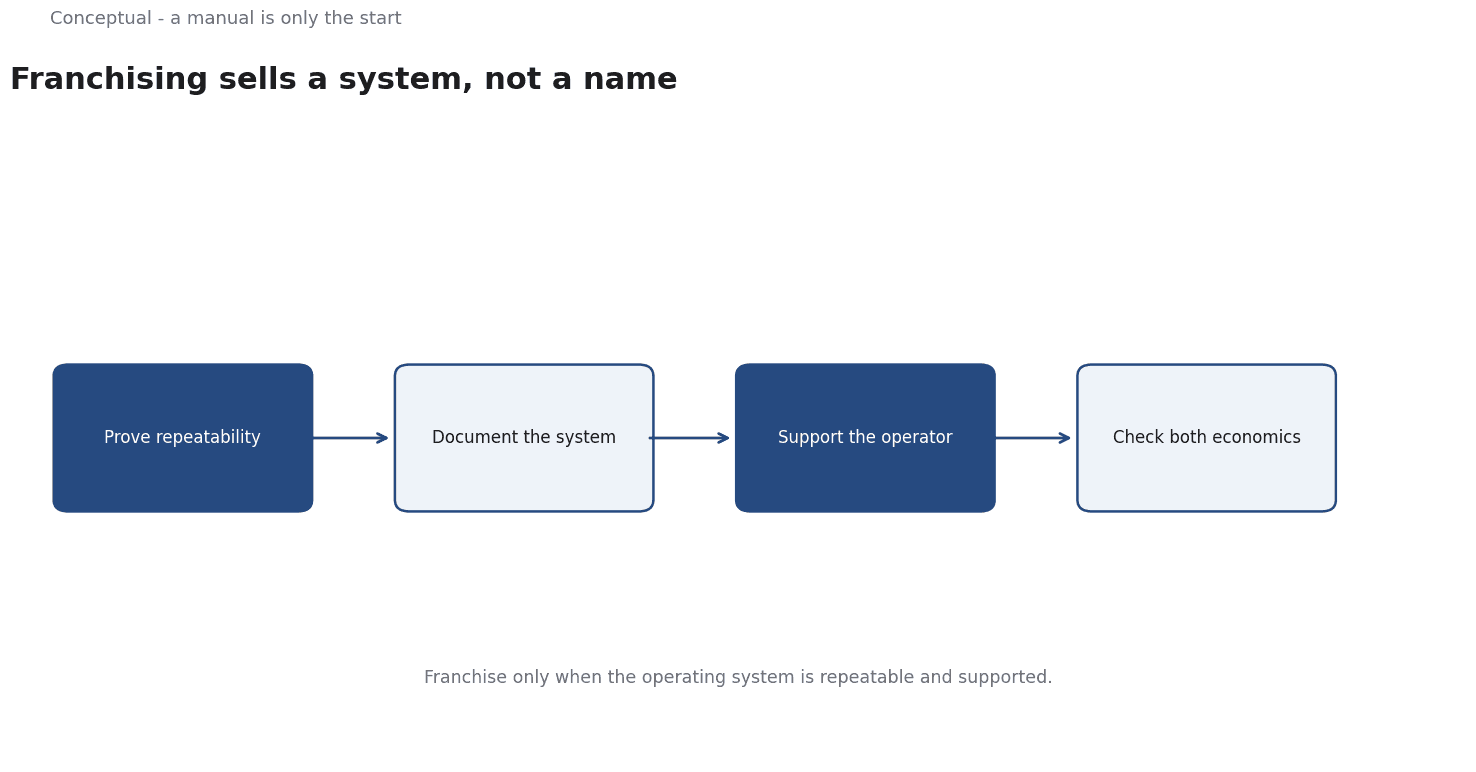
The considerations
A repeatable system. The value transferred is a way of operating, which the franchising entry describes, as Content Operations in Practice treats documented process, as the documentation article advises for artefacts people use, as Content Operations in Practice treats execution as the mechanism.
Economics for both sides. A franchisee must earn a return after fees, as Understanding Unit Economics: CAC, LTV, Churn, and Contribution Margin requires for contribution, as the pricing article treats margin as a constraint, as the cash-flow article requires for the cash received, as the decision-memo article requires for a recorded judgement.
Support and control. Training and standards must be real, which the franchising entry treats as the relationship, as the team-culture article warns about implicit norms, as the monitoring article advises for review, as the data-governance article requires for records.
Legal obligations. Disclosure and franchise rules apply, which the franchising entry notes, as the legal article requires a dated check, as the term-sheet article treats formal terms as substantive, as the governance checklist requires an accountable owner.
Three consequences follow. Documentation should be tested in practice, as Content Operations in Practice advises, as the documentation article treats roles, as the customer-journey article advises for evidence from real people. The economics should work for both sides, as Understanding Unit Economics: CAC, LTV, Churn, and Contribution Margin requires, as the cash-flow article advises. And the rules should be checked, as the legal article requires, as the decision-memo article requires for a record.
A worked review
The following is hypothetical and illustrative. A small chain considers franchising after opening three successful locations.
Three checks decide. First, is the operating system documented and repeatable, as the franchising entry and content-operations article require, with artefacts people actually use, as the documentation article advises? Second, does a franchisee earn a return after fees, as the unit-economics and cash-flow articles require, with a recorded decision, as the decision-memo article requires? Third, are the disclosure and franchise rules current, as the legal article requires, with qualified advice, as the term-sheet article advises?
Three conclusions follow.
The franchisee economics decide whether the model holds, as Understanding Unit Economics: CAC, LTV, Churn, and Contribution Margin advises. And the decision should be recorded, as the decision-memo article requires, as the legal article requires a dated check.
Why the manual is only the start
A documented process is a precondition, not the whole system, which the content-operations article treats as the substance of a working operation, as the documentation article advises for artefacts people use, as the customer-journey article advises for evidence from real people, as the franchising entry describes the relationship, as the team-culture article warns about norms nobody makes explicit, as the monitoring article advises for review after a change, as the decision-memo article requires for a recorded judgement, as the risk article requires residual risk to be stated, as the data-governance article requires for dated records, as Understanding Unit Economics: CAC, LTV, Churn, and Contribution Margin requires for contribution.
What franchising cannot do
It cannot substitute for a repeatable system, which the franchising entry treats as the basis, as the documentation and operations articles advise. It does not remove legal obligations, which the legal article requires, as the term-sheet article advises. And it cannot guarantee growth, which the publication standard forbids claiming, as the risk-assessment article requires residual risk.
The counterargument that franchising is free growth is fair about capital and incomplete about system-building and support, which the worked review shows, as the content-operations and unit-economics articles advise.
A decision test
- Document the operating system, as Content Operations in Practice advises.
- Test repeatability, as the documentation article advises.
- Model franchisee economics, as Understanding Unit Economics: CAC, LTV, Churn, and Contribution Margin requires.
- Design real support, as the franchising entry advises.
- Check disclosure rules, as the legal article requires.
- Use dated figures, as data governance requires.
- Record the decision and residual risk, as the decision-memo and risk articles require.
For the operations basis, see Content Operations; for the economics, see Unit Economics.
References & Further Reading
- Wikipedia contributors, 2026. Franchising - Wikipedia — The structure of franchising and the franchise relationship.
- Wikipedia contributors, 2026. Small business financing - Wikipedia — Sources of funding for small businesses including internal funds.