Futures Markets Mistakes to Avoid
Futures are leveraged and settled daily. Read the four mistakes that hurt beginners, a worked margin example, and the risk controls that matter.
Futures look like a simple way to gain exposure to an index or a commodity, which is why beginners are drawn to them. They are also leveraged, marked to market daily, and capable of losing more than the amount deposited. The mistakes that hurt new traders are usually about these mechanics rather than about market direction.
Direct answer:
Futures are standardised contracts traded on exchanges, with clearing and margin that make counterparty risk manageable but amplify price movements.
The futures-exchange overview provides the structure, and the derivatives article explains pricing and Greeks. The boundary: this is education, not trading advice — leverage can produce losses beyond the initial margin, and position sizing is the primary control, as the risk article treats exposure.
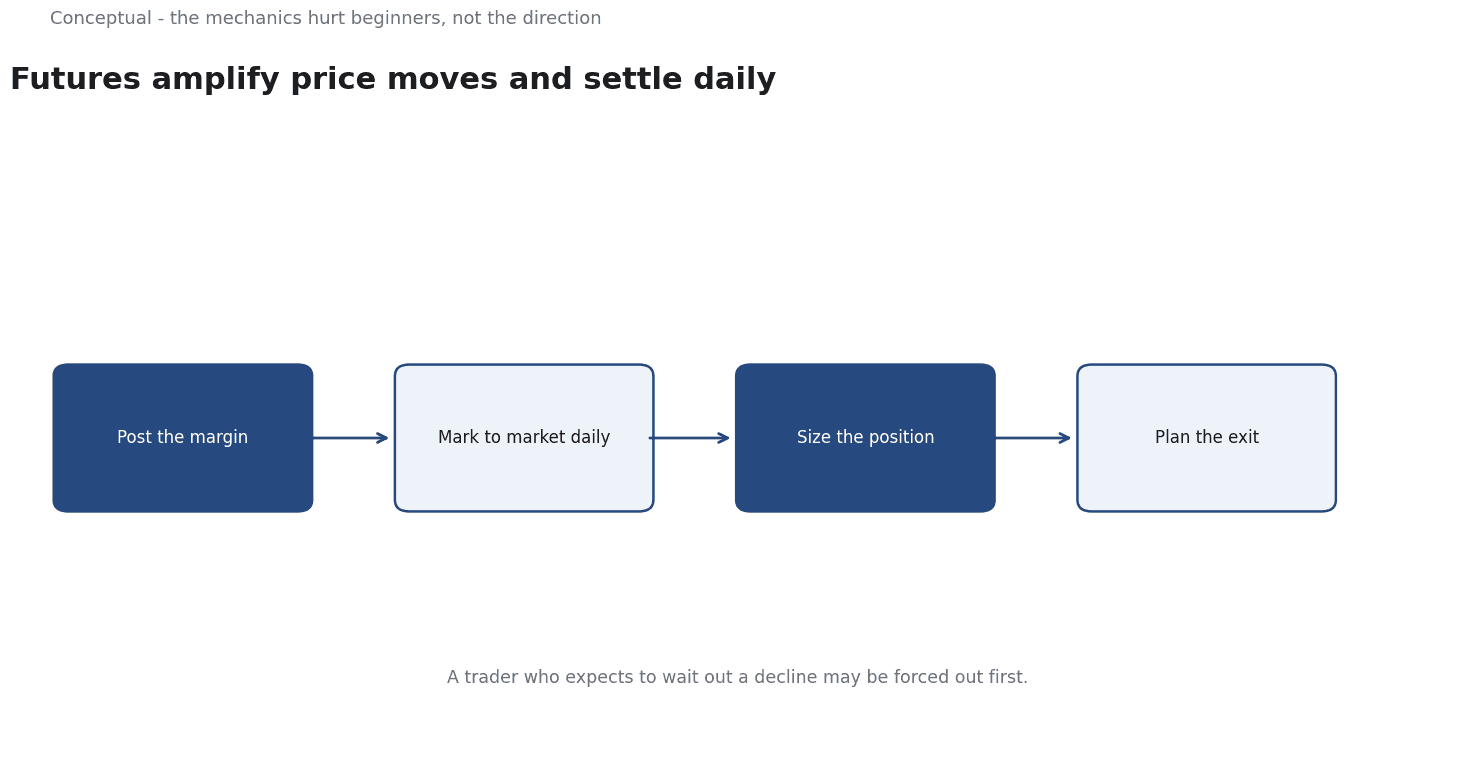
Four mistakes
Confusing notional with capital. A futures contract controls a large notional amount with a small margin deposit, which makes a small price move significant. The leverage is a property of the contract, as Derivatives and Options: Pricing, Greeks, and Hedging Strategies explains for how exposure is created.
Ignoring daily settlement. Gains and losses are settled each day, so a position can generate a margin call before the market turns, which the futures-exchange article describes for clearing and margin.
Treating hedging and speculation as the same. A producer hedging a known future sale has a different risk profile from a trader taking a directional view, which the commodity-markets article explains for price discovery. The same instrument serves both, and the appropriate sizing differs.
Ignoring roll and basis. A futures contract expires; maintaining exposure requires rolling to a later contract, which has a cost when the curve is not flat, as the yield-curve article explains for term structure in a different market.
A worked margin example
The following is hypothetical and illustrative. An index futures contract has a notional value of 100,000 and an initial margin of 5,000, giving 20x leverage.
A 1% adverse move in the index is a 1,000 loss, or 20% of the margin. Three checks decide whether the position is survivable. First, what is the maintenance margin, and how much room before a call, as the futures-exchange article explains for daily settlement? Second, how much of the account is at risk across all positions, which the risk-assessment article treats as exposure aggregation? Third, is there a plan for a adverse move — a stop, a reduction, or additional capital — which the decision-memo article requires for a recorded decision?
Three conclusions follow. The leverage that makes the contract attractive is the same feature that creates the risk, which the derivatives article explains. Position sizing, not market direction, is the primary control, as the portfolio article argues for the target decision preceding the instrument. And the trader should understand the roll cost if the position is held beyond expiry, as the term-structure discussion implies.
The discipline of position sizing
Most serious futures losses are not caused by a wrong view of the market but by a position too large for the account. Because margin is a fraction of notional, a trader can control a exposure many times their capital, and a routine price move becomes a large percentage of the balance, which the derivatives article explains for how leverage is created. The primary control is therefore sizing, decided before entering the trade rather than after the market moves, as the portfolio article treats the target decision as prior to the instrument.
A practical approach is to define risk per trade as a fixed fraction of capital and derive the position size from the distance to the exit point, which the risk-assessment article frames as exposure aggregation. A trader who risks a small, consistent fraction can survive a run of losses, while one who risks a large fraction may be forced out before a correct view plays out, as the daily-settlement mechanics in the futures-exchange article explain. The plan should also account for gaps and limit moves, where the exit may not fill at the expected price, which the financial-crises article treats as a question of market structure under stress.
This discipline also separates hedging from speculation in practice. A producer hedging a known future sale sizes the contract to the exposure, which the commodity-markets article explains for price discovery, while a directional trader sizes to risk tolerance. Confusing the two leads to a hedge that is really a bet or a trade that is too large to hold, which is the mistake the worked example is meant to illustrate.
What futures cannot do
They cannot remove risk; they transfer it to another party and change its shape, which the market-structures article explains for how trades clear. They do not guarantee liquidity in stressed markets, which the financial-crises article treats as a question of market structure. And they are not a substitute for understanding the underlying market, which the commodity-markets article argues for reading the physical balance behind a price.
The counterargument that futures are too dangerous for anyone but professionals is overstated.
They are useful for hedging a known exposure, which the commodity and fixed-income articles describe, provided the mechanics and sizing are understood.
A decision test
- Distinguish hedging from speculation before trading.
- Compute notional exposure relative to account capital, as Derivatives and Options: Pricing, Greeks, and Hedging Strategies requires.
- Understand initial and maintenance margin, as the futures-exchange article explains.
- Plan for daily settlement and a margin call.
- Account for roll cost and basis, as the term-structure discussion advises.
- Size the position as part of a total risk budget, as the portfolio article recommends.
- Record the decision and the exit condition, as the decision-memo article requires.
For the instrument, see Derivatives and Options; for the underlying, see Commodity Markets.
References & Further Reading
- Wikipedia contributors, 2026. Futures exchange - Wikipedia — The structure of futures contracts, exchanges, clearing and margin; a secondary reference.
- FINRA, 2026. Introduction to Investing (SEC Investor.gov) — Regulator explanation of market mechanics, bonds, and investor protection.