GDPR Compliance Costs Explained
Compliance cost is more than a fine. Read where the spend actually goes, a worked estimate, and why the number is jurisdiction-specific.
The cost of GDPR is often reduced to the threat of a fine, which makes it easy to dismiss for a small company. The real cost is operational: changing how data is collected, documented, and deleted, and maintaining those changes as the business grows. A fine is a tail risk; the operating cost is certain.
Direct answer:
GDPR compliance costs sit in data inventory, consent and notice design, rights fulfilment, vendor review, security controls, and documentation.
GDPR Article 33 defines a 72-hour breach-notification duty, and NIST control guidance supports the security side. The boundary: this is educational orientation, not legal advice — the regulation's application depends on role, jurisdiction, and processing, and the authoritative text must be checked with a qualified adviser, as the AI Act article treats current law generally.
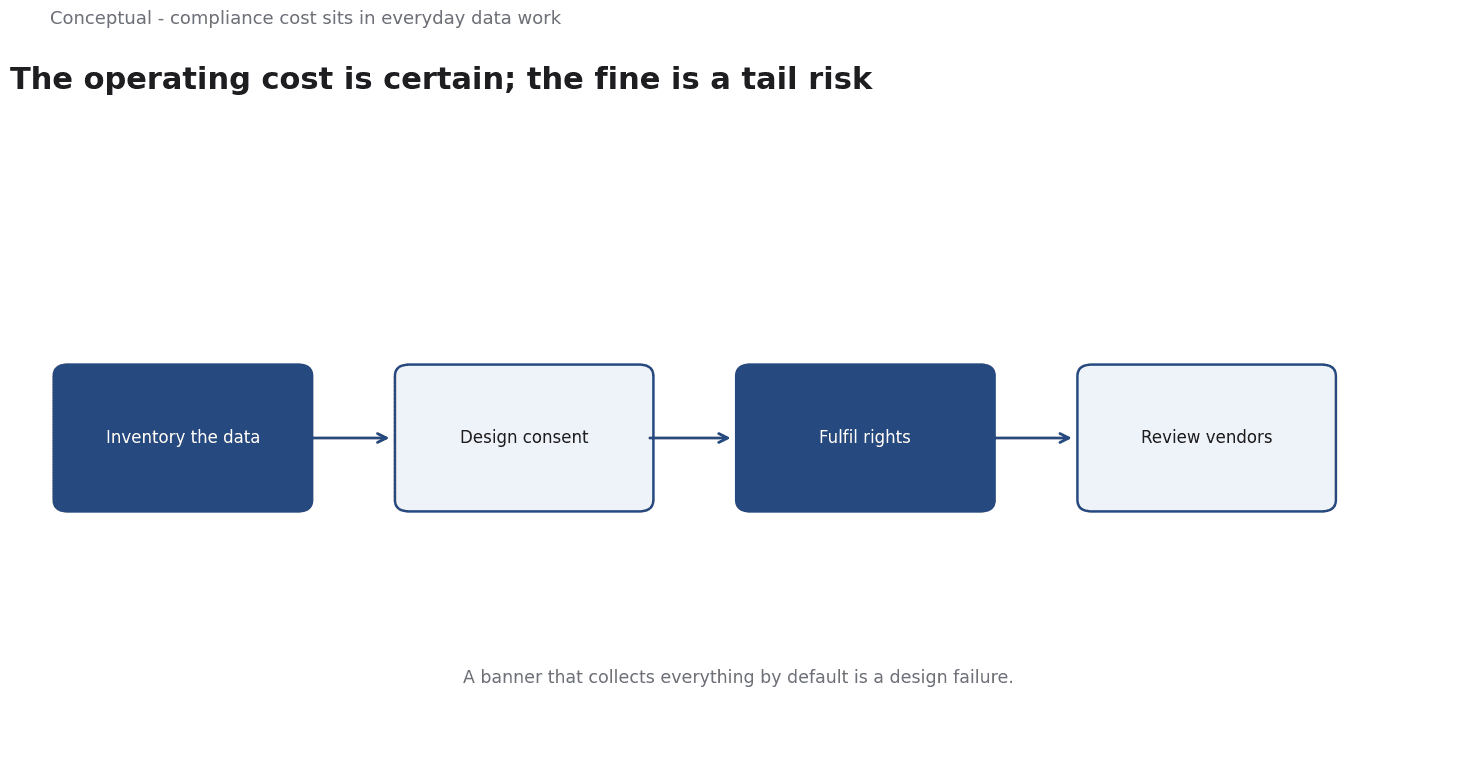
Where the cost sits
Data inventory. You cannot protect or delete what you cannot locate, which the data-governance article argues for a record with an owner. Building the inventory is a one-off project; keeping it current is ongoing work, as the monitoring article treats any maintained record.
Rights fulfilment. Access, correction, and deletion requests require a process that can find a person's data across systems, as Data Privacy: GDPR, CCPA, Data Governance, and Privacy by Design explains for deletion as a system capability. A manual process does not scale, which the workflow-automation article treats as a candidate for bounded automation with a human owner.
Consent and notice. Clear wording and a defined population, which AAPOR's standards require for any survey-based claim and apply here by analogy to how consent is requested.
Vendor review. Processors need assessment and contracts, which the build-versus-buy article treats as diligence for any external dependency. The cost grows with the number of tools, as the martech discussion implies for a proliferating stack.
Security and documentation. Controls such as access management and logging, which NIST's catalogue structures, and records of processing, as the regulation requires. A breach-notification plan should be rehearsed, which the incident-response article recommends for any timed obligation.
A worked estimate
The following is hypothetical and illustrative, in days of internal time rather than currency because rates and scope vary.
A small company doing initial work might spend twenty days on inventory, ten on consent and notice changes, fifteen building a rights-request process, five on vendor terms, ten on security controls, and five on a breach plan — about sixty-five days of one-off effort. Ongoing work might be two days a month for requests and reviews, plus a yearly reassessment, as the monitoring article recommends for a maintained control.
Three checks decide whether this is realistic. First, scope: a company processing only employee data has a different job from one processing customer behaviour at scale, which the data-strategy article treats as a question of what data exists. Second, existing maturity: an organisation with a data inventory and access controls already has much of the work, as Data Privacy: GDPR, CCPA, Data Governance, and Privacy by Design argues for building on artefacts. Third, growth: each new system adds a surface to document, which the technical-debt article treats as complexity that accrues without decision.
What the cost estimate cannot do
It cannot predict a fine, which depends on facts and enforcement, as the regulation's text and a qualified adviser must settle. It cannot be copied across jurisdictions, which the AI Act article treats as date- and place-dependent. And it does not create compliance — spending days on a project is not the same as meeting an obligation, as the evaluation-rubric article argues for measuring outcomes rather than activity.
The counterargument that compliance is too expensive for a small company misses the point that the obligations scale with processing, which the data-governance article treats as a question of what you actually do with data.
A decision test
- Identify what personal data you process and why, as Data Privacy: GDPR, CCPA, Data Governance, and Privacy by Design requires.
- Map where it lives with an owner, as the inventory guidance advises.
- Build a rights-request process with a measured response time.
- Review consent wording and vendor terms, as the privacy and build-versus-buy articles advise.
- Rehearse the 72-hour notification path, as the incident-response article recommends.
- Record decisions and dates, as the decision-memo article requires.
- Check current authoritative text with qualified counsel, which the legal article treats as essential.
For the obligations, see Data Privacy; for the breach process, see Crisis Management.
References & Further Reading
- European Union (GDPR text via gdpr-info.eu), 2016. Art. 33 GDPR – Notification of a personal data breach to the supervisory authority — Article 33: notification of a personal-data breach to the supervisory authority within 72 hours where feasible, and the risk-based exception. Stable HTML rendering of the EU regulation text.
- NIST, 2020. NIST SP 800-53: Security and Privacy Controls for Information Systems and Organizations — The control catalogue behind most compliance programmes.