How Energy Markets Actually Work
Energy markets are not simple supply-and-demand curves. Learn how generation, transmission, and pricing interact, and why electricity prices can be negative or spike without
Energy markets are often discussed as if electricity were a commodity like wheat or oil. It is not. Electricity must be consumed the instant it is produced, cannot be stored cheaply at scale, and travels through a physical network with real constraints. These properties make energy markets unlike most others.
Direct answer:
Energy markets match generation and consumption in real time through a combination of forward contracts, day-ahead auctions, and real-time balancing.
Prices reflect the marginal cost of the last unit needed to meet demand, which means a single expensive power plant can set the price for all generators in the market. Because electricity cannot be stored cheaply and transmission has limits, prices vary by location and time—and can even turn negative when supply exceeds demand.
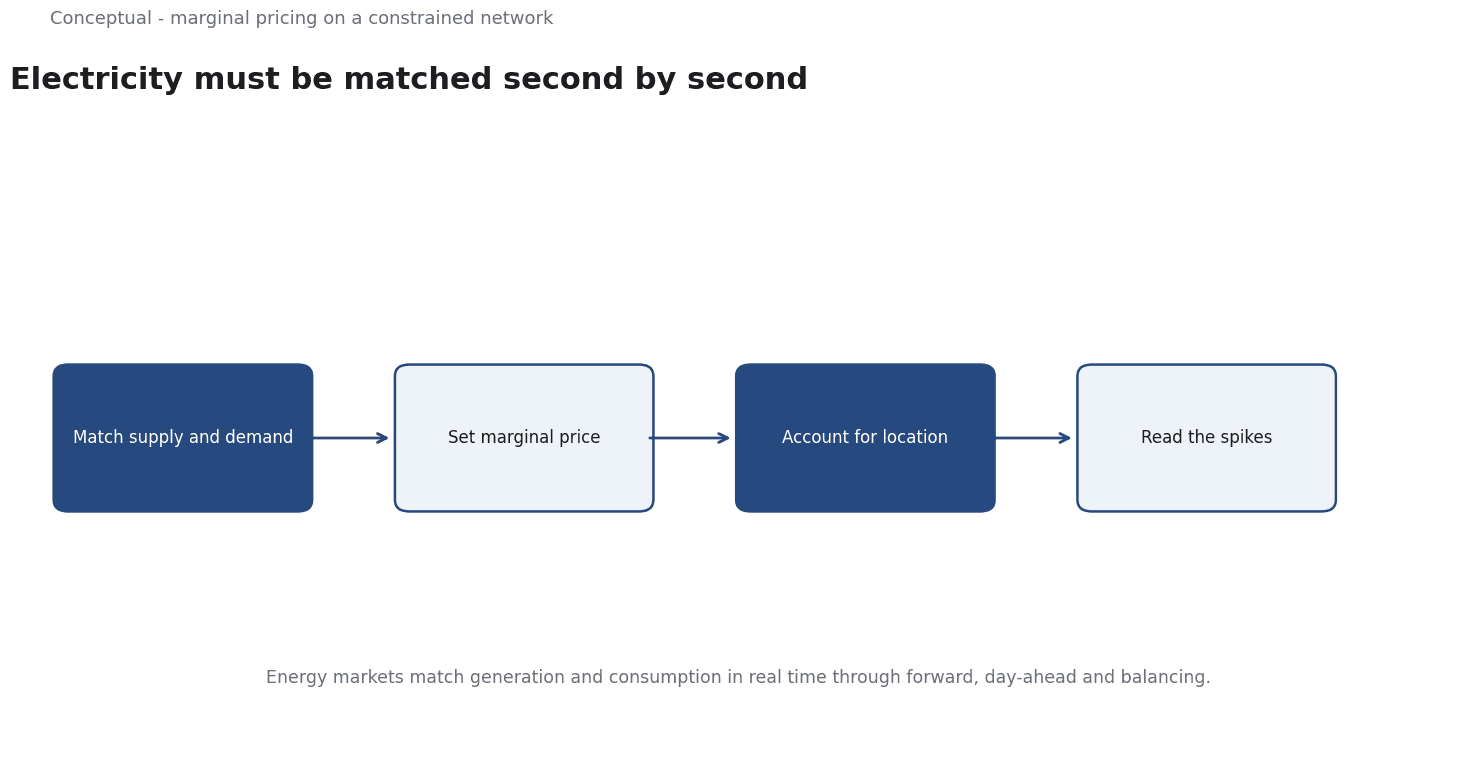
Generation must equal consumption, every second
Unlike a warehouse that can hold unsold goods, the power grid has almost no buffer. If generation exceeds consumption, frequency rises and equipment can be damaged. If consumption exceeds generation, frequency falls and the grid risks blackouts. System operators balance the two continuously, seconds by seconds.
This means energy markets operate on multiple timescales:
- Forward markets: contracts for delivery months or years ahead, used by utilities and large consumers to hedge price risk.
- Day-ahead markets: auctions where generators bid to supply each hour of the next day, and buyers bid to purchase. The market clears at the price where supply meets demand.
- Real-time or balancing markets: adjustments made in the hours and minutes before delivery, as forecasts change and plants trip offline.
The day-ahead price is the most visible benchmark, but it is not the price everyone pays. Large consumers may have long-term contracts, and real-time prices can diverge sharply from day-ahead when weather, outages, or demand surprises occur.
Marginal pricing sets the market clearing price
Most energy markets use marginal pricing: the last (most expensive) generator needed to meet demand sets the price for all accepted generators. If cheap wind and nuclear can meet 80 % of demand, but a gas-fired peaker plant is needed for the remaining 20 %, the gas plant's fuel and operating cost determines the market price for every megawatt-hour sold.
This has two consequences that surprise people outside the industry. First, all generators receive the same price, even those with much lower costs. Wind and solar earn the gas-set price when gas is marginal, which can create windfall profits in periods of high gas prices. Second, when gas prices spike, electricity prices rise across the board—even for power generated by zero-marginal-cost sources.
Marginal pricing is designed to incentivize efficient dispatch: the cheapest plants run first, expensive plants run only when needed. But it means the market price can be driven by a single input—natural gas—that has little to do with most of the electricity actually produced.
Location and time matter
Electricity is difficult to move. Transmission lines have physical limits, and power loses energy over distance. When congestion prevents cheap power from reaching a high-demand area, local prices rise. This creates locational price differences: the same megawatt-hour can cost $20 in one region and $200 in another at the same time.
Time matters because demand follows daily and seasonal patterns. Air conditioning load in summer afternoons, heating load in winter evenings, and industrial shifts create predictable peaks. Peaker plants—expensive, fast-starting generators—run only during these peaks, and their cost sets the marginal price at those times.
Renewables add a new variable. Wind and solar output depends on weather, not on market signals. When the wind blows strongly at night with low demand, wholesale prices can fall to zero or below. Generators may pay consumers to take power rather than shut down turbines, because restarting is costly.
Negative prices and price spikes
Negative wholesale prices occur when supply exceeds demand and generators cannot easily shut down. This happens during periods of high renewable output and low demand, or when inflexible nuclear or coal plants must keep running. Negative prices are a signal: they tell the system to consume more, store more, or generate less.
Price spikes occur at the opposite extreme: demand exceeds available supply, often because of extreme weather, plant outages, or fuel shortages. During spikes, prices can rise hundreds or thousands of percent above normal. Consumers on variable-rate plans feel this immediately; those on fixed tariffs do not, though their utilities may pass costs through later.
Both extremes are normal features of energy markets, not failures. They reflect the physical reality that electricity must be balanced in real time with limited storage.
Storage is changing the math
Batteries and pumped hydro can absorb excess generation and discharge it during peaks, smoothing price volatility. But grid-scale storage remains expensive relative to the energy it shifts. Until storage is cheap enough to arbitrage daily price differences at scale, energy markets will continue to experience sharp intraday and seasonal price movements.
For the related question of how data center electricity demand fits into these markets, see Data Centre Electricity: Reading the IEA Forecasts Without Fooling Yourself.
A worked example
The following is hypothetical and illustrative. A regional operator plans a winter evening when wind is high and demand is modest, and walks through what the market would do. Check one, marginal pricing: a cheap wind fleet covers most demand but a gas peaker is needed at the margin, so under the marginal rule the gas plant's fuel cost sets the price for every generator, as the cited EIA data describes. Check two, location and time: a transmission constraint separates the windy region from a high-demand area, so the same megawatt-hour clears at different local prices, and the evening peak is when the peaker runs. Check three, the negative-price possibility: if wind output rises further while demand stays low and inflexible plants cannot shut down, the clearing price can fall below zero, a signal to consume, store, or generate less. The bounded outcome is a price path the operator can anticipate - cheap or negative overnight, higher at the peak - not a forecast of any real market, since the rules are market design rather than physics and storage remains too costly to erase the swing.
A counterargument
A reasonable critic would separate the physics from the rules. Balancing generation and consumption in real time, transmission limits, and the cost of storage are physical facts; marginal pricing, locational prices, and negative prices are outcomes of market design, not forced by physics. The article concedes that 'most' markets use marginal pricing, which is an admission that other designs exist, yet it writes as if the gas-set price and the resulting windfall profits were natural laws. Its sources do not settle this: EIA and IEA are data portals describing generation, prices, and capacity, not analyses of why prices behave this way, and the FinOps Foundation entry concerns cloud cost rather than electricity markets. The claim that storage 'is changing the math' is equally asserted rather than measured.
The physical constraints are real, but they underdetermine the pricing institutions the article treats as inevitable.
References & Further Reading
- U.S. Energy Information Administration, 2026. Electricity data — Primary electricity generation and price data.
- International Energy Agency, 2026. Electricity — Global electricity demand and capacity outlook.
- FinOps Foundation, 2026. The FinOps Foundation — The cross-industry framework for managing cloud cost as an engineering discipline.