Getting Started with Customer Retention
Retention starts with a measured cohort and a reason customers leave. Read the starting steps, a worked example, and why points are not a strategy.
Retention is often treated as a programme — a loyalty scheme, a win-back email, a discount — before it is treated as a measurement. The starting question is which customers stay, which leave, and why, which the retention article frames as an economic choice, as the unit-economics article treats churn as a direct input to margin. A programme without that measurement optimises the wrong behaviour.
Direct answer:
Start by defining a cohort, measuring repeat behaviour, finding where customers leave, and testing one intervention against a baseline.
The demand-generation overview explains the stages a customer passes through, and AAPOR's standards apply to any survey used to learn why. The boundary: a high retention number can reflect a loyal few, which the cohort view reveals, and no programme guarantees loyalty, as the publication standard states for commercial claims, as the loyalty article warns about points that change behaviour only briefly.
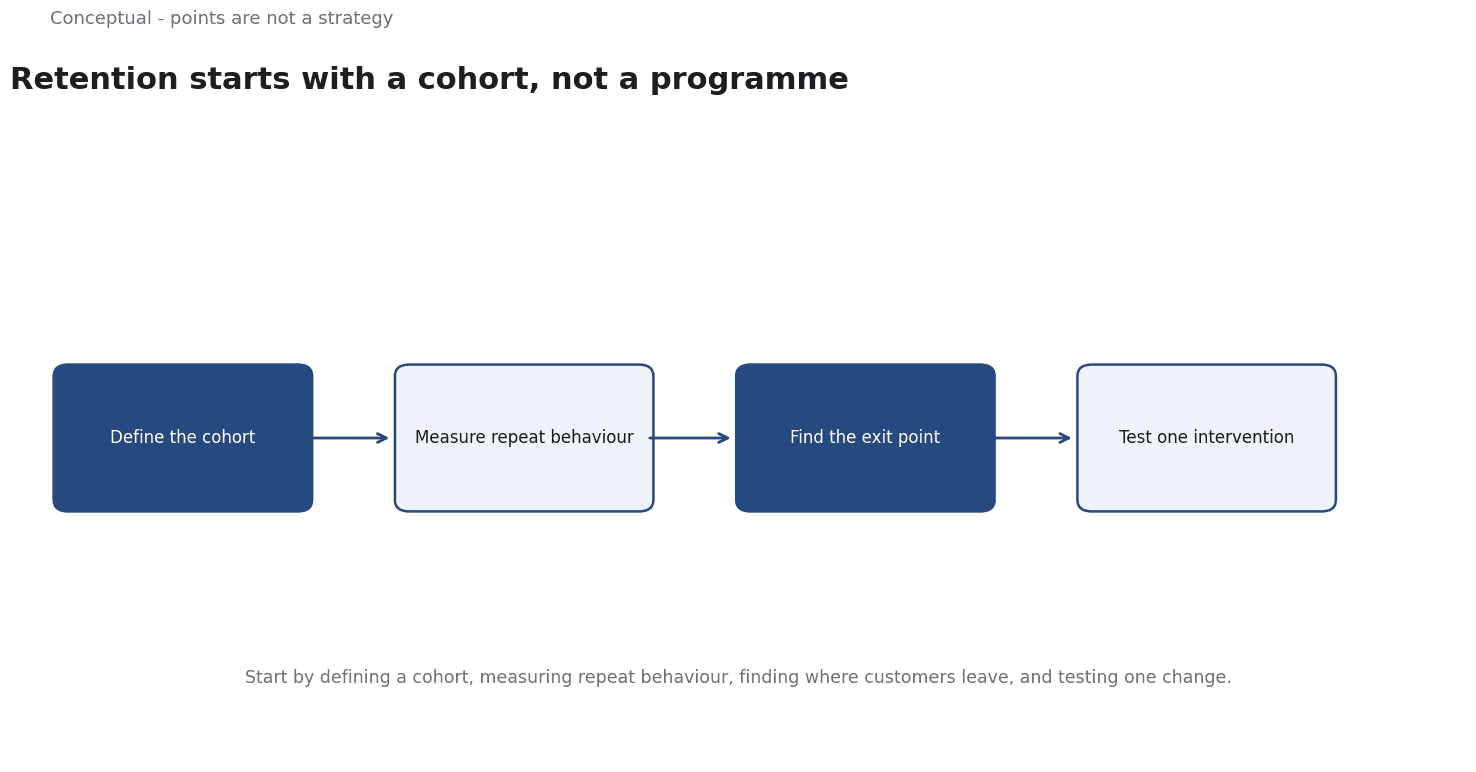
The starting steps
Define the cohort. A retention rate without a cohort and a window is hard to interpret, which the retention-analytics article requires for comparable measures, as the data-governance article requires for a dated definition. Group customers by the period they joined, as Customer Retention: Keeping Customers Is Cheaper Than Acquiring Them advises.
Measure repeat behaviour. The signal is what customers do, not what they say they will do, which the NPS article warns about for intentions, as the product-analytics article recommends for observed behaviour. Define the repeat event before looking at the data, as the evaluation-rubric article requires for concrete criteria.
Find the leak. Where in the journey do customers stop, which the funnel article treats as a stage measure, as the churn-reduction article advises for diagnosis? A problem at onboarding is different from one at renewal, as the customer-journey article advises for evidence from real people.
Test one intervention. Start with a bounded change, as the integration blueprint recommends for experiments, with a baseline and a comparison, as the geo-experiment guidance advises, as the decision-memo article requires for a recorded judgement.
Three consequences follow. The measurement comes before the programme, which the retention-analytics article argues for. A survey can explain a reason but should be neutrally worded, as AAPOR's standards require, as the survey-design article advises. And the result should be reviewed after a change, as the monitoring article treats as a trigger.
A worked example
The following is hypothetical and illustrative. A subscription business sees 8% monthly churn overall.
Three checks decide where to start. First, split by cohort, as How to Evaluate Retention Analytics requires: are customers who joined in a recent month leaving faster than earlier cohorts, which the customer-retention article advises for grouping? Second, locate the leak, as the funnel article advises, using onboarding completion as a stage measure, as the churn-reduction article recommends for diagnosis. Third, if a survey is used to learn why, is the wording neutral and the sample defined, as AAPOR's standards require, as the survey-design article advises?
Three conclusions follow. The overall 8% may hide a worse recent cohort, which the split reveals. The leak may sit at onboarding rather than renewal, which the stage measure shows, as the customer-journey article advises. And the intervention should be tested against a baseline, as the geo-experiment guidance recommends, as the decision-memo article requires for a recorded judgement.
What a retention start cannot do
It cannot fix a weak product, which the value-proposition article treats as the prior decision, as the advocacy article argues for genuine value. It cannot make a survey substitute for behaviour, which the NPS article warns about for stated intentions, as the product-analytics article recommends for observed signals. And it does not guarantee loyalty, which the loyalty article treats points as unable to ensure, as the publication standard forbids guaranteed outcomes.
The counterargument that loyalty points are the obvious first step is fair for habits that already exist and misplaced as a starting move, which the loyalty article treats as a change in behaviour, as the worked example shows for diagnosis first.
A decision test
- Define a cohort and a window, as How to Evaluate Retention Analytics requires.
- Measure the repeat event as behaviour, as the product-analytics article advises.
- Locate the leak by stage, as the funnel and churn articles recommend.
- Word any survey neutrally, as AAPOR's standards require.
- Test one intervention against a baseline, as the geo-experiment guidance advises.
- Check that the economics still work, as the unit-economics article requires.
- Record the decision and review after change, as the decision-memo article requires.
For the economics, see Customer Retention; for the measurement, see Evaluating Retention Analytics.
References & Further Reading
- Wikipedia contributors, 2026. Demand generation - Wikipedia — An overview of demand generation as a marketing discipline distinct from lead generation; secondary reference used with the lead-generation entry.
- American Association for Public Opinion Research, 2026. AAPOR — The professional association for public opinion and survey research; its standards and resources underpin the survey-design discussion.