Getting Started with Martech Stacks
A marketing stack should start from a decision, not a category list. Read a build sequence, a worked example, and why tool count is a poor goal.
A martech stack is a set of systems for measuring and acting on customer behaviour. Teams often begin by listing categories — analytics, email, CRM, personalisation — and buying one of each, which produces a stack before the decisions are defined. The result is a collection of tools with overlapping data and unclear ownership, as the martech-evaluation article warns about dependencies nobody can explain.
Direct answer:
Build the stack around one decision at a time, starting with the measurement needed to make it.
The demand-generation overview explains the stages a stack supports, and AAPOR's standards apply to any survey data collected. The boundary: tools do not create a strategy, which the value-proposition article treats as the prior decision, and no structure guarantees a result, as the publication standard states for marketing claims.
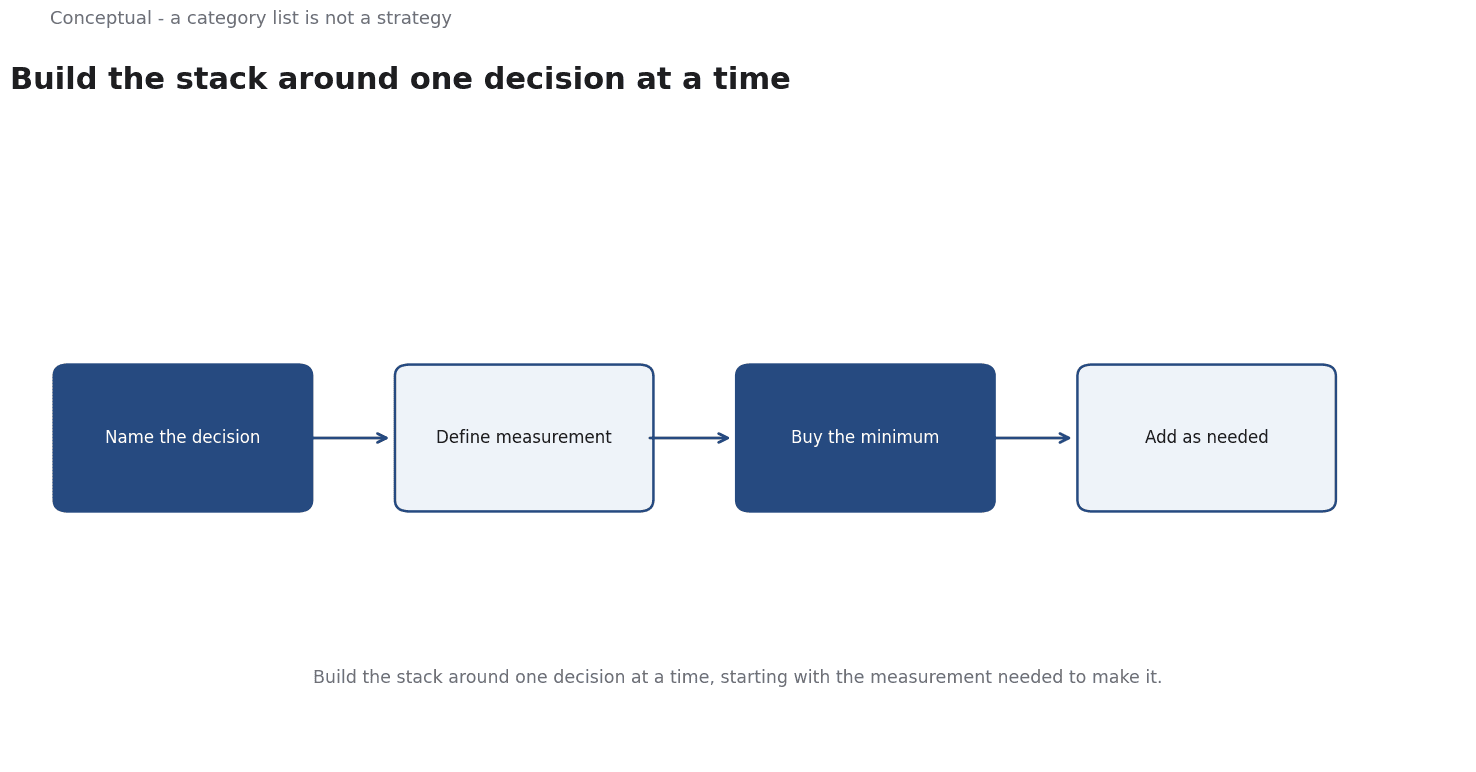
The sequence
Name the decision. What should the organisation decide differently — where to spend, what to send, which lead to call? The funnel article treats transitions as the unit of measurement, as the decision-memo article requires a specific question.
Define the data. What is needed to make that decision, and where does it come from, which the data-governance article requires as provenance, as the data-quality article requires a quality bar? A tool that needs data you do not have is a purchase without a use.
Start with measurement. Before automation, establish a baseline, as the evaluation-rubric article requires for concrete evidence, as the geo-experiment guidance recommends for comparisons. A stack that cannot measure a decision cannot improve it, which the marketing-dashboard article argues for metrics tied to action.
Add one capability. Choose the smallest tool that changes the decision, as the build-versus-buy article advises for software capabilities, as the AI-integration blueprint recommends for bounded experiments.
Assign an owner. Every tool needs someone accountable for its data and its use, which the governance checklist requires, as the monitoring article treats maintenance as a change trigger.
Three consequences follow. The stack grows deliberately, which the martech-evaluation article advises for audit, as the technical-debt article warns about accumulated complexity. Each addition has a test, which the evaluation article requires. And the result is a system that serves decisions, which the dashboard article treats as the point of measurement.
A worked example
The following is hypothetical and illustrative. A team wants to decide which campaigns to fund.
Three checks decide the first purchase. First, what data exists, which the data-governance article requires? If campaign spend and qualified conversions are already recorded, analytics may not be needed. Second, what is the baseline, as the evaluation-rubric article requires? If there is no baseline cost per qualified opportunity, measurement comes before optimisation, as the budget article advises. Third, what is the smallest change, as the build-versus-buy article asks? A dashboard with a defined metric may be enough before any automation, as the dashboard article suggests, as the decision-memo article requires for a recorded judgement.
Why starting small is a strategic choice
A stack that grows around decisions has a property that a purchased category list does not: every tool can be defended. When a new vendor appears, the question is not whether it is impressive but which decision it would change and what evidence would show that it did, which the martech-evaluation article treats as the core of an audit, as the evaluation-rubric article requires for concrete criteria. This discipline is harder at the start, when the decisions are not yet clear, and easier later, when each addition has a precedent.
There is also a cost to premature scale.
A team that waits one quarter to establish a baseline often moves faster afterwards, as the AI-integration blueprint recommends for bounded experiments, as the decision-memo article requires for recorded reasoning.
Finally, the stack should reflect the organisation's capacity to operate it, which the build-versus-buy article treats as the deciding factor for software capabilities. A small team with one clear decision and two well-understood tools is in a better position than a large stack nobody owns, as the martech-evaluation article advises for ownership, as the governance checklist requires an accountable owner.
What a starting stack cannot do
It cannot create demand, which the demand-generation article treats as preference built before capture. It cannot fix a weak offer, as the value-proposition article argues for the buyer's evaluation. And it does not remove the need for governance, which the data-governance article requires for any relied-upon record, as the privacy article makes obligations jurisdiction-specific.
The counterargument that a well-known stack is safe is partly true about support and misses the fit question, which the build-versus-buy article treats as a decision about capability, as the worked example shows.
A decision test
- Name one decision the stack must support, as the funnel article advises.
- Check the data exists and has an owner, as the governance article requires.
- Establish a baseline, as the evaluation-rubric article requires.
- Add one capability with a test, as the integration blueprint recommends.
- Avoid buying categories without a use, as the martech-evaluation article warns.
- Keep privacy obligations current, as the privacy article advises.
- Record the decision and review on change, as the decision-memo article requires.
For the audit method, see How to Evaluate Martech Stacks; for the measurement, see Marketing Dashboards.
References & Further Reading
- Wikipedia contributors, 2026. Demand generation - Wikipedia — An overview of demand generation as a marketing discipline distinct from lead generation; secondary reference used with the lead-generation entry.
- American Association for Public Opinion Research, 2026. AAPOR — The professional association for public opinion and survey research; its standards and resources underpin the survey-design discussion.