Getting Started with Positioning Ladders
A bounded introduction to positioning ladders that maps competitive position and value proposition to a dimension choice, a tradeoff, and a fit test.
Positioning ladders are often drawn as a ranking of brands, but teams rarely agree on what the ladder measures. The real problem is choosing the dimension on which a product should be compared, because that choice determines which rung is even available. Without that decision, positioning work becomes a list of adjectives that competitors can copy.
Direct answer: A positioning ladder ranks alternatives in a buyer's mind on a specific dimension, so getting started means choosing that dimension before claiming a rung. Porter's strategy argument holds that a valuable position requires a distinct set of activities and explicit tradeoffs, while a value proposition states the benefit a customer receives. The practical move is to define the dimension, name the tradeoff, and check that the activities support the claim.
Delta: This article adds a starting framework beyond the sources: it maps a chosen dimension to a defensible rung and a fit check, with claim status explicit.
The mechanism
Porter's argument in "What Is Strategy?" is that strategy is not operational effectiveness but the choice of a unique and valuable position supported by a different set of activities. The practical consequence for positioning is that a rung on a ladder is not a slogan; it is the visible result of a system of choices.
A firm that claims a position while running the same activities as its competitors has a claim without a position.
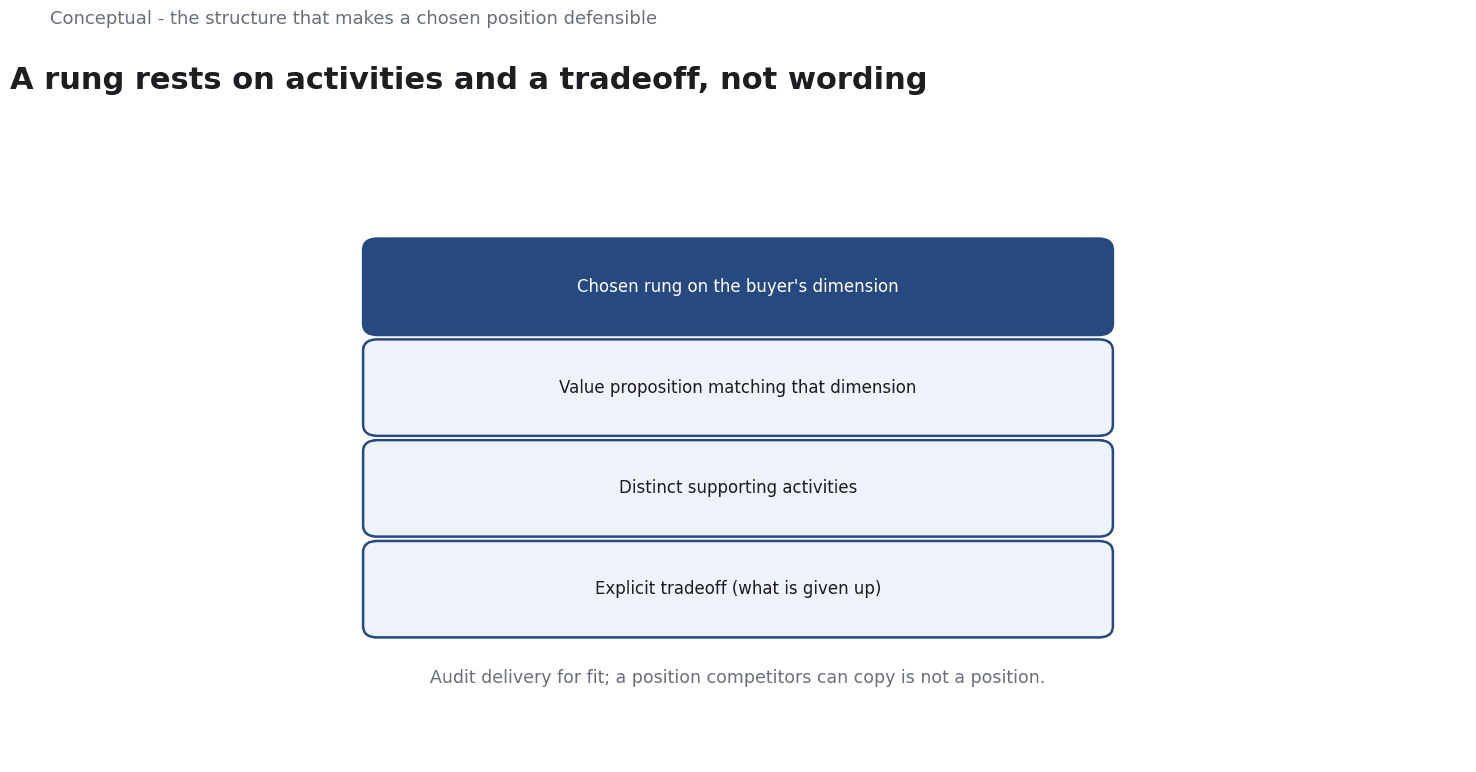
The value proposition entry describes the bundle of benefits a product promises to deliver to customers and the reason they should choose it over alternatives. The mechanism connecting the two is the buyer's comparison. A ladder exists in the mind of a buyer who is choosing among options, and the dimension of that comparison is what makes one option preferable. If the promised benefit matches the dimension the buyer uses, the value proposition and the position reinforce each other; if not, the message misses the decision.
Choosing a dimension is therefore the first substantive step. A team can compete on price, speed, reliability, status, or specialization, but each dimension implies a different set of activities and excludes some customers. Porter's point about tradeoffs is the constraint that makes the ladder meaningful: to occupy a rung, a firm must give up something. A claim of being both the cheapest and the most customized usually signals that no position has been chosen.
Fit is the test that follows. The activities, messages, and delivery must be consistent with the rung claimed. The practical consequence is that a positioning exercise is not finished when the wording is agreed; it is finished when the operating choices line up with the wording. A value proposition that promises responsiveness cannot sit on top of a slow approval process without the gap eventually showing up in customer experience.
A worked example
The following is hypothetical and illustrative. A hypothetical business software firm wants a clearer position against larger incumbents. Three checks shape the choice. First, it interviews buyers and finds the dimension they actually use is implementation speed, not feature breadth. Second, it names a tradeoff: it will not match the incumbents' customization, and it says so explicitly. Third, it audits its delivery process and confirms that a fixed-scope onboarding supports the promised speed. The outcome: the firm claims the fast-implementation rung, drops deals that require heavy customization, and sees its value proposition match what the operation can deliver.
Evidence status
| Claim | Status | Source | Verified | Recheck when |
|---|---|---|---|---|
| Strategy requires a distinct position and explicit tradeoffs | source-reported | Porter (1996) | 2026-11-18 | Strategy theory is revised |
| A value proposition states the benefits that justify customer choice | source-reported | Value proposition (Wikipedia) | 2026-11-18 | Marketing terminology shifts |
| A defensible rung depends on activity fit, not wording alone | inferred | Derived from the sources | 2026-11-18 | New positioning research appears |
The first two rows restate arguments from the two sources and are reasonably stable, though both fields revise their language over time. The third row is an inference from Porter's emphasis on activities and fit. It guides the starting decision rather than reporting a measured effect, and it should be revisited if positioning research changes.
What it cannot do
A positioning ladder cannot create a category by force of wording. The ranking exists in the mind of a buyer comparing alternatives, and a firm cannot simply declare itself the top rung. The practical consequence is that positioning begins with observation of how buyers compare, not with a creative workshop. A claim that no buyer uses as a comparison criterion is decoration, not a position.
The hidden cost is the tradeoff. Choosing a rung means giving up other customers, and those lost opportunities are real. A firm that specializes in speed will lose buyers who want maximum customization, and a price position excludes those who equate price with quality. The practical consequence is that the decision must be owned at the top, because it reallocates resources rather than just changing a message. Teams that treat positioning as copywriting will discover the cost later in lost deals.
Porter's distinction makes this clear: a position that competitors can copy with the same activities is not a position. The practical consequence is that a value proposition promising a distinct benefit must be backed by a different delivery system. Without that fit, the claim is quickly exposed by customer experience, and the ladder becomes a slogan.
Boundaries matter. Dimensions shift as categories mature, and a ladder that was useful early may collapse when buyers learn to compare on a new attribute. Crowded categories leave few open rungs, and regulated categories constrain what can be claimed at all. The practical consequence is that the choice of dimension needs evidence, not just ambition. A firm should not build a position on an attribute buyers do not use.
Finally, the claim needs review. Competitors move, activities drift, and a position that once fit can erode without anyone deciding to change it. The practical consequence is that the fit audit is a recurring check, not a one-time launch task. A positioning ladder is maintained, not merely announced.
Counterargument: the counterargument that positioning is just marketing language is fair for message drafting and incomplete for strategy, where the chosen rung dictates which activities the firm must maintain.
A decision test
- Identify the buyers and the alternatives they compare.
- Name the dimension they actually use to choose.
- Check which rungs are already occupied.
- Choose a rung that fits the firm's activities.
- State the tradeoff the position requires.
- Write a value proposition that matches the dimension and the tradeoff.
- Audit delivery for fit, then review the claim periodically.
These steps put the buyer before the message: dimension first, then rung, then the activities that make the rung credible. The tradeoff is the checkpoint that separates a position from a wish list. Review the fit on a schedule, because a ladder that once matched the operation can drift as the firm and its category change.
For further reading, see Voice of customer: turning feedback into decisions.
References & Further Reading
- Michael E. Porter, 1996. What Is Strategy? — The differentiation-versus-cost argument behind competitive-advantage analysis.
- Wikipedia contributors, 2026. Value proposition - Wikipedia — The value a product promises to a buyer.