Getting Started with Remote Work
Remote work is done outside a traditional office using technology. Learn the source definitions, the coordination practices that make it work, and where the model breaks.
Remote work is commonly treated as a change of location, when the harder change is how coordination happens. The Wikipedia entry defines telecommuting as work done away from a traditional office through technology, and the Google re:Work material treats team effectiveness as a design problem. The real problem for a team going remote is that informal office signals disappear, and nothing automatically replaces them.
Direct answer: Remote work is work performed outside a traditional office with the help of technology. The sources define that arrangement and describe practices that support effective teams, including clear goals and psychological safety. The practical answer is that remote work succeeds or fails on explicit coordination, not on where people sit.
Delta: This article adds a claim-status table and a coordination decision test beyond the sources: it maps each remote-work practice to a team decision, with claim status explicit.
The mechanism
The Wikipedia entry on remote work, also indexed as telecommuting, describes working outside a conventional workplace by using communication technology. The defining feature is not the physical setting but the substitution of technology for the informal channels an office provides. In an office, context is absorbed through overheard conversations, quick clarifications, and shared physical artifacts. Remove the office and those channels vanish, so the burden shifts to deliberate communication.
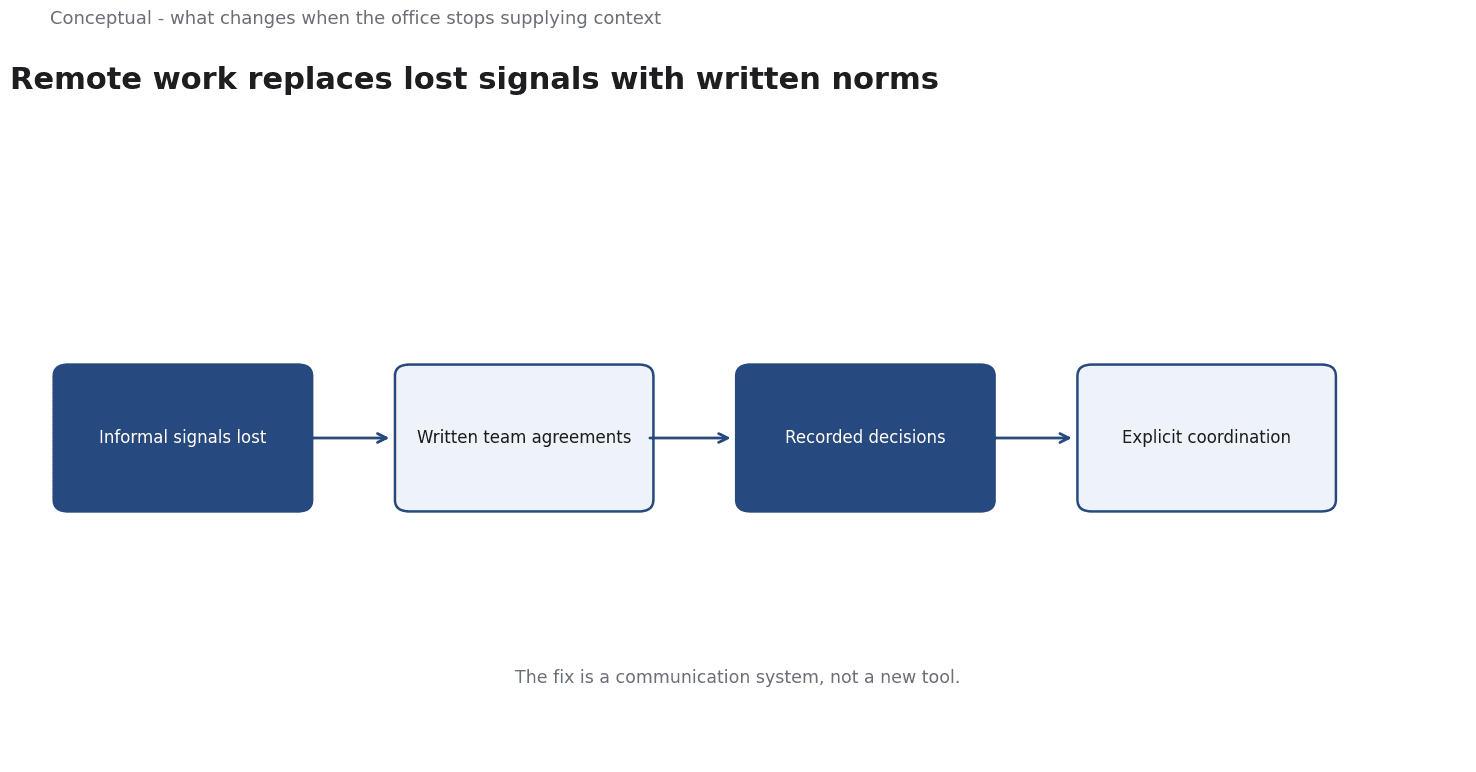
The Google re:Work material frames team effectiveness around measurable practices. It emphasizes psychological safety, the sense that a person can speak up without penalty, and it connects that to clear goals and to how teams make decisions. The practical consequence is a set of team agreements: which channel carries which message, how decisions are recorded, what done means, and how a handoff works. These agreements are not administrative overhead; they are the replacement for the lost office signals.
A team that relies on proximity cannot simply transport its habits into a distributed setting. A question that would have been answered by turning around a desk becomes a message that may sit unread for hours. The cost of ambiguity rises, and so does the cost of a decision that was made in a private channel and never shared.
The mechanism that keeps remote work functional is a shift from implicit to explicit: write the norm, record the decision, and make the goal visible to everyone who must act on it.
The output of these practices is a coordination system, not a productivity tool. The sources describe the concept of remote work and a set of team effectiveness practices; they do not prescribe a particular chat tool or a meeting cadence. Those are local choices. The discipline is to keep them explicit and reviewable, so a new member can learn the system and a reviewer can see how a decision was reached.
A worked example
The following is hypothetical and illustrative. A product team moves from one office to three cities and keeps its old habits: decisions are made in hallway conversations and specs live in one person's notes. Three checks frame the review. First, does a written charter name which channel carries decisions, so decisions are not lost in chat? Second, are team goals written where every member can read them and tied to a visible owner? Third, is there a decision log that records the reason behind each choice? The team finds that half its decisions exist only in the memories of two people. It adopts a written charter and a short decision log. The outcome is a communication fix, not a new tool purchase. The numbers are hypothetical; the verification method is the contribution.
Evidence status
| Claim | Status | Source | Verified | Recheck when |
|---|---|---|---|---|
| Remote work means working away from a traditional office through technology | source-reported | Wikipedia, Remote work | 2026-11-18 | Definition revised |
| Team practices such as psychological safety and clear goals support effectiveness | source-reported | Google re:Work | 2026-11-18 | Guidance updated |
| Written norms replace the informal signals of a shared office | inferred | Derived from the sources | 2026-11-18 | Team composition changes |
The first two rows report what the sources state: a definition of remote work and a set of team effectiveness practices. The third is an inference about what replaces lost office signals, because neither source prescribes written norms for every team. Recheck the definition when the Wikipedia entry changes and the inferred claim when the team's size or distribution changes.
What it cannot do
Remote work is not a productivity guarantee. The sources define an arrangement and describe supportive practices; they do not claim that distributed teams outperform co-located ones. A team can be remote and still be uncoordinated. Treating the location change as the whole intervention ignores the coordination work that the change creates. The honest claim is that remote work removes a set of implicit signals and requires deliberate replacements, not that it raises output by itself.
The hidden cost is the writing. Every norm, decision, and handoff that used to happen in person now has to be recorded somewhere a teammate can find it. That writing takes time and skill, and it decays: a charter that no one updates becomes misleading. Teams often underestimate this cost and budget for software instead. The expense is paid in attention and in the discipline to keep shared records current, which is a recurring obligation rather than a one-time setup.
Remote members can be left out of informal advancement conversations even while the team calls itself distributed. A related failure is isolation: without deliberate connection, individuals work in silos and stop challenging one another. Both failures are coordination problems that the written norms must address explicitly, because they do not announce themselves in a dashboard.
There is a boundary around the model. Some work depends on physical presence, shared equipment, or hands-on mentorship, and does not transfer cleanly to a remote setting. The sources describe remote work and team practices in general terms; they do not sort roles by suitability. A blanket remote policy applied to every function will strain tasks that need a bench, a lab, or a whiteboard. The judgement of which work can be remote is local and must be made role by role.
Because norms drift, the arrangement needs periodic review. A charter written for five people may fail at twenty, and a decision log that stops being updated stops being trusted. Each practice should carry a recheck condition, and the team should revisit which channel carries which message when membership changes. Without that review, a remote team slowly accumulates unwritten exceptions and the explicit system it relied on erodes.
The counterargument that remote work is fair for knowledge tasks done independently is incomplete when the work depends on fast, informal exchange that a shared office supplied for free.
A decision test
- State which tasks can be done away from a shared office.
- Write a channel charter naming where decisions and requests live.
- Set goals with a visible owner and a written definition of done.
- Keep a decision log that records the reason behind each choice.
- Check that remote members have the same access to information as local ones.
- Review the charter and log when team size or membership changes.
- Record each norm with a recheck condition and an owner.
A remote setup is only as sound as the agreements that hold it together. The test turns a location change into a set of reviewable decisions, so a new member can join and a reviewer can trace how the team coordinates. For further reading, see Decision Memos That Survive Review.
References & Further Reading
- Wikipedia contributors, 2026. Remote work - Wikipedia — Distributed and asynchronous ways of working.
- Google, 2026. Google re:Work — A large company's published people practices, including hiring and growth frameworks.