How Companies Use Predictive Analytics to Make Business Decisions
Predictive analytics pays off when a prediction is tied to a decision, a threshold, and a measured outcome. Read the mechanism and the four failure modes.
A model that predicts customer churn is not a decision. Nothing changes until someone decides what to do with the prediction, at what threshold, and with what budget. The gap between a good model and a good outcome is a design problem that most technical discussions skip.
Direct answer:
Predictive analytics creates value when a predicted quantity is linked to an action, an intervention cost, and a measured result.
Kuhn and Johnson's Feature Engineering and Selection is useful here because it treats features in the context of the modelling problem, while scikit-learn's cross-validation guidance supplies the validation discipline. The boundary: a model estimates a probability under the conditions it was trained on; it does not guarantee that an intervention will work, and it does not establish causation.
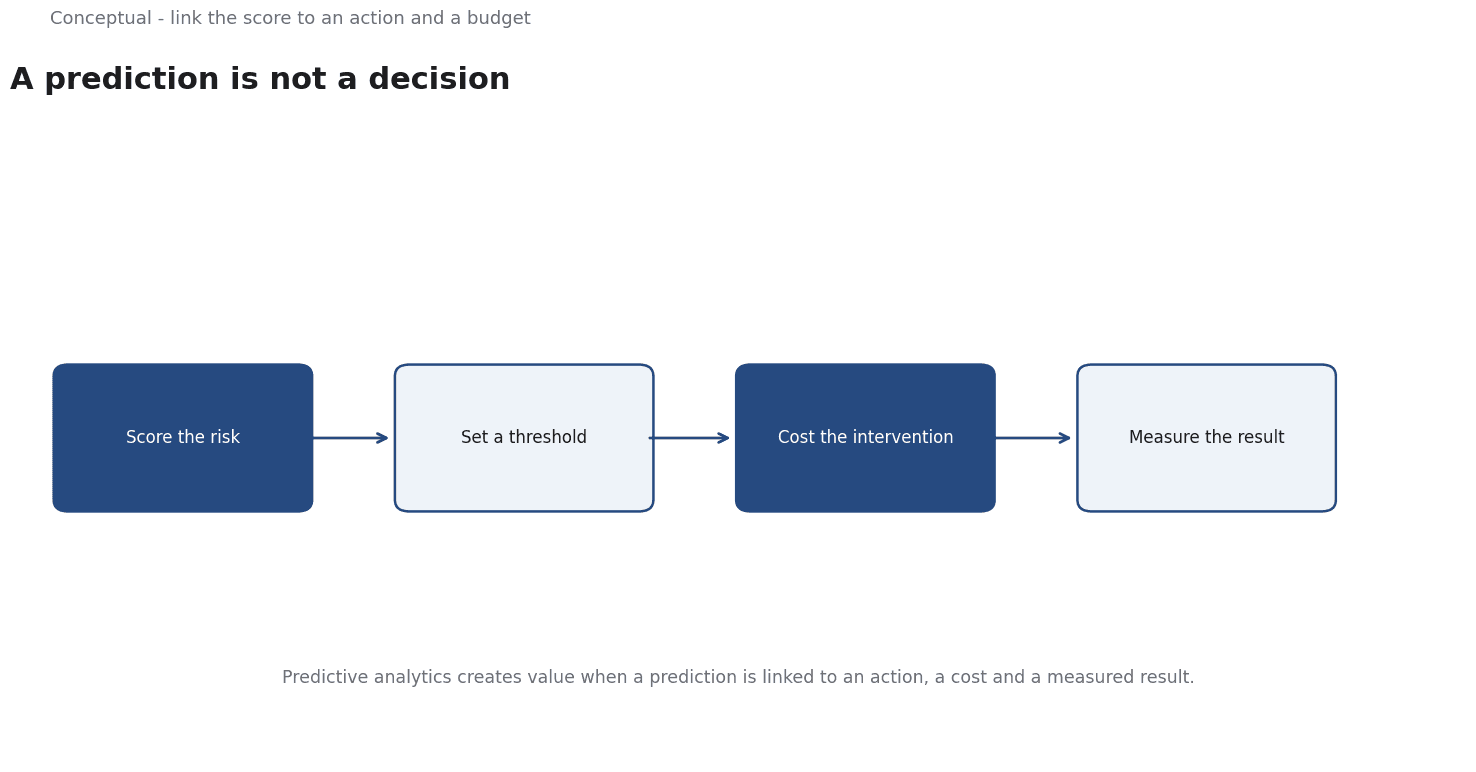
The decision chain
Five links connect a model to a business result:
- The question — what decision is being made, by whom, and when?
- The prediction — what quantity is estimated, for which population, at what point in time?
- The threshold — at what score do we act, given the cost of acting and the cost of missing?
- The intervention — what actually happens to the flagged case?
- The measurement — did the intervention change the outcome relative to a control?
Links three to five are where the value is created or destroyed.
scikit-learn's guidance on leakage is relevant at the prediction step: "data leakage occurs when information that would not be available at prediction time is used when building the model". In a business context, a common form is using a field recorded after the decision was made — a cancellation reason that only exists because the customer already left. A model built on that field will look excellent and be useless.
A worked example of a churn intervention
The following numbers are hypothetical and illustrative.
Suppose a subscription business has 100,000 customers, an annual churn rate of 12% (12,000 customers), and a retention offer that costs 30 per customer and succeeds in 25% of cases, saving 200 of contribution per retained customer. A churn model identifies a group of 10,000 customers containing 4,000 of the 12,000 who will churn — 40% recall within the flagged group.
Evaluate the intervention on the flagged group:
- Cost of offers: 10,000 × 30 = 300,000.
- Churners in the group: 4,000. Retained: 25% × 4,000 = 1,000.
- Contribution saved: 1,000 × 200 = 200,000.
- Net result: −100,000. The campaign loses money.
Now change the threshold so the business contacts only the top 3,000 scores, which contain 2,400 churners — an 80% precision group:
- Cost: 3,000 × 30 = 90,000.
- Retained: 25% × 2,400 = 600.
- Contribution saved: 600 × 200 = 120,000.
- Net result: +30,000.
The model did not change. Only the threshold and the intervention scope changed, and the decision flipped from a loss to a gain.
Three lessons follow:
- Accuracy is the wrong objective. The relevant quantity is expected value at a threshold, which combines precision, intervention cost, and saved contribution.
- The threshold is a business decision, not a modelling default. It should be recomputed when any input changes.
- The 25% success rate is an assumption, not a fact. If the offer works less well on model-identified customers — perhaps they were going to stay anyway — the calculation collapses. That is why a holdout group is required.
The holdout is the fifth link in the chain. Without a group that receives no offer, the business cannot know whether the 25% was caused by the intervention or would have happened anyway.
Validation is part of the economics
Cross-validation estimates how a model performs on unseen data. scikit-learn documents several schemes and warns that the choice must match the data structure: for time-ordered data, an expanding-window split such as TimeSeriesSplit preserves chronology, while a random split lets the model learn from the future.
Two business-specific rules follow:
Score at the decision time. If the model is used every Monday, the validation folds must simulate what was known each Monday. A model trained on data that includes Friday's outcome is not available on Monday.
Evaluate by segment. Aggregate precision can hide the fact that the model performs poorly on the highest-value customers. A decision that is profitable on average can be a large loss on the segment that matters most.
Kuhn and Johnson's emphasis on feature engineering in context is the methodological counterpart: a feature's value depends on the prediction target and the moment of prediction, not on its statistical appeal in isolation.
Where the value actually appears
Three places in an organisation tend to produce measurable returns, and they differ in how the decision chain closes.
Triage — ranking a queue so that limited human attention goes to the highest-value cases. Fraud review, support escalation, and clinical review fit this pattern. The gain comes from the ordering, not from automation, so the evaluation question is whether the queue is better than the previous rule.
Timing — predicting when to act. Maintenance, replenishment, and re-engagement campaigns are timing problems. The gain is in avoiding an earlier or later action, and the baseline is the existing schedule.
Personalisation — choosing among a small set of known options for a specific case. The gain depends on having distinct options whose value differs by person; a model that cannot change the action cannot create value.
In each case the same discipline applies: define the action, the counterfactual, and the metric before building the model. An organisation that cannot say which of these three it is doing will often build a technically impressive model that nobody acts on.
The counterargument is that some models are exploratory — built to understand a problem rather than to drive an immediate decision. That is legitimate, but it should be labelled as research rather than presented as a business case.
What predictive analytics cannot do
Three limitations change the conclusion.
Prediction is not causation. A model can identify customers who look likely to churn without identifying why they churn. An intervention based on a correlated feature may have no effect, or a harmful one. Causal claims require a design — an experiment or a credible quasi-experiment — that a predictive model does not provide.
The world changes. A model trained before a price change or a competitor's entry describes a population that no longer exists. Predictive systems need monitoring of both input distributions and realised outcomes, with a defined retraining trigger.
Optimisation can be gamed. If customers learn that complaining triggers a discount, the model's "churn risk" feature becomes a target. A feedback loop of this kind is a business problem that no amount of model tuning fixes.
The counterargument to a rigorous decision chain — that the business just needs a good model — is a category error.
A good model is a component; a good decision system includes the threshold, the intervention, and the measurement.
A decision test
- Name the decision and the person who will make it before building the model.
- State the prediction target and the prediction time, and audit every feature against that time.
- Compute expected value at several thresholds, not accuracy at one.
- Define the intervention and its cost, including the cost of a false positive.
- Reserve a holdout to measure whether the intervention caused the outcome.
- Validate with a scheme that matches the data's structure and the decision cadence.
- Monitor inputs and outcomes with an explicit retraining trigger.
For the validation and monitoring discipline, see Model Monitoring; for the operational handoff, see MLOps.
References & Further Reading
- Max Kuhn and Kjell Johnson, 2019. Feature Engineering and Selection: A Practical Approach for Predictive Models — The closest thing to a reference text on feature construction, resampling, and selection.
- scikit-learn developers, 2026. Cross-validation: evaluating estimator performance (scikit-learn) — Time-series splits and the validation design that keeps a backtest honest.
- Aswath Damodaran, 2026. Damodaran Online: Home Page for Aswath Damodaran — Publicly maintained datasets for industry averages, WACC, and valuation.