How Marketplace Business Models Actually Work
Marketplaces connect buyers and sellers without owning inventory. Learn how they make money, solve the chicken-and-egg problem, and where the economics break down.
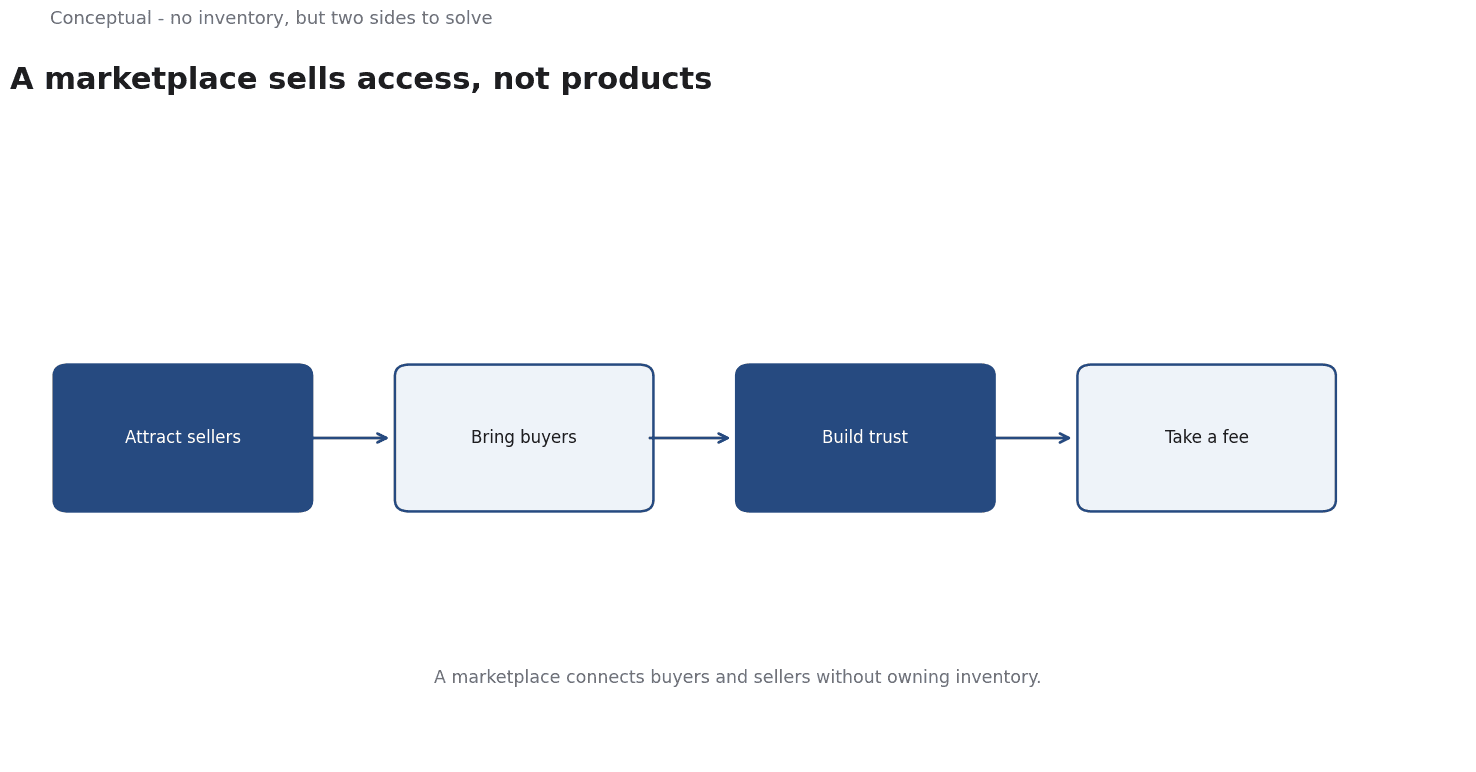
Marketplaces do not sell products. They sell access to other sellers.
Direct answer:
A marketplace business model connects buyers and sellers on a platform, facilitating transactions without owning inventory.
Marketplaces earn revenue through commissions, listing fees, subscriptions, or advertising. The core challenge is the chicken-and-egg problem: buyers will not join without sellers, and sellers will not join without buyers. Success depends on liquidity, trust, and unit economics—factors that often determine whether a marketplace thrives or fails.
What defines a marketplace
A marketplace has three characteristics:
- Two (or more) sides: buyers and sellers (or demand and supply).
- No inventory ownership: the marketplace does not buy and resell goods.
- Transaction facilitation: the platform enables discovery, payment, and often fulfillment or delivery.
Examples range from global platforms to niche local services. What unites them is that value comes from the network, not from the products the platform itself sells.
How marketplaces make money
Commission or take rate. A percentage of each transaction. This aligns marketplace revenue with seller success but can discourage high-volume sellers if too high.
Listing fees. Charged to sellers for posting items, regardless of sale. Predictable revenue but can deter casual sellers.
Subscriptions. Monthly fees for sellers or buyers, often bundled with features or lower commissions.
Advertising. Sellers pay for prominent placement. Common in large marketplaces where attention is scarce.
Value-added services. Payments processing, shipping, insurance, or fulfillment offered to sellers for a fee.
The mix matters. A marketplace that relies too heavily on one revenue stream is vulnerable to pricing pressure or seller migration.
The chicken-and-egg problem
A marketplace is useless without both sides. Buyers leave if there is nothing to buy. Sellers leave if there are no buyers. Solving this requires deliberate strategy:
- Start narrow. Focus on one category, geography, or niche where critical mass is achievable.
- Subsidize one side. Pay sellers to list, or pay buyers to purchase, until organic activity takes over.
- Seed supply yourself. The marketplace operator may initially act as a seller to demonstrate activity.
- Leverage existing demand. Bring buyers from another channel before asking sellers to join.
Liquidity—buyers finding what they want and sellers finding buyers—is the metric that matters. Without it, nothing else works.
Trust and safety
Marketplaces intermediate transactions between strangers. Trust is the product:
- Verification: confirming seller identity and legitimacy.
- Reviews and ratings: giving buyers information about sellers and products.
- Dispute resolution: handling returns, refunds, and disagreements.
- Payments: holding funds in escrow until delivery is confirmed.
Trust failures—fraud, counterfeit goods, unsafe transactions—destroy marketplaces faster than competition does.
Unit economics and the path to profitability
Many marketplaces lose money for years while building network effects. But network effects are not a guarantee of profitability. Key metrics:
- Take rate vs cost to acquire. Does the commission cover acquisition and operating costs?
- Repeat transactions. Do buyers return, or is every sale a new acquisition effort?
- Seller retention. Do sellers stay, or do they leave once they build direct relationships with buyers?
- Marketplace leakage. Do buyers and sellers transact outside the platform to avoid fees?
Leakage is a particular threat: successful connections often move off-platform, cutting the marketplace out of future revenue.
When marketplaces work and when they do not
Marketplaces work when:
- Transactions are frequent and standardized.
- Trust and verification add real value.
- The platform reduces search and transaction costs.
- Network effects create defensibility.
Marketplaces struggle when:
- Supply is highly differentiated and sellers want brand control.
- Transactions are infrequent (buying a house happens once).
- Disintermediation is easy (buyers and sellers can connect directly).
- Regulation treats the marketplace as liable for seller behavior.
For the related question of how businesses build sustainable advantages, see How Companies Build Competitive Advantages and how unit economics determine viability, see Understanding Unit Economics: CAC, LTV, Churn, and Contribution Margin.
Working backwards from the customer
Bryar and Carr's account of the working-backwards method describes starting with the customer and reasoning back to what the business must do. Applied to a marketplace, that habit reframes the chicken-and-egg problem. Instead of asking how to attract sellers and buyers in the abstract, the team asks what a specific buyer needs to complete one successful transaction, then works back to the smallest set of sellers who can satisfy it.
This keeps the focus on the unit of value: a completed transaction in which the buyer found what they wanted and the seller was paid. Subsidies, seeding supply, and verification all become tools for delivering that unit rather than ends in themselves. A marketplace that subsidizes one side without a clear picture of the end experience risks buying activity that never converts into repeat use.
Working backwards also exposes where trust is actually required. If buyers in a niche already trust the sellers, heavy verification adds cost without value. If they do not, verification is the product. The method forces the team to name the assumption rather than copying another platform's playbook.
Why 'we are a marketplace' is not a strategy
Porter's argument about strategy distinguishes a defensible position from mere operational activity. A marketplace is a business form, not a position. Two marketplaces in the same category can differ sharply in which side they serve, which transactions they own, and what makes them hard to replace.
Porter's differentiation-versus-cost lens is useful here. A marketplace can compete on cost, by lowering search and transaction costs more efficiently than alternatives, or on differentiation, by offering trust, curation, or a specialized experience that generic platforms cannot match.
The implication for defensibility follows from the earlier section on leakage. If buyers and sellers can reconnect directly, the marketplace has no durable advantage unless it provides something worth keeping: reliable discovery, escrow, dispute resolution, or a reputation system. Network effects are not automatic; they are the result of a position the platform has chosen and reinforced.
A worked example
The following is hypothetical and illustrative. Imagine a platform for freelance designers considering entry into a crowded category. Rather than launching broadly, the team applies working backwards: it defines one buyer who needs a specific deliverable quickly, and identifies the small set of designers who can provide it reliably. That narrow scope makes the chicken-and-egg problem tractable.
The team then borrows the activation logic that product-led growth writing describes. It measures whether a new buyer reaches a first completed transaction, not whether they registered, and whether a new seller receives a first paid order. Those activation events become the signal that liquidity is real rather than assumed. Subsidies are tied to reaching them, then removed once organic activity takes over.
Porter's lens clarifies the choice the team is making. It is not competing on the breadth of a general marketplace; it is differentiating through curation and trust for one narrow job. Whether that position holds depends on the questions from the unit-economics section: do buyers return, do sellers stay, and can the platform keep enough of the relationship to earn a commission on the next transaction?
A counterargument
A reasonable critic would say the definition is drawn too tightly to hold. The article insists a marketplace 'does not buy and resell goods,' then recommends seeding supply by acting as a seller and lists fulfillment among its value-added services - both of which blur the no-inventory boundary it opened with. The Porter section is also an analogy rather than an argument: trade-offs require activities to be incompatible, but the defences it names - discovery, escrow, dispute resolution, reputation - are services any competitor can add, with nothing shown to be mutually exclusive. Bryar and Carr's working-backwards method is a product discipline, not evidence that a marketplace position is defensible, and the worked example is explicitly hypothetical.
The piece is strongest as a checklist of failure modes; its claim to a general theory of marketplace strategy rests on frameworks borrowed from other contexts.
References & Further Reading
- Michael E. Porter, 1996. What Is Strategy? — The differentiation-versus-cost argument behind competitive-advantage analysis.
- Colin Bryar and Bill Carr, 2019. Amazon Company News — Primary company material on how the working-backwards method is applied.
- Wes Bush, 2026. Product-Led Growth — The activation and engagement loop definition that PLG teams actually use.