How Recommendation Systems Influence What We Buy
Recommendations do not only reflect taste; they shape it. Read the mechanisms and the evidence about choice, attention, and bias.
A recommendation system is often described as a mirror of preferences, and the metaphor is partly true — it is trained on behaviour — and partly misleading, because the output changes the behaviour that trains it. The system is not merely finding what you would have chosen; it is participating in the choice.
Direct answer:
Recommenders influence purchasing through three mechanisms: they change the choice set by deciding what is visible, they shape attention through ranking and position, and they create feedback loops in which early exposure becomes evidence of preference.
The consequence is that a system optimised purely for immediate clicks can narrow what a person sees and reinforce their past behaviour, and the effect is measurable at the level of the marketplace, not only the individual session.
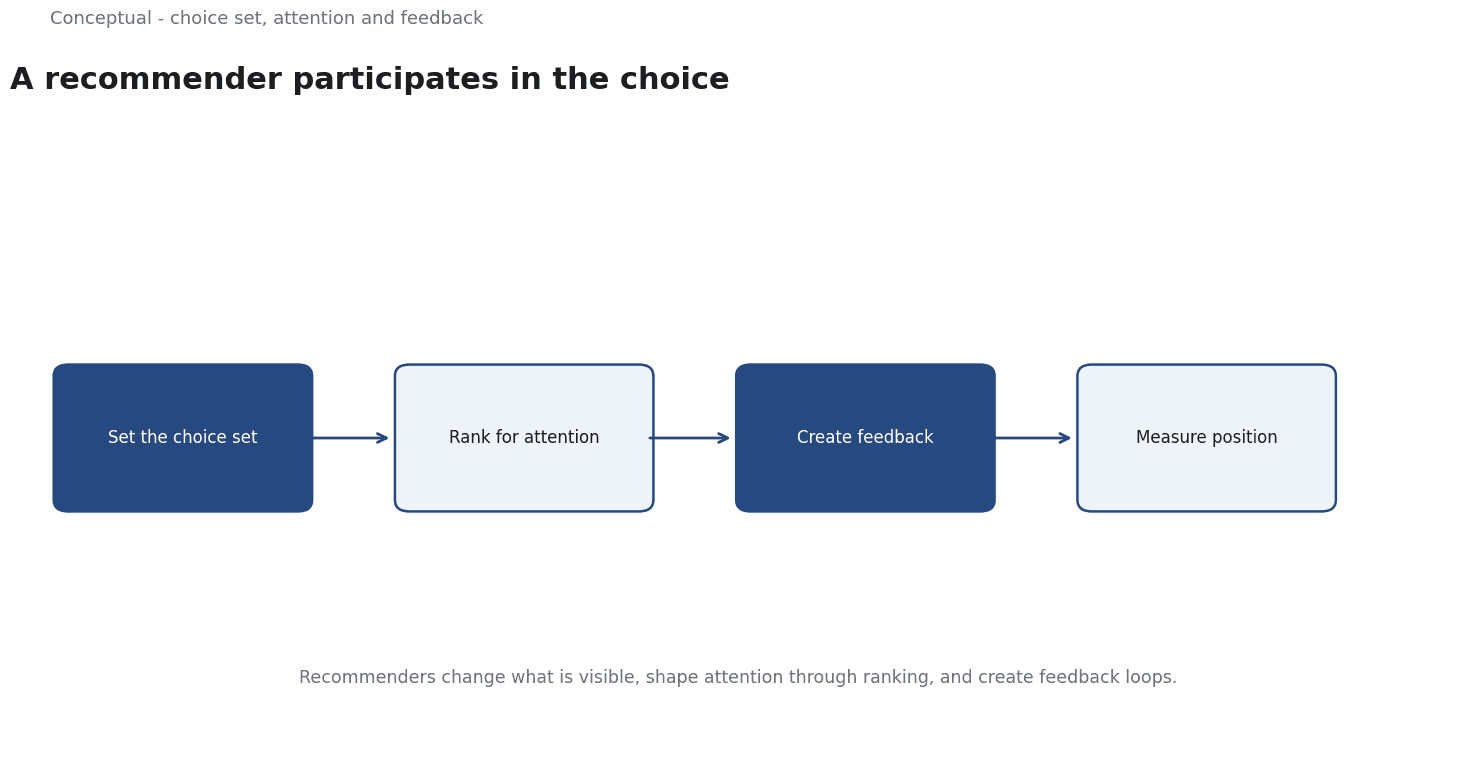
The choice set is the first lever
A purchase happens among the options a person actually encounters. A recommender decides that set, which means it has power before any persuasion occurs.
This is the same mechanism that makes distribution strategically important: a customer cannot choose an item that was never shown to them, and no amount of product quality fixes absence from the consideration set. A recommender is distribution at the level of the individual session, and its most consequential decision is which items get the chance to be considered.
The effect compounds. An item that receives exposure accumulates interactions, which makes it more likely to be recommended again. An item that never receives exposure never accumulates the evidence needed to be recommended. The system therefore has a systematic bias toward its own past, which is why new items are structurally disadvantaged and why a deliberate exploration policy is a design requirement rather than an experiment.
Attention and position
Ranking is an attention mechanism. Users scan from the top, so a higher position attracts clicks independent of relevance, and the recommendation system's ordering therefore shapes what gets examined and what gets bought.
This has two consequences that are easy to conflate. The first is measurement: a click on a top-ranked item is partly a click caused by position, and any model evaluation that does not log and adjust for position will misattribute it. The second is behavioural: if the system learns from those clicks without correcting for the position that produced them, it will reinforce its own ordering, and the feedback loop will make the ranking increasingly self-confirming.
The research on ranking and click-through reflects this. DeepFM's work is motivated by the need to learn "sophisticated feature interactions behind user behaviours" in order to maximise CTR, which is a genuine advance in modelling the signal — and it also illustrates why CTR alone is an incomplete objective for a system that shapes attention.
Feedback loops and the narrowing of choice
The most consequential effect is temporal. A user clicks an item, the system recommends similar items, the user clicks those, and the system's estimate of their preferences becomes more confident. The loop is a sensible use of evidence and it has a side effect: the range of items the user is shown can narrow over time, which reduces the chance of discovering a different preference.
This is the recommenders-as-filter-bubble argument in its precise form. It does not require any intent to manipulate; it follows from optimising immediate engagement on a system that also controls exposure. The practical response is to include diversity and exploration as explicit objectives, and to measure longer-term outcomes — catalogue coverage, discovery of new categories, retained usage — rather than only the click metrics that drive the loop.
The psychological layer
Kahneman's work on judgment and decision-making under uncertainty explains why users are susceptible to the choice architecture a recommender creates. The Nobel lecture is the primary source for the underlying research, and the relevant idea here is that preferences are often constructed in the moment rather than retrieved from a stable store.
If preferences are partly constructed, then the ordering and framing of options genuinely change what people choose, and the recommendation system is not discovering a fixed truth about the user. It is participating in the construction. That is a descriptive claim, not a moral one — but it changes what a responsible system should measure.
For designers, the implication is practical: the system's effect on outcomes should be evaluated with the same care as its predictions. A/B tests with a horizon long enough to capture repeat behaviour are the right instrument, and the metrics should include whether users discovered anything outside their established pattern.
What a responsible system measures
- Exposure diversity: the share of the catalogue that receives impressions, not just clicks.
- New-item discovery: whether new items can escape the cold start in a reasonable time.
- Long-term satisfaction: repeat usage and retained value, not only immediate engagement.
- Segmented effects: whether some users are experiencing a narrowing of choice that others are not.
- Counterfactual outcomes: what would have happened under a different ranking, measured with a controlled experiment rather than inferred from the model.
None of these is achieved by changing the model architecture alone. They are objectives and constraints on the system, and they belong in the ranking configuration and the evaluation design.
For the modelling side, see Deep Learning for Recommendations; for the experiment design, see A/B Testing Recommendation Systems.
A worked example
The following is hypothetical and illustrative. A retailer's recommendation panel is optimised for click-through, and a developer suspects it is narrowing what customers see. Three checks follow from the argument. First, does the click log record ranking position, so a click on a top slot can be separated from a click caused by relevance - the DeepFM result implies that a better CTR predictor is not evidence that exposure changes choice? Second, does the system track exposure diversity and new-item discovery - the share of the catalogue receiving impressions, not clicks - so a cold-start item can escape the loop described in collaborative filtering? Third, is the A/B test long enough to capture repeat behaviour and scored on retained usage and segmented effects, rather than a same-session click lift, consistent with the constructed-preference point from Kahneman's lecture?
If all three checks pass, the team can attribute a change to exposure rather than inference. The outcome is a decision about what to measure, not a claim about any measured marketplace.
A counterargument
A reasonable critic can argue that the article's central claim outruns its sources. DeepFM is presented as evidence that ranking shapes attention, but the cited work models feature interactions to predict click-through rate; a better CTR model is not itself evidence that exposure changes what people buy. Kahneman's lecture supports the idea that preferences are constructed in the moment, yet that generality does not establish that a recommender specifically narrows choice rather than merely reveals it. The feedback-loop story is plausible, but the references are about modelling and judgment, not measured marketplace-level effects.
The framing is incomplete where it treats a design concern as a demonstrated outcome.
References & Further Reading
- Steffen Rendle et al., 2012. Neural Graph Collaborative Filtering — Graph collaborative filtering that propagates over the user-item graph.
- Ruibin Gai et al., 2017. DeepFM: A Factorization-Machine based Neural Network for CTR Prediction — Feature interactions in click-through-rate models, the shared core of search and recommendation ranking.
- Daniel Kahneman, 2002. Daniel Kahneman Prize Lecture - NobelPrize.org — The primary source for the bias taxonomy used in behavioural finance.