How the Internet Actually Works: From DNS to Global Connectivity
The internet is not a cloud. It is a network of networks, held together by DNS, IP routing, undersea cables, and exchange points. Learn how a request actually travels.
The internet is often drawn as a cloud, which hides how it actually works. It is not a single thing. It is a network of networks, held together by agreements, cables, and protocols that most users never see.
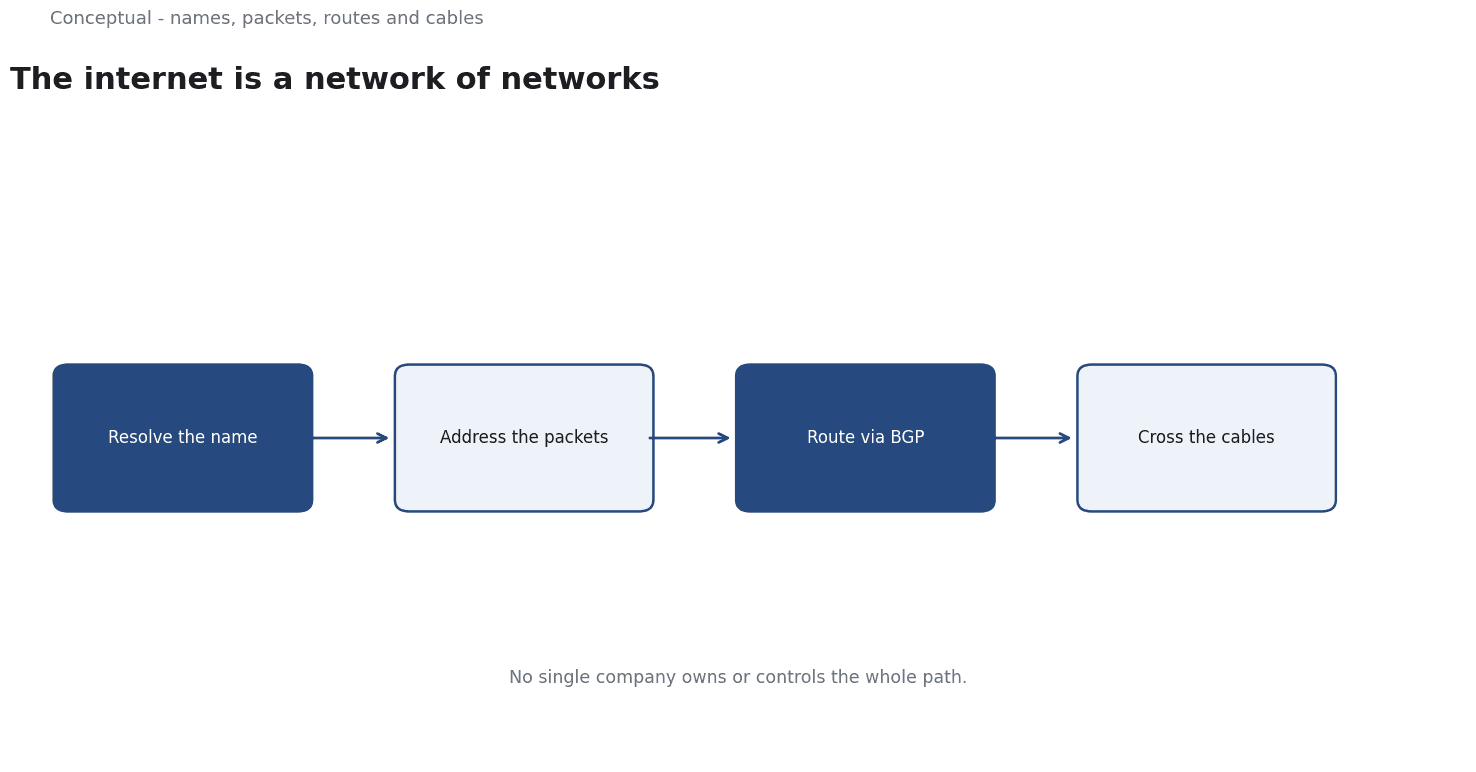
Direct answer: The internet works by breaking data into packets, addressing them with IP, routing them across interconnected networks via BGP, and translating human-readable names into addresses via DNS. A request from your browser to a server on another continent typically crosses multiple autonomous systems, undersea cables, and exchange points before a response comes back.
No single company owns or controls the whole path.
Names become addresses: DNS
Before a browser can connect to a server, it needs an IP address. DNS (Domain Name System) is the distributed directory that maps names like example.com to addresses like 93.184.216.34.
DNS is hierarchical. The root zone knows where top-level domains like .com live. TLD servers know where authoritative servers for individual domains live. Resolvers—operated by ISPs, public DNS providers, or your network—walk this hierarchy, cache answers, and return them to your device.
That is why DNS is often the first thing checked when a site is unreachable.
Packets and IP: the best-effort delivery
Once a name is resolved, data is broken into packets. Each packet carries a source and destination IP address. IP (Internet Protocol) is best-effort: it tries to deliver packets, but does not guarantee delivery, order, or speed. Lost packets are handled by higher layers such as TCP.
Packets from the same message can take different paths. The internet routes around damage dynamically, which is why it is resilient—but also why latency and packet loss vary moment to moment.
Routing across networks: BGP
The internet is made of autonomous systems (ASes): networks operated by ISPs, universities, companies, and governments. Each AS controls its own routing policy. BGP (Border Gateway Protocol) is the protocol ASes use to tell each other which IP prefixes they can reach.
BGP is trust-based. An AS announces routes, and neighbors accept them. Misconfigurations or malicious announcements can misdirect traffic—a BGP hijack—or make a network unreachable—a BGP leak. Because BGP relies on trust rather than validation, routing incidents happen regularly and can affect large parts of the internet.
The physical layer: cables and exchange points
Packets do not travel through the air for most of their journey. They travel through fiber-optic cables: undersea cables between continents, terrestrial cables across land, and local loops to homes and offices.
Internet exchange points (IXPs) are physical locations where networks connect directly to exchange traffic. Peering at an IXP is often cheaper and faster than sending traffic through a third-party transit provider. The density of IXPs and undersea cables in a region affects cost, latency, and resilience for users there.
From your device to the server
A typical request looks like this:
- Your device resolves the domain name via DNS.
- Your device opens a TCP connection (with TLS) to the server IP.
- Your router forwards packets to your ISP.
- Your ISP routes them through its network, possibly via an IXP, to another network.
- Packets cross undersea cables if the server is overseas.
- The destination network delivers packets to the server.
- The server responds, and the reverse path carries the response back.
Each hop adds latency. Each network on the path can see the packet headers (but not the encrypted contents if TLS is used). No single network sees the whole picture.
What this means in practice
Understanding the internet as a network of networks changes how you diagnose problems:
- A slow site may be fine locally but slow because of a congested transit link or a BGP detour.
- A site unreachable from one ISP may work from another because of different routing.
- DNS changes take time to propagate because of caching at every level.
- Local infrastructure—cables, IXPs, data centers—matters as much as the software running on servers.
For the related question of how DNS specifically affects site availability and crawling, see DNS for SEO: How Domain Resolution Works and How to Debug It. For how servers and applications fit into the request path, see Web Server vs Application Server: Where SEO Errors Begin.
A worked example
The following is hypothetical and illustrative. Suppose a browser in one country requests a page hosted on another continent. The resolver walks the hierarchy defined in RFC 1035, from the root through the top-level domain to the authoritative server, caches the answer, and returns an address. The device then opens a transport connection: RFC 9293 defines the TCP behaviour that establishes it, while RFC 9110 defines the HTTP request and response semantics carried inside. If the connection uses HTTP/3, RFC 9114 maps those same semantics onto QUIC instead.
The packets cross several autonomous systems, perhaps meet at an internet exchange point, and travel undersea before reaching the destination network. Each hop adds latency, and each network along the way can read the packet headers even though TLS hides the encrypted contents. The response retraces a path that need not be the same as the request. Nothing in this sequence belongs to a single owner, which is the point the cloud metaphor conceals.
Where the reasoning breaks down
The mental model fails in predictable ways. Because DNS resolves names before anything else happens, a resolution failure looks exactly like an internet failure even though the network is healthy. Because BGP is trust-based, a bad announcement can misdirect traffic or make a network unreachable, and the effects can be felt far from the mistake. Because answers are cached at every level, a DNS change appears to propagate slowly rather than take effect everywhere at once.
None of these are software bugs in the ordinary sense. They are consequences of a system built from independently operated networks. The practical implication is that "the internet is down" is rarely a useful diagnosis; the useful question is which layer failed.
A decision test
When a site is unreachable or slow, separate the layers. Ask whether the name resolves from more than one resolver. Ask whether the address is reachable from more than one network, since routing differs between providers. Ask whether latency or loss appears at a particular hop, which points toward congestion or a detour rather than the server. Ask whether the region's physical infrastructure - cables, exchange points, data centers - is the constraint.
If the answer is yes at every layer, the fault is likely in the application rather than the network. The layered model is useful precisely because it turns one vague symptom into a sequence of checkable claims.
A counterargument
A reasonable critic can argue that the article's tidy layering is more pedagogical than analytical. Every cited source is a protocol specification - DNS in RFC 1035, TCP in RFC 9293, HTTP in RFC 9110 and RFC 9114 - and none of them says anything about undersea cables, exchange points, or the commercial agreements the article emphasizes. The 'network of networks' claim and the diagnostic sequence are therefore asserted rather than supported by the references given. The layering is useful for forming checkable questions, but it may also conceal how much traffic is concentrated in a few transit and cloud operators, where the failure is neither a clean DNS nor a clean routing problem.
The model is a starting heuristic, not a description of where control actually sits.
References & Further Reading
- M. Mockapetris, 1987. Domain Names: Implementation and Specification (RFC 1035) — The DNS protocol specification.
- R. Fielding, M. Nottingham, and J. Reschke, 2022. HTTP Semantics (RFC 9110) — The normative definition of HTTP methods, status codes, and headers.
- J. Postel, 2022. TCP Specification (RFC 9293) — The transport behaviour underneath HTTP/1.1 and HTTP/2.
- M. Bishop, 2022. HTTP/3 (RFC 9114) — HTTP semantics mapped onto QUIC.