How to Become a T-Shaped Professional in the AI Era
A T-shaped professional has deep expertise in one area and broad ability to collaborate across others. Learn how to choose your depth, maintain your breadth, and stay relevant as
The T-shaped professional is a hiring cliché and a useful model. The vertical bar is deep expertise in one domain; the horizontal bar is broad capacity to work across domains. In an era where AI makes individual tools easier to use, the model is more relevant, not less.
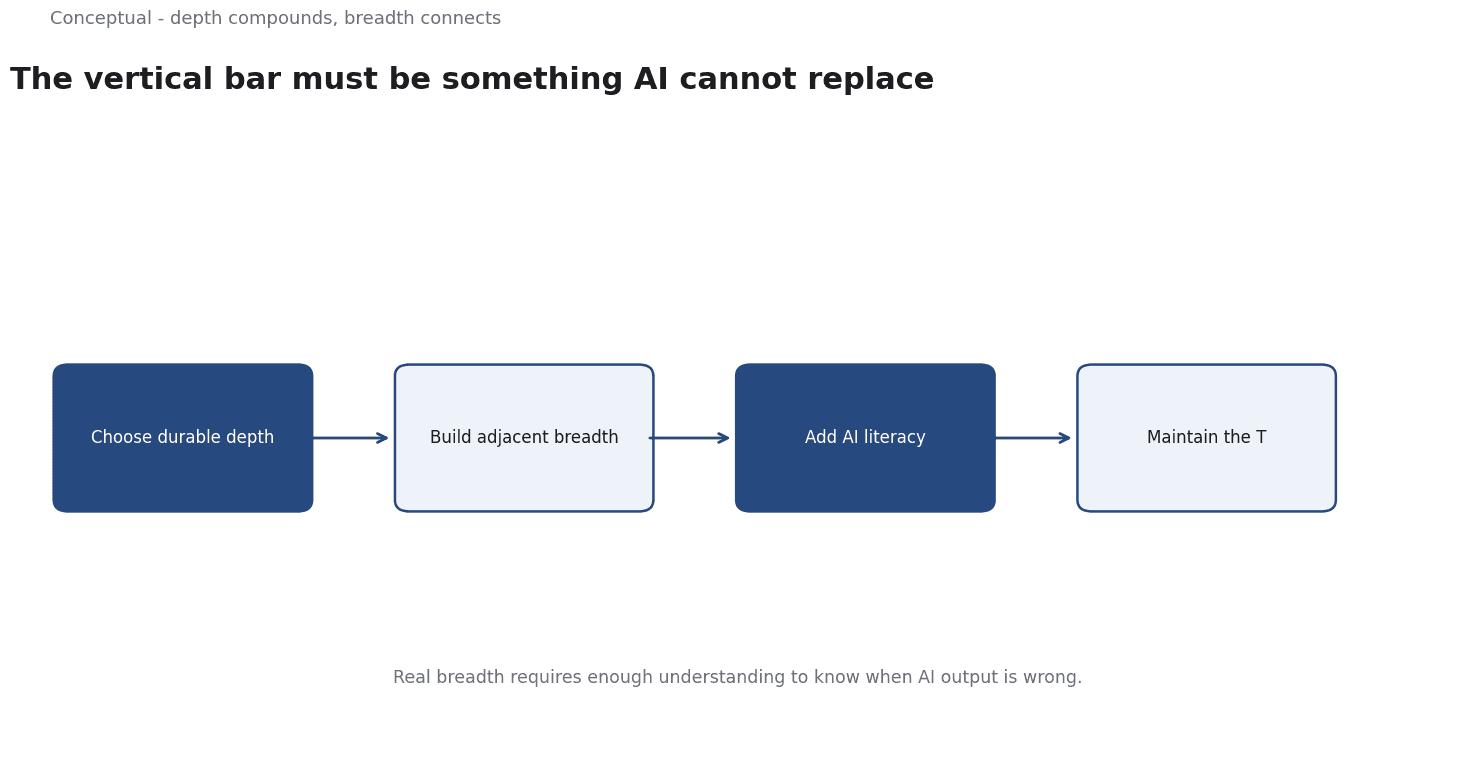
Direct answer: A T-shaped professional combines deep expertise in one discipline with broad working knowledge across adjacent domains. The depth creates unique value; the breadth enables collaboration, learning, and adaptation. In the AI era, the vertical bar should be in something AI cannot easily replace—judgment, context, or complex systems thinking—and the horizontal bar should include AI literacy without relying on it as a substitute for understanding.
Choose depth that compounds
Depth is not knowing every feature of a tool. It is understanding the underlying system well enough to diagnose problems, make trade-offs, and evaluate new tools. A deep specialist in data engineering understands distributed storage, query optimization, and pipeline reliability—not just how to configure one platform. A deep specialist in product management understands user research, pricing, and go-to-market—not just how to write user stories.
Choose depth in an area where:
- Problems are complex and non-routine.
- Context matters more than generic best practices.
- Tools change, but principles endure.
- Your judgment is harder to automate than your execution.
Depth in a domain (e.g., "I understand customer data infrastructure") compounds as tools evolve.
Build breadth that connects
Breadth is not surface-level familiarity with many tools. It is enough understanding to speak the language of adjacent disciplines, recognize constraints, and spot integration points. A software engineer with breadth understands what designers need, what legal constraints exist, and what sales promises to customers. A marketer with breadth understands what data is technically feasible and what engineering timelines look like.
Breadth prevents the common failure where each team optimizes its own metric and the system as a whole degrades. The T-shaped person is the one who can see the whole.
AI shifts the value of breadth and depth
AI makes it easier to perform tasks outside your depth. A developer can use AI to write a SQL query; a marketer can use AI to analyze a spreadsheet. This lowers the cost of breadth—you can operate in adjacent domains without mastering them.
But AI also makes shallow depth less valuable. If your entire expertise is executing a procedure that AI can execute, your value is the procedure, not the judgment. The vertical bar must be in judgment, architecture, or context—areas where AI assists but does not replace human decision-making.
The risk is becoming "T-shaped" in name only: a thin vertical bar and a wide horizontal bar of AI-assisted surface knowledge.
Real breadth requires enough understanding to know when AI output is wrong, not just to accept it.
Maintain the T over time
Depth and breadth both decay. The domain you specialize in changes; the adjacent domains you need to understand change. Maintenance requires:
- Continuing depth: read primary sources in your specialty, solve harder problems, and work on systems where your judgment is tested.
- Refreshing breadth: rotate projects, talk to people in other functions, and learn enough about new domains to recognize their constraints and possibilities.
- Re-evaluating the T: as AI and markets change, the most valuable depth may shift. Be willing to move the vertical bar.
A practical starting point
- Identify your current vertical bar. What do you understand deeply enough to teach? Where is your judgment trusted?
- Identify gaps in your horizontal bar. What adjacent disciplines do you collaborate with but not understand?
- Pick one depth investment and one breadth investment per quarter. Depth might be a course or a complex project. Breadth might be shadowing another team or reading their primary documentation.
- Measure by judgment, not output. Are you making better decisions? Can you evaluate AI output critically? Can you explain your domain to outsiders?
The T-shaped professional is not a finished state. It is a habit of maintaining both depth and breadth as the world changes.
For the related question of how to demonstrate skills honestly, see How to Build a Technical Portfolio That Demonstrates Real Skills. For the distinction between tool knowledge and system understanding, see The Difference Between Knowing a Tool and Understanding a System.
Locating the vertical bar with O*NET
The O*NET occupational taxonomy is a useful reference for choosing depth because it describes roles by the tasks, skills, and knowledge they require rather than by job title. That matches the article's point that depth is domain understanding, not tool familiarity. A title can stay stable while the tools inside it change; the underlying tasks and knowledge are what compound.
Reading a role through O*NET's task list also exposes where judgment sits. Tasks that require interpreting context, weighing trade-offs, or coordinating with other functions are the ones the article argues belong in the vertical bar. Tasks that are procedural and repeatable are the ones most exposed to automation.
This makes "choose depth that compounds" concrete. Rather than guessing which skills will endure, compare the knowledge and skill entries across adjacent occupations and look for what recurs. Recurring, context-heavy requirements are better candidates for depth than a single platform's feature set, which is why depth in a domain outlasts depth in a tool.
What the evidence says about AI-assisted output
The METR study of experienced open-source developers is a necessary corrective to easy claims about AI and breadth. It is controlled evidence on AI coding assistance, including where it did not help, and that second part is the point. Assistance can lower the cost of operating in an adjacent domain without producing the understanding that the article says real breadth requires.
This is exactly the "T-shaped in name only" failure described above: a thin vertical bar and a wide horizontal bar of AI-assisted surface knowledge. Because the developers in the study were experienced, the result also cautions against assuming assistance substitutes for judgment. The output may look correct while the person cannot tell when it is wrong, which is the test the article sets for genuine breadth.
The following is hypothetical and illustrative. A marketer uses AI to analyze a spreadsheet and gets a plausible answer; a T-shaped marketer with enough technical breadth recognizes that the analysis ignored a filtering rule and catches the error before it reaches a customer. Google re:Work's published people practices describe how teams hire and grow people who work across functions, which is the same capacity: breadth that can evaluate output, not just produce it.
A counterargument
A fair objection is that the article gives the T-shape a precision it does not have. O*NET classifies roles by tasks and knowledge, but it does not identify which skills compound or which judgment is hard to automate; the article reads that conclusion into a taxonomy that only describes occupations. Google re:Work documents one company's people practices, not evidence that T-shaped people outperform specialists. The METR study is the strongest source cited, yet it found AI slowed experienced developers, which is a caution about productivity rather than a demonstration that AI-assisted breadth produces the 'T-shaped in name only' failure.
The advice to put judgment in the vertical bar is sensible but hard to falsify, since any displaced skill can be relabelled as judgment after the fact.
References & Further Reading
- U.S. Department of Labor, 2026. O*NET OnLine — The standard occupational taxonomy used to compare roles across industries.
- Google, 2026. Google re:Work — A large company's published people practices, including hiring and growth frameworks.
- METR, 2025. Measuring the Impact of Early-2025 AI on Experienced Open-Source Developer Productivity — Controlled evidence on AI coding assistance, including where it did not help.