How to Evaluate Hedging
A hedge offsets a defined exposure, and evaluation asks whether it does so without becoming a speculative bet. Learn the definitions, a worked check, and the limits.
Hedging is used to reduce or offset a defined financial exposure, such as a change in interest rates. The sources describe hedging as a risk-management practice and interest rate risk as one of the exposures it often addresses. The real problem is that a hedge can be evaluated as protection or, if it is not matched to the underlying exposure, as an uncovered position.
Direct answer:
Evaluate a hedge by first naming the exposure it offsets, then checking whether the instrument moves against that exposure in the right direction and size.
The sources define hedging and interest rate risk; the evaluation steps are a synthesis. A position that does not track the exposure is speculation, not hedging.
Delta: This article adds a claim-status table and an exposure-matching decision test beyond the sources: it maps each hedge to the exposure it offsets, with claim status explicit.
The mechanism
The hedge source describes a hedge as a position taken to offset the risk of adverse price movement in another holding or obligation. Derivatives are often used, but the defining feature is the purpose: reducing exposure rather than seeking profit from the price move itself. The practical consequence is that evaluation must start from the exposure, not from the instrument. A derivative is only a hedge relative to something it is designed to counter.
Interest rate risk is the risk that changes in interest rates affect the value or earnings of an institution. It arises when assets and liabilities reprice on different schedules or when rate-sensitive positions are left unmatched. The practical consequence is that the exposure has a direction and a scale. A hedge against rising rates must be sized against the specific cash flows or positions that move when rates change, not against a general sense that rates might move.
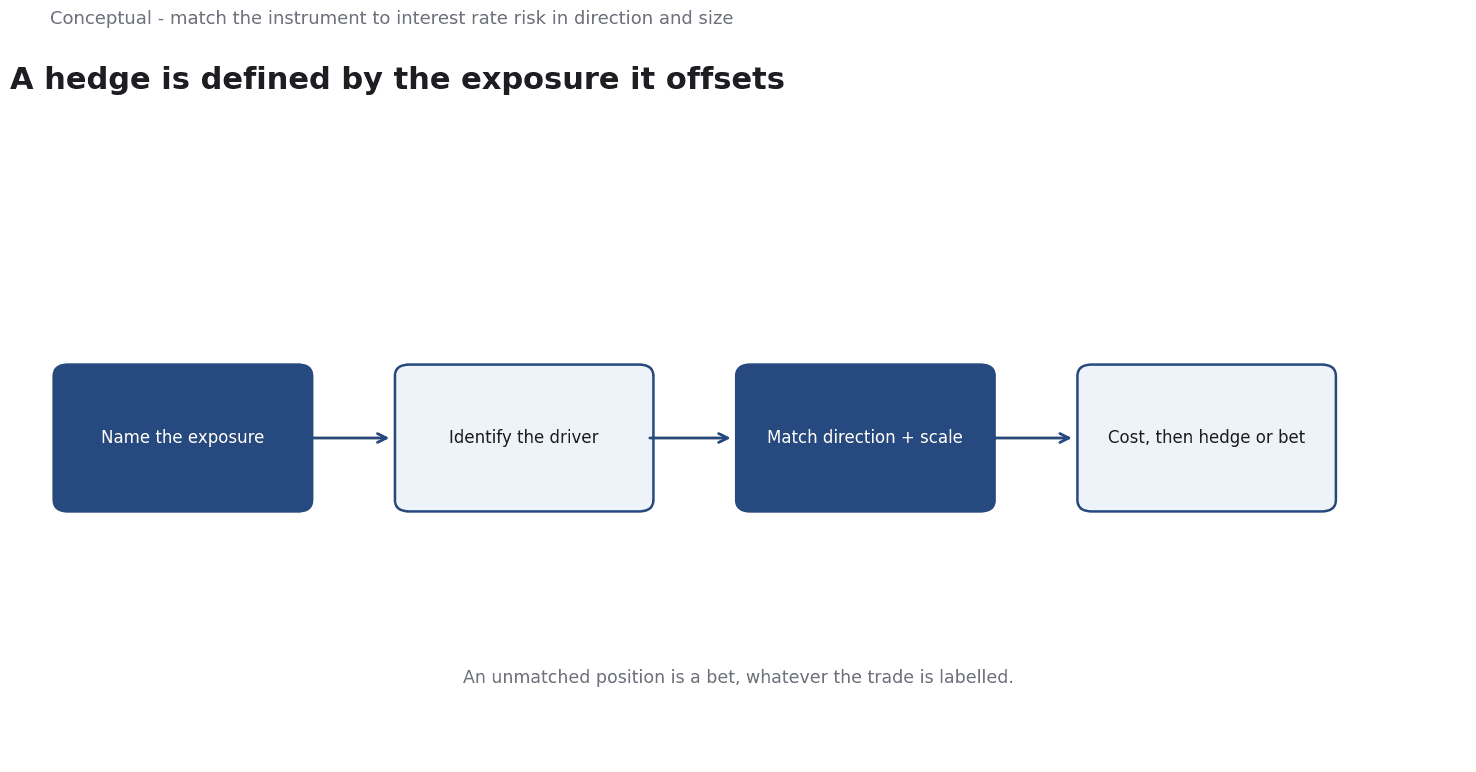
The evaluation logic follows from those definitions. Name the exposure, identify what drives it, and compare that behavior with the instrument under consideration. Direction matters: the hedge should move against the exposure. Size matters: a hedge that is too small leaves risk open, and one that is too large creates a new position. Cost matters as well, because a hedge that removes variability at a price that exceeds the benefit may not be worthwhile. The sources define the concepts but do not set out an evaluation protocol.
That gap is where local judgment enters. Basis risk, correlation, accounting treatment, and transaction cost are facts about a particular hedge and a particular balance sheet. The sources do not supply them. They should be marked as inferred or as items to verify, so that the definitional claims stay separate from the assessment of a specific position. A reviewer can then see which parts of the evaluation are grounded in the sources and which depend on the instrument chosen.
A worked example
The following is hypothetical and illustrative. A holder of a floating-rate obligation considers a hedge against rising rates. Three checks decide the review. First, is the exposure named precisely, meaning which cash flows move when rates change? Second, does the instrument move in the opposite direction and at a comparable scale to that exposure? Third, after cost, does the position still reduce net variability rather than add a new bet? The review finds the instrument tracks the rate exposure but leaves a basis gap. The outcome is a sizing decision, not a claim that hedging is always beneficial. The scenario is hypothetical; the verification method is the contribution.
Evidence status
| Claim | Status | Source | Verified | Recheck when |
|---|---|---|---|---|
| A hedge offsets a defined financial exposure | source-reported | Wikipedia, Hedge (finance) | 2026-11-18 | Definition revised |
| Interest rate risk concerns changes in rates affecting value or earnings | source-reported | Wikipedia, Interest rate risk | 2026-11-18 | Definition revised |
| Evaluation requires matching the instrument to the named exposure | inferred | Derived from the sources | 2026-11-18 | Instrument or exposure changes |
The first two rows are factual claims drawn from the sources. The third is an inference about how a hedge should be judged, because neither source sets out an evaluation rule. Recheck the definitions when the source entries change, and the inferred claim when the instrument or the underlying exposure changes.
What it cannot do
This evaluation does not say whether a particular hedge should be bought. The sources define hedging and interest rate risk; they do not provide prices, volatility estimates, correlation data, or a suitability rule. An evaluation that ignores those inputs cannot conclude that a hedge is worthwhile. It can only show whether the instrument is aligned with the named exposure in direction and scale. The purchase decision requires evidence the sources do not carry.
The hidden cost is the ongoing work after a hedge is in place. Positions drift as the underlying exposure changes, so a hedge that matched at inception can become over- or under-sized. It must be monitored and adjusted, and each adjustment has a transaction cost. There is also the cost of the instrument itself, whether paid as a premium or embedded in pricing. A hedge that is assessed only at the moment it is opened will silently stop being a hedge as the balance sheet evolves.
A derivative that does not track the exposure is not a hedge in the sense the source defines; it is a bet on rates or prices. The label on the trade does not change its behavior. This failure is easy to miss because both hedges and speculative positions can produce gains when markets move favorably. The difference appears when the exposure moves the other way and the position fails to offset it.
There is a boundary around what the sources support. They do not model basis risk, correlation breakdown, or the accounting treatment that determines how gains and losses are reported. They do not address the tax treatment of hedging instruments or the governance rules that authorize them. They do not make a judgment about whether reducing variability is worth the cost in a specific case. Those questions need inputs and rules beyond the two definitions.
Because exposures and instruments change, the evaluation needs a periodic review. Each assumption about direction, size, and cost should carry a recheck condition, and the position should be re-tested whenever the underlying exposure shifts. Without that record, a future reviewer cannot tell whether the hedge was matched to a real exposure or simply assumed to be one.
The counterargument that hedging is fair for reducing known variability is incomplete when the instrument leaves a basis gap.
A decision test
- Name the exposure the hedge is meant to offset.
- Identify what drives that exposure.
- Check the instrument's direction relative to the exposure.
- Compare the instrument's scale with the exposure.
- Account for the cost of the hedge.
- Record whether the position is a hedge or a bet.
- Set a recheck date for the exposure and the instrument.
The evaluation is useful only when the exposure is named and the instrument is measured against it. The test turns a trade label into a sequence of matching checks with a visible recheck point, so a reviewer can see why the position was classified as it was. For further reading, see Decision Memos That Survive Review.
References & Further Reading
- Wikipedia contributors, 2026. Hedge (finance) - Wikipedia — Reducing an existing exposure with an offsetting position.
- Wikipedia contributors, 2026. Interest rate risk - Wikipedia — Exposure of value to changes in rates.