How to Evaluate Oil Markets
Oil prices move on supply, demand, and inventories. Read the evaluation frame, a worked example, and why a single headline price is thin evidence.
Oil is often discussed through headlines about a price target, which misses the structure that actually moves it: supply decisions, demand, inventories, and the difference between benchmark grades, as the EIA oil explainer describes supply and demand, as the petroleum entry describes the product and its grades, as Commodity Markets: Oil, Gold, and Price Discovery treats price discovery, as the futures article explains contracts.
Direct answer: Evaluate oil markets by reading supply, demand, inventories, and the benchmark with dated data, then distinguishing a price view from an exposure. The EIA explainer is the primary source, and the petroleum entry covers the physical product. The boundary: this is educational orientation, not trading advice — prices are volatile and forecasts are conditional, as the time-series article warns about non-stationarity, as the publication standard forbids guaranteed outcomes.
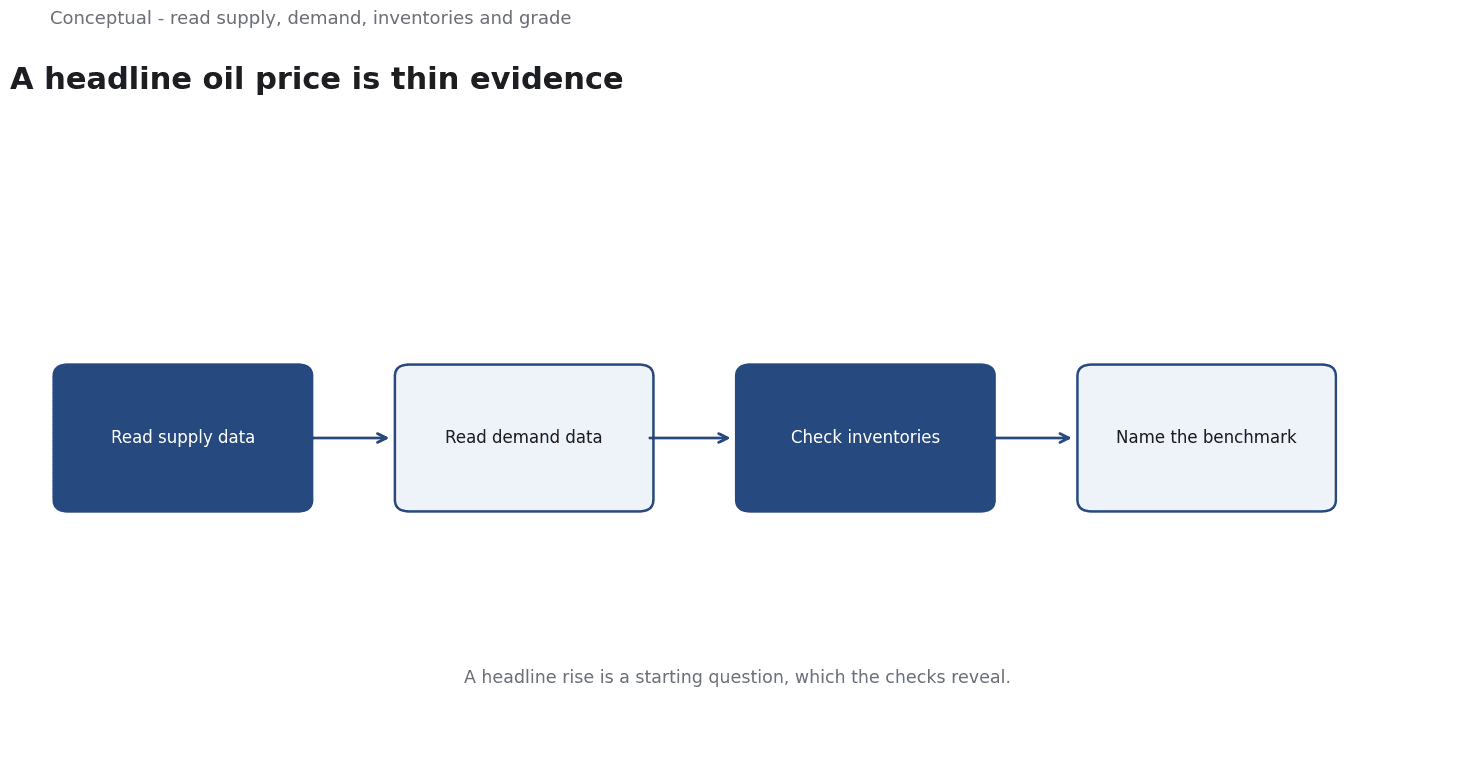
The frame
Supply. Production decisions, spare capacity, and disruptions, which the EIA explainer describes, as the supply-chain article treats capacity, as the scenario-analysis article requires conditional thinking, as the risk assessment requires residual risk.
Demand. Consumption by region and sector, which the EIA explainer covers, as the demand-forecasting article advises for metric choice, as the GDP article treats the macro context, as the data-governance article requires dated figures.
Inventories. Stocks are the visible balance between supply and demand, which the EIA explainer treats, as the inventory article treats stock as cash, as the time-series article warns about non-stationarity, as the monitoring article advises for review.
The benchmark. Oil is not one product; benchmarks differ, which the petroleum entry explains for grades, as Commodity Markets: Oil, Gold, and Price Discovery treats standardisation, as the futures entry explains contracts, as the comparables article requires consistent definitions.
Three consequences follow. The data should be dated, as data governance requires, as the EIA series provides dated releases, as the market-structure article advises. A price view should be separated from an exposure, as the hedging article advises, as the risk assessment requires residual risk. And the result should be recorded, as the decision-memo article requires.
A worked example
The following is hypothetical and illustrative. An analyst sees a benchmark price rise and asks whether it reflects a durable shift.
Three checks decide. First, did inventories or supply change, as the EIA explainer advises, with a dated series, as data governance requires? Second, is the benchmark the right one for the exposure, as the petroleum entry and comparables article require, with a matching contract, as the futures entry advises, as basis risk warns about mismatch? Third, is the price view separate from the physical exposure, as the hedging and risk articles require, with a recorded judgement, as the decision-memo article requires?
Three conclusions follow.
A headline rise is a starting question, which the checks reveal.
Benchmark choice matters, as the petroleum and comparables articles advise. And the decision should be recorded with residual risk, as the decision-memo and risk articles require.
Why the grade matters as much as the number
A benchmark price describes a specific grade at a specific location, which the petroleum entry explains, as the EIA explainer describes different crude streams, as Commodity Markets: Oil, Gold, and Price Discovery treats standardisation, as the comparables article requires consistent definitions, as the futures entry explains what a contract delivers, as the hedging article warns about basis risk, as the risk-assessment article requires residual risk to be stated, as the decision-memo article requires for a recorded judgement, as the data-governance article requires for dated figures, as the monitoring article advises for review when conditions change.
What oil evaluation cannot do
It cannot predict prices, which the time-series article warns about non-stationarity, as the scenario-analysis article requires conditional thinking, as the publication standard forbids guaranteed outcomes. It does not remove exposure, which the hedging article treats as reduction, as the risk article requires residual risk. And it cannot guarantee data completeness, which the data-governance article treats as provenance, as the EIA explainer advises on release schedules.
The counterargument that the spot price is enough is fair for a snapshot and incomplete for a decision, which the worked example shows, as the EIA explainer and comparables article advise.
A decision test
- Read supply, demand and inventories, as the EIA explainer advises.
- Use dated data, as data governance requires.
- Choose the right benchmark, as the petroleum entry advises.
- Match any contract to the exposure, as the futures entry requires.
- Separate a view from a hedge, as the hedging article advises.
- Check basis risk, as the hedging article warns.
- Record the decision and residual risk, as the decision-memo and risk articles require.
For the physical and grade context, see Petroleum; for the market structure, see Commodity Markets.
References & Further Reading
- U.S. Energy Information Administration, 2026. Oil and petroleum products explained - U.S. Energy Information Administration (EIA) — Primary source on oil supply, demand, prices and products.
- Wikipedia contributors, 2026. Petroleum - Wikipedia — The structure and use of crude oil and petroleum products.