How to Evaluate Prioritization
A prioritisation method is useful if it changes the order of work. Read the evaluation, a worked example, and why a score can encode a bad assumption.
Prioritisation methods are often debated as if their frameworks were the point. The Wikipedia entry describes prioritisation as ranking competing work, and the decision-making entry covers structure and evidence. The question is whether the method produces a better order of work.
Direct answer: Evaluate a prioritisation method by whether its output changes decisions and whether its assumptions can be challenged. The sources describe the concepts; the evaluation rule is a synthesis.
Delta: This article adds a claim-status table and a worked example, separating documented concepts from local choices about criteria.
The mechanism
The first test is whether the method uses information the team actually has. A framework that requires precise estimates of future revenue will produce confident scores from weak inputs. A method that uses observable signals — effort, risk, customer evidence — is easier to apply honestly. The decision-making entry treats evidence as a component of a choice, which applies here.
The second test is whether the assumptions are visible. A score that combines several factors hides the weighting unless it is written down. Different weights produce different orders, and a team that cannot see them will argue about the result without knowing what drives it. Making the weights explicit turns an argument into a decision about criteria.
The third test is stability. A method whose order changes every week cannot be used to plan. A method that never changes despite new information is equally unhelpful. Somewhere between those extremes is a method that responds to evidence at a sensible cadence, which is a local choice.
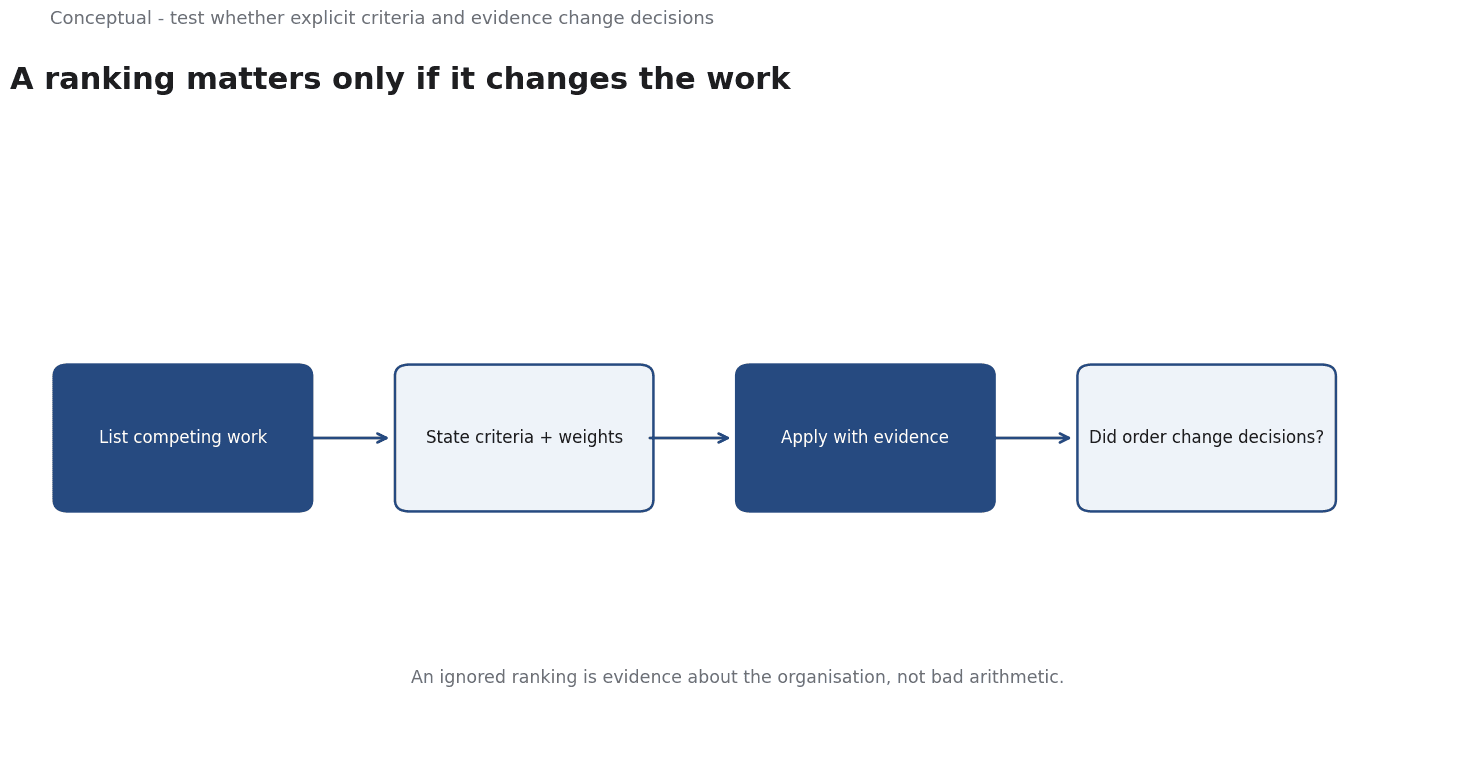
The sequence is: list the work, state the criteria, apply them, then check whether the order changed anything.
The checking is often skipped, which is why prioritisation can become a ritual that produces a list nobody follows.
A worked example
Illustrative. A team ranks five projects by impact and confidence.
Three checks decide. First, are the impact estimates based on evidence, or on whoever argued most recently? Second, are the weights explicit, so a change in the order can be traced to a change in criteria? Third, did the ranked order change what the team built this quarter, and did the result justify the choice?
The outcome is a judgment about the method, not the list. The scenario is hypothetical; the evaluation method is the contribution.
Evidence status
| Claim | Status | Source | Verified | Recheck when |
|---|---|---|---|---|
| Prioritisation ranks competing work | source-reported | Wikipedia, Prioritization | 2026-11-18 | Definition changes |
| Decisions use owners and evidence | source-reported | Wikipedia, Decision making | 2026-11-18 | Source revised |
| Test whether the order changes decisions | inferred | Derived from the concepts | 2026-11-18 | Work changes |
Why a score can encode a bad assumption
If those are wrong, the score is precisely wrong, which is harder to challenge than an acknowledged judgement. Writing the assumptions beside the score is the simplest correction.
A final consideration is that prioritisation assumes the work can be compared, which is not always true. Compliance work and product experiments often serve different purposes, and forcing them onto one scale produces a ranking that hides the difference. Keeping a separate category for non-negotiable work is a design choice that preserves the method's usefulness.
The method should also be allowed to fail. If a ranking is consistently ignored, the reason may be that the criteria do not match how decisions are actually made. That is information about the organisation, and it is more useful than adjusting the scores to produce a list that people will follow.
The criteria should be reviewed after results, because a method that never changes cannot learn from the work it ordered.
An ignored ranking is evidence about the organisation, not a failure of arithmetic, and it deserves investigation.
The weights should be stated beside the score, since a precise number built on hidden assumptions is hard to challenge.
What it cannot do
It cannot create capacity. It does not replace a decision about strategy. And it cannot guarantee that the most important work was identified.
The counterargument that a framework makes decisions fair is fair for consistency and incomplete when the criteria are wrong.
A decision test
- List the competing work.
- State the criteria and weights.
- Apply them with evidence.
- Check whether the order changed decisions.
- Review the criteria after results.
- Record the decision and recheck date.
For the decision form, see Decision Memos.
References & Further Reading
- Wikipedia contributors, 2026. Prioritization - Wikipedia — Methods for ranking competing work.
- Wikipedia contributors, 2026. Decision-making - Wikipedia — Overview of decision processes, trade-offs and the distinction between the decision and its outcome; secondary reference.