How to Evaluate Promotions
A promotion changes behaviour or only timing. Read how to evaluate one, a worked example, and why a sales spike is not a result.
Promotions are often reported by the sales during the offer, which cannot distinguish new demand from purchases moved forward. The Wikipedia entry describes short-term incentives, and A/B testing covers controlled comparison. The evaluation question is what would have happened without the promotion.
Direct answer: Evaluate a promotion against a comparable baseline, with a measurement window long enough to reveal timing effects, and check contribution rather than revenue. The sources describe the method; the rule is a synthesis.
Delta: This article adds a claim-status table and a worked example, separating documented method from local choices about the baseline.
The mechanism
The first requirement is a baseline. The sales-promotion entry describes incentives used for a limited period, which means the period around the offer matters. Comparing a promotional week with an ordinary week that has different seasonality produces a misleading lift, and the comparison should be chosen before the offer.
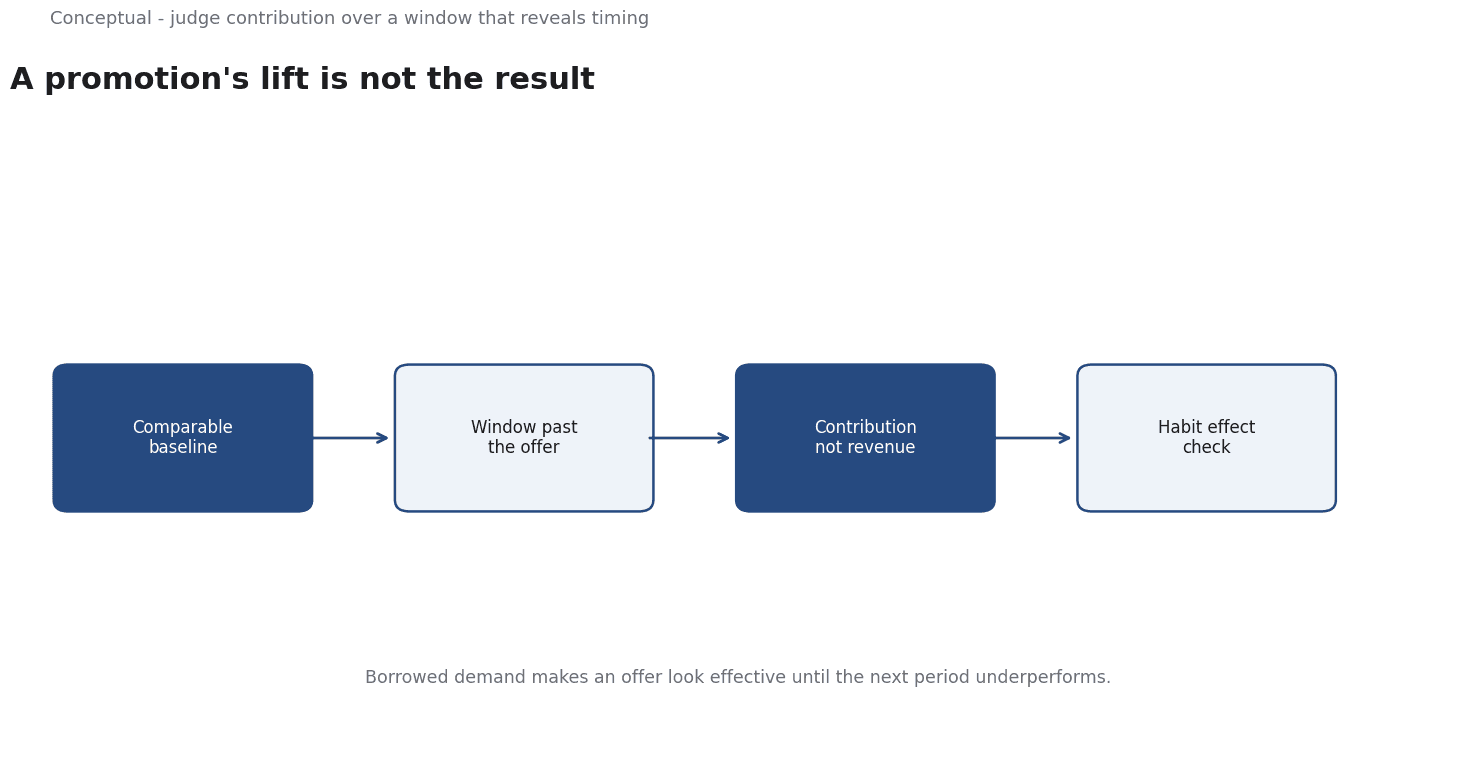
The second requirement is a window that extends beyond the offer. A promotion can move purchases forward from the following week, which makes the offer look effective while the next period underperforms. Extending the measurement by one or two cycles is the correction, and it costs nothing in tooling.
The third requirement is contribution. A/B testing provides the logic of comparison, but the metric should reflect the decision. Revenue can rise while margin falls, especially once the discount and operational costs are counted. Contribution is the measure that answers whether the promotion was worth running.
The sequence is: set a baseline, choose a window, measure contribution, then check for a habit effect.
Each step involves local judgement, so the conclusions are inferred; the method is source-reported.
A worked example
Illustrative. A retailer runs a weekend discount and reports a 20% lift.
Three checks decide. First, is the baseline comparable in season and channel? Second, did sales in the following week fall, suggesting borrowed demand? Third, what happened to contribution after the discount and extra staffing?
The outcome is a qualified assessment rather than a headline lift. The scenario is hypothetical; the method is the contribution.
Evidence status
| Claim | Status | Source | Verified | Recheck when |
|---|---|---|---|---|
| Promotions are short-term incentives | source-reported | Wikipedia, Sales promotion | 2026-11-18 | Definition changes |
| Controlled comparison supports causal claims | source-reported | Wikipedia, A/B testing | 2026-11-18 | Method changes |
| Use a comparable baseline and contribution | inferred | Derived from the method | 2026-11-18 | Calendar changes |
Why the spike is not the result
A spike measures activity during the offer. The result is the change in contribution over a window long enough to show whether demand was created or moved.
A baseline can never be perfect, because the counterfactual is unobserved. The goal is a comparison that is defensible, not one that is exact, and stating its limitations is part of the result. A report that presents a lift without the comparison it used is harder to challenge than one that names its assumptions.
The habit effect is another limit. A customer who learns to wait for discounts will change behaviour slowly, and a short evaluation will not detect it. Reading the same category over several promotions is the way to see whether the offer has changed the reference price, which is a different question from the immediate lift.
The promotion also has an operational cost that rarely appears in the sales report. Extra staffing, support, and fulfilment are real costs, and a lift that ignores them can be negative in contribution terms.
Contribution is the measure that answers the decision, and it should be reported beside the headline lift.
A promotion that shifts sales forward will look successful within the offer window and weak immediately after.
The baseline and the window should be chosen before the offer, not after the result is known.
A reported lift should always name the comparison it was measured against.
What it cannot do
It cannot guarantee that a baseline is perfect. It does not remove the need to understand the customer. And it cannot prove causation from a single comparison.
The counterargument that a lift is good enough is fair for a quick read and incomplete for a decision to repeat.
A decision test
- Choose a comparable baseline.
- Extend the window beyond the offer.
- Measure contribution.
- Check for timing effects.
- Check for habit formation.
- Record the decision and recheck date.
For the costs, see Promotions Costs.
References & Further Reading
- Wikipedia contributors, 2026. Sales promotion - Wikipedia — The mechanisms and costs of short-term promotional incentives.
- Wikipedia contributors, 2026. A/B testing - Wikipedia — Controlled comparison of two variants.