How to Evaluate Rebranding
A rebrand is more than a new look; this article maps identity and positioning signals to a bounded verdict, with evidence status made explicit.
Rebrands are often judged by whether people like the new look, which conflates visual identity with brand meaning. A logo change is visible, but the real question is whether the change communicates the intended positioning and is understood by the audience. Without a way to separate those two things, a team cannot tell whether a rebrand worked or merely generated attention.
Direct answer: Evaluate rebranding as two linked questions: does the new corporate identity consistently express the intended positioning, and do the intended audiences interpret it that way? Brand management supplies the positioning frame, and corporate identity supplies the visible system. Judge alignment and interpretation separately; attention is evidence of neither on its own.
Delta: This article adds an evaluation sequence beyond the sources: it maps identity and positioning signals to a rebrand verdict, with claim status explicit.
The mechanism
Brand management is the analysis and planning applied to building and maintaining a brand. It treats the brand as an asset whose value depends on awareness, associations, and the coherence of what the organization stands for. Corporate identity is how an organization presents itself to the public, and visual identity is the visible part of that presentation: the name, logo, design system, and related artifacts. The two concepts are related but distinct. One concerns the meaning the organization wants to own; the other concerns the signals it sends.
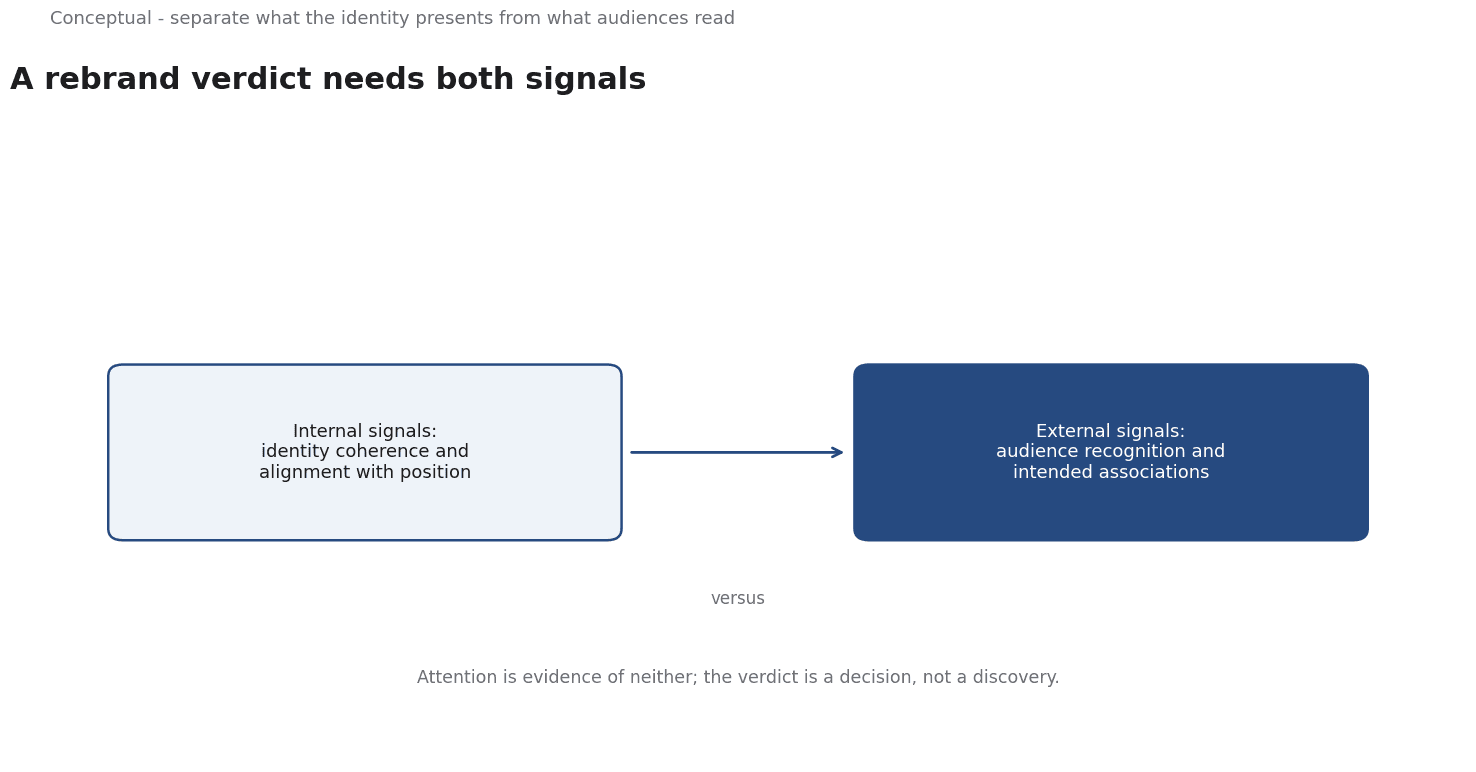
That distinction changes what evaluation means. A change to a logo is a change to the identity system, but it does not automatically change the brand's position. If the surrounding signals, such as messaging, product experience, and service behavior, do not change with it, the visual update can read as cosmetic. Conversely, a shift in positioning without a matching identity can leave the audience without a cue that anything changed. Practical evaluation therefore checks both the internal coherence of the identity system and the alignment between that system and the intended position.
The useful signals are of two kinds. Internal signals ask whether the identity elements are consistent with one another and with the stated positioning, which is a design and governance question. External signals ask whether audiences recognize the organization and attribute the intended associations to it, which is a perception question. Both matter, and neither substitutes for the other. An identity that is internally coherent but unrecognized has not communicated; one that is widely noticed but linked to the wrong meaning has communicated the wrong thing.
The practical consequence is that a rebrand verdict should be built from these signals rather than from a single reaction.
The brand-management frame says what the organization is trying to stand for; the corporate-identity frame says what is being presented. Bringing them together yields a bounded judgment: whether presentation and position now match, and whether that match is being received. Anything beyond that, such as predicting financial return, is a different question that needs different evidence.
A worked example
The following is hypothetical and illustrative. A company updates its visual identity to signal a shift toward a more technical positioning. Three checks decide how to read it. First, internal coherence: do the new logo, colors, and design rules consistently express that positioning, or do old elements persist in customer-facing materials? Second, alignment: does the rest of the presentation, including product naming and messaging, change with the identity, or only the logo? Third, reception: do target customers describe the company using the intended associations after the change, or do they read it as a cosmetic refresh? The outcome depends on the pattern. If coherence and alignment hold but reception lags, the rebrand is incomplete and needs time or reinforcement; if reception is strong but associations are wrong, the positioning itself is mis-set. The example is illustrative, not a verdict on any real brand.
Evidence status
| Claim | Status | Source | Verified | Recheck when |
|---|---|---|---|---|
| Brand management covers analysis and planning to build and maintain a brand | source-reported | Brand management entry | 2026-11-18 | positioning framework or strategy changes |
| Corporate identity covers how an organization presents itself, including visual identity | source-reported | Corporate identity entry | 2026-11-18 | identity guidelines or design system change |
| A rebrand verdict separates internal coherence from external reception | inferred | Derived from the sources | 2026-11-18 | audience or positioning changes |
The first two rows rest on definitions in the reference entries and are treated as reported, not measured here. The third row is an inference: it follows from combining the two concepts but is not asserted by either source. Each row is dated and should be revisited when the intended position, the identity system, or the audience being evaluated changes in a material way.
What it cannot do
Evaluation cannot prove a return. It can show whether presentation and position align and whether audiences read them, but it cannot attribute sales or valuation changes to the rebrand alone. Many factors move at the same time during a rebrand, and the sources describe frameworks rather than causal estimates. A verdict of alignment is not a verdict of financial performance, and it should not be presented as one.
Rebrands carry costs that are easy to underestimate. Updating every artifact that carries the identity, from documents to interfaces, is labor-intensive and rarely complete on the first pass. Partial application produces inconsistency, which undermines the very coherence the evaluation is meant to find. There is also the cost of audience confusion when established recognition is disrupted, and the cost of maintaining two identities during a transition. These costs can persist well after the launch date.
A rebrand can attract attention and still communicate the wrong thing, or communicate little beyond novelty. A related failure is treating the visual system as the whole identity: if behavior and messaging stay unchanged, the new look can be read as a wrapper around the same organization. Evaluation that measures only recognition misses this gap, because it never checks whether the intended associations actually moved.
The boundary is the scope of the sources themselves. Brand management and corporate identity describe what brands and identities are and how they are managed, not a validated scoring model. Any threshold for success is a practical choice, not something the sources supply. An evaluation must therefore state its own criterion openly and treat it as a decision rule rather than as a fact discovered in the material.
Verdicts also expire. Positioning changes, markets shift, and identity systems drift as new materials are produced without review. A rebrand judged coherent at launch can degrade as exceptions accumulate across teams and channels. Evaluation should be periodic, checking whether the identity still matches the intended position and whether reception has held over time. What it cannot do is deliver a permanent answer from a single review.
The counterargument that a rebrand is mostly a visual exercise is fair for recognition and incomplete for positioning, because visible change does not by itself move the meaning audiences attach to the organization.
A decision test
- State the positioning the rebrand is meant to express.
- List the identity elements that carry that positioning.
- Check internal coherence across the identity system.
- Check alignment between identity and the rest of the presentation.
- Gather evidence of audience reception and interpretation.
- Compare coherence and reception, and name the gap.
- Record the verdict with its criterion and review date.
A rebrand verdict is a decision, not a discovery. Write down the criterion used, the evidence behind each signal, and the point at which the verdict should be revisited. That habit keeps the evaluation honest about what the sources can support and leaves room to correct the judgment when reception or positioning changes.
For further reading, see Voice of Customer: Turning Feedback into Decisions.
References & Further Reading
- Wikipedia contributors, 2026. Brand management - Wikipedia — The discipline of maintaining a brand across touchpoints; secondary reference used for channel consistency.
- Wikipedia contributors, 2026. Corporate identity - Wikipedia — Visual elements that represent an organisation.