How to Get Competitive Battlecards Right
Battlecards fail when they mix competitor trivia with sales claims. Learn how analysis and value proposition shape a usable card, plus the limits.
Most competitive battlecards are assembled from a competitor's website and a few sales calls, then handed to reps who cannot tell which claims are verified. The real problem is that a card must serve a live conversation, not document everything known about a rival. Without a clear decision to support, the card becomes trivia that slows the sale.
Direct answer: Competitive analysis is the structured study of rivals and their position, and a value proposition is the promise of value a company makes to customers. A useful battlecard selects the few differences that change a buyer's decision. The sources define the concepts; the selection rule is a synthesis.
Delta: This article adds a decision frame beyond the sources: it maps competitive analysis and value proposition to a sales decision, with claim status explicit.
The mechanism
The Wikipedia entry on competitive analysis describes assessing competitors, including their products, strengths, weaknesses, and market position, as input to strategy. The practical consequence is that analysis is a broad inventory, not a script. A card that reproduces the inventory gives a rep everything except the one thing needed: which fact matters for this buyer.
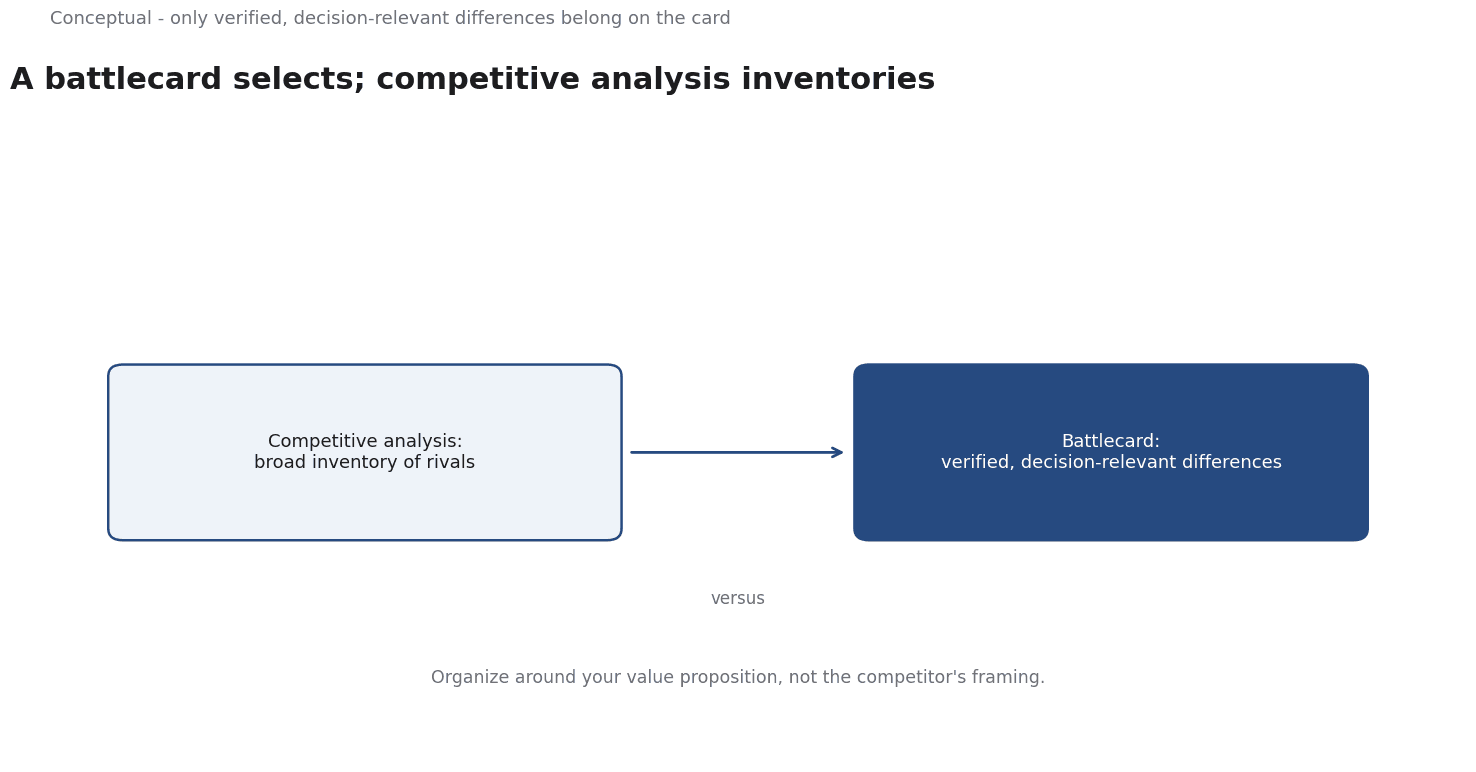
The value proposition entry describes the promise of value a company offers and the combination of benefits that distinguish it. The practical consequence is that a battlecard should be organized around that promise, not around the competitor. The rep's job is to connect a specific buyer need to a specific difference, and the card should make that connection easy.
The mechanism is selection. From the full analysis, keep only the differences that are both true and decision-relevant: the claims a buyer is likely to raise and where the company's value proposition is stronger. Discard the rest. A shorter card is easier to use under the time pressure of a call, and a claim that is not decision-relevant has no place in it.
The result is a decision loop: identify the common objections, map each to the strongest verified difference, and state how to raise it. The decision it supports is narrow, namely what to say when a competitor comes up. The card is not a strategy document; it is a tool for a conversation, and its value is measured by whether a rep can use it without hesitating.
A worked example
The following is hypothetical and illustrative. A sales team is building a card for a competitor that appears in many deals.
Three checks decide what goes on it. First, is the claim supported by a source the team can name, or is it office folklore? Second, does the claim connect to a buyer need that actually appears in deals, rather than a feature the competitor happens to lack? Third, does the claim point back to the company's own value proposition, so the rep can pivot from objection to benefit?
The outcome is a short card with three verified differences and a review condition: recheck each claim when the competitor ships a release or when win-loss notes show a new objection. The scenario is hypothetical; the method is the contribution.
Evidence status
| Claim | Status | Source | Verified | Recheck when |
|---|---|---|---|---|
| Competitive analysis assesses rivals and position | source-reported | Wikipedia, Competitive analysis | 2026-11-18 | Scope changes |
| Value proposition is a promise of value to buyers | source-reported | Wikipedia, Value proposition | 2026-11-18 | Definition changes |
| Select only decision-relevant verified differences | inferred | Derived from the sources | 2026-11-18 | Competitor or objections change |
The first two rows restate documented definitions. The third is a synthesis: the sources define the concepts but do not set a card standard. Recheck it when a competitor ships or when win-loss notes reveal a new objection, since a difference that stopped mattering should come off the card.
What it cannot do
The card cannot win a deal on its own. It shapes what a rep says but cannot substitute for understanding the buyer's situation. A well-built card used without listening produces a script recited at the wrong moment. The analysis behind the card is broad, but the conversation it supports is specific, and the gap between the two is filled by the rep's judgement, not the document.
The hidden cost is maintenance. Competitors change pricing, features, and positioning, and a card that is not updated becomes a source of confident errors. Keeping a card accurate means someone owns it, checks claims, and retires stale ones. That effort is easy to underestimate and the first thing dropped when a team is busy, which is exactly when bad claims do the most damage.
If the rival defines the evaluation criteria, the card will always be playing defence. The value proposition exists to offer a different frame, so a card should reframe the conversation around strengths rather than mirror the competitor's list. A card that argues on the rival's terms reinforces the rival's advantage.
The boundary is verification. A claim that cannot be sourced should not be on a customer-facing card, however useful it feels internally. Competitive analysis is sometimes loose, and sales pressure rewards confident claims. The discipline of naming a source for each line is what separates a tool from a liability, and it is a boundary the team must enforce rather than assume.
Finally, the card needs a review rhythm tied to evidence. Win-loss notes and call recordings show which claims land and which draw scepticism. A scheduled review forces the team to test the card against real conversations and to remove claims that no longer help. Without it, the card reflects the moment it was written, not the market it is used in.
The counterargument that battlecards oversimplify is fair for complex deals with many stakeholders and incomplete where a rep needs a fast, defensible answer.
Simplicity is a feature when the alternative is a rep improvising under pressure.
A decision test
- Name the decision the card should support in a live call.
- Draw only from claims that have a named source.
- List the objections that actually appear in deals.
- Map each objection to a verified difference.
- Check each difference against the company's value proposition.
- Keep the card short enough to scan during a call.
- Set a review date tied to releases and win-loss evidence.
A battlecard earns its place by shortening the path from objection to answer.
When it is built from sourced analysis and organized around the value proposition, a rep can use it without pausing. When it is a dump of competitor trivia, it slows the sale and risks credibility. The test keeps the card tied to the conversation it is meant to serve.
For further reading, see Decision Memos That Survive Review.
References & Further Reading
- Wikipedia contributors, 2026. Competitive analysis - Wikipedia — Assessing competitors and market position.
- Wikipedia contributors, 2026. Value proposition - Wikipedia — The value a product promises to a buyer.