How to Get Creative Testing Right
Testing headlines without a hypothesis produces noise. Read how to design a creative test, a worked example, and why wins decay.
Creative testing is often treated as a tournament of variants: write ten headlines, run them, pick a winner. The result can be a real lift that disappears a month later, because the test measured a short-term preference rather than a change in decision. A better test starts from a question about the buyer.
Direct answer: Test creative against a stated hypothesis and a downstream outcome, with a fixed audience and a defined window. The A/B testing overview provides the method, and geo-experiment guidance covers tests where the unit is a region rather than a user. The boundary: no creative structure guarantees a result, which the publication standard states for marketing claims, and short-term wins can decay, as the brand-awareness article distinguishes spikes from lasting preference.
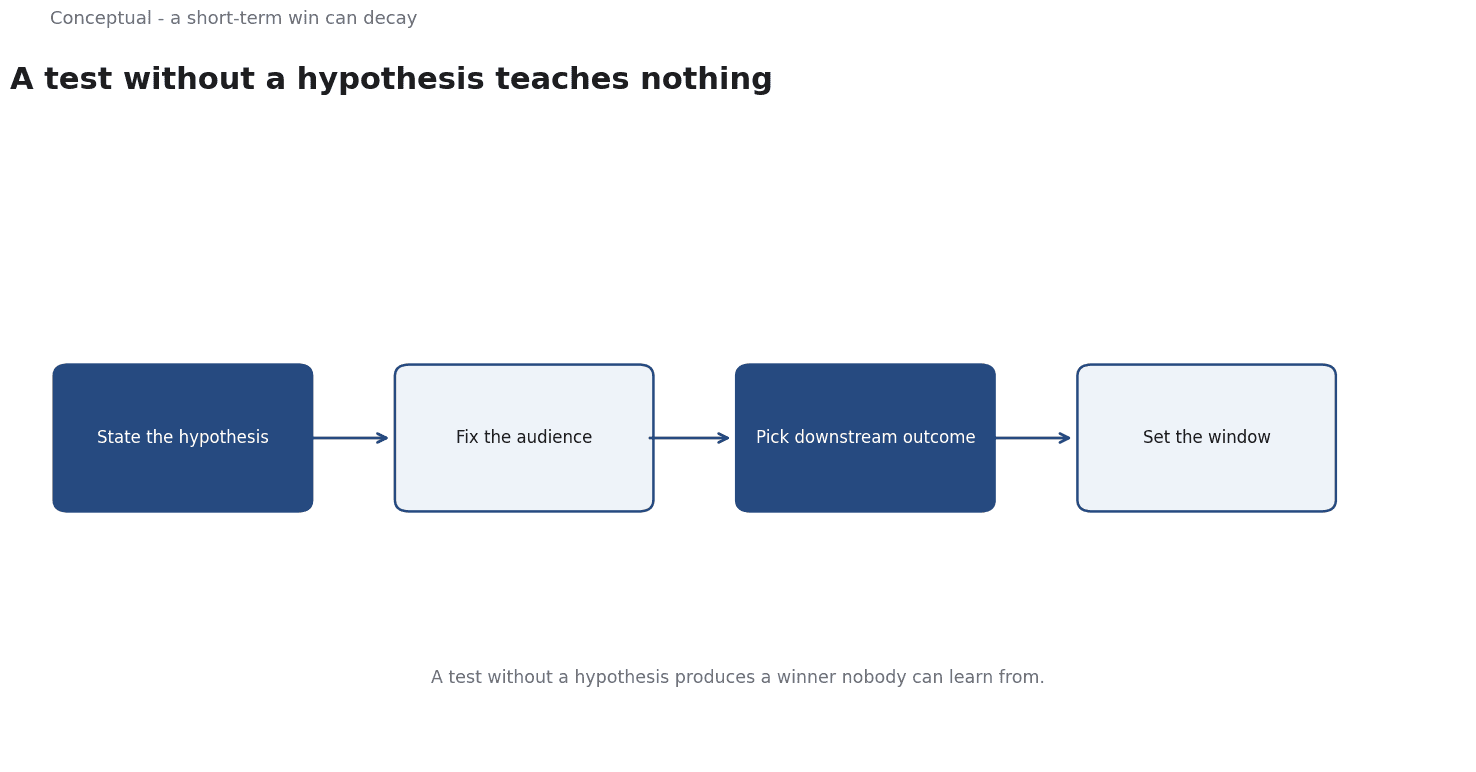
The design
A hypothesis. "Buyers respond to proof rather than adjectives" is testable; "this headline is better" is not, which the evaluation-rubric article argues for explicit criteria. The hypothesis should come from research into the buyer's decision, as the jobs-to-be-done article advises for framing value.
One variable. Change the headline or the image, not both, or the result cannot be attributed, which the A/B testing overview requires for a clean comparison.
A downstream metric. Clicks are a leading signal, but the decision is about qualified conversion or retention, which the funnel article treats as a stage measure. The email-metrics article makes the same point for opens versus actions.
A fixed audience and window. AAPOR's standards apply to any survey used to understand the audience, and the test itself should run to a defined end, as the geo-experiment guidance recommends for comparisons.
Three consequences follow.
A test without a hypothesis produces a winner nobody can learn from, which the evaluation-rubric article warns about for metrics without substance.
A test on a changing audience mixes effects, as the segmentation article advises for stable groups. And a test that ends when a variant looks ahead is biased, which the A/B testing overview treats as a violation of the method.
A worked example
The following is hypothetical and illustrative. A team tests two headlines: one leads with a speed claim, the other with a compliance outcome. The hypothesis is that the target audience is compliance-driven, drawn from support conversations, as Voice of Customer: Turning Feedback into Decisions recommends.
The test runs for two weeks on a fixed audience with a qualified-demo outcome, not clicks, as the funnel article advises. The compliance version wins by 25%. Three checks decide what to do. First, is the difference stable across the window, or driven by one day, which the A/B testing overview requires for a reliable result? Second, do the converted leads retain, as the retention article measures by cohort? Third, does the win hold in a second campaign, which the brand-lift article treats as a test of durability?
Three conclusions follow. The hypothesis gains support, but only as a hypothesis with evidence, which the decision-memo article requires for a recorded judgement. The creative should not be treated as a universal winner, as the brand-consistency article distinguishes context from meaning. And the result should be fed back into the value proposition, as the content-marketing article argues for using evidence to sharpen a claim.
What creative testing cannot do
It cannot fix a weak offer, which the value-proposition article treats as the buyer's real evaluation. It cannot guarantee a durable lift, which the brand-awareness article distinguishes from a short spike. And it does not replace research: a test can tell you which of two options performs, not why, which the voice-of-customer article treats as a separate method.
The counterargument that good creative is intuitive is partly true and untestable, which is why the method exists, as the A/B testing overview argues for controlled comparison.
A decision test
- State a hypothesis from buyer evidence, as the jobs-to-be-done article advises.
- Change one variable, as the A/B testing overview requires.
- Choose a downstream metric with a window, as the funnel article recommends.
- Fix the audience and run to a defined end, as the geo-experiment guidance advises.
- Check stability and retention, as the brand-lift and retention articles require.
- Record the result and the limits, as the decision-memo article requires.
- Re-test after an audience or product change, as the monitoring article advises.
For the method, see A/B Testing; for the buyer evidence, see Voice of Customer.
References & Further Reading
- Wikipedia contributors, 2026. A/B testing - Wikipedia — The structure and limits of controlled experiments on user behaviour.
- Brian Vaver and Koehler, 2011. Measuring Ad Effectiveness Using Geo Experiments — Geo experiments for incrementality, the cleanest way to attribute marketing spend.