How to Get More Customer Reviews
Reviews come from asking at the right moment and making it easy. Read the timing mechanism, a worked example, and the rules that prevent manipulation.
Review programmes often ask too early, too broadly, or in a way that selects only happy customers. The result is either a small number of reviews or a suspiciously positive set that buyers discount. Getting more reviews is an operations problem: find the moment when a customer has a reason to respond, then remove the friction.
Direct answer: Ask for a review after the customer has experienced value, make the request short and specific, and use a defined sample so the result is not cherry-picked. Research standards from AAPOR apply if you report survey-based findings, and demand-generation principles explain where reviews sit in a buying decision. The boundary: a review is evidence of one customer's experience, not a representative measure of satisfaction, and a programme must not manufacture or suppress them.
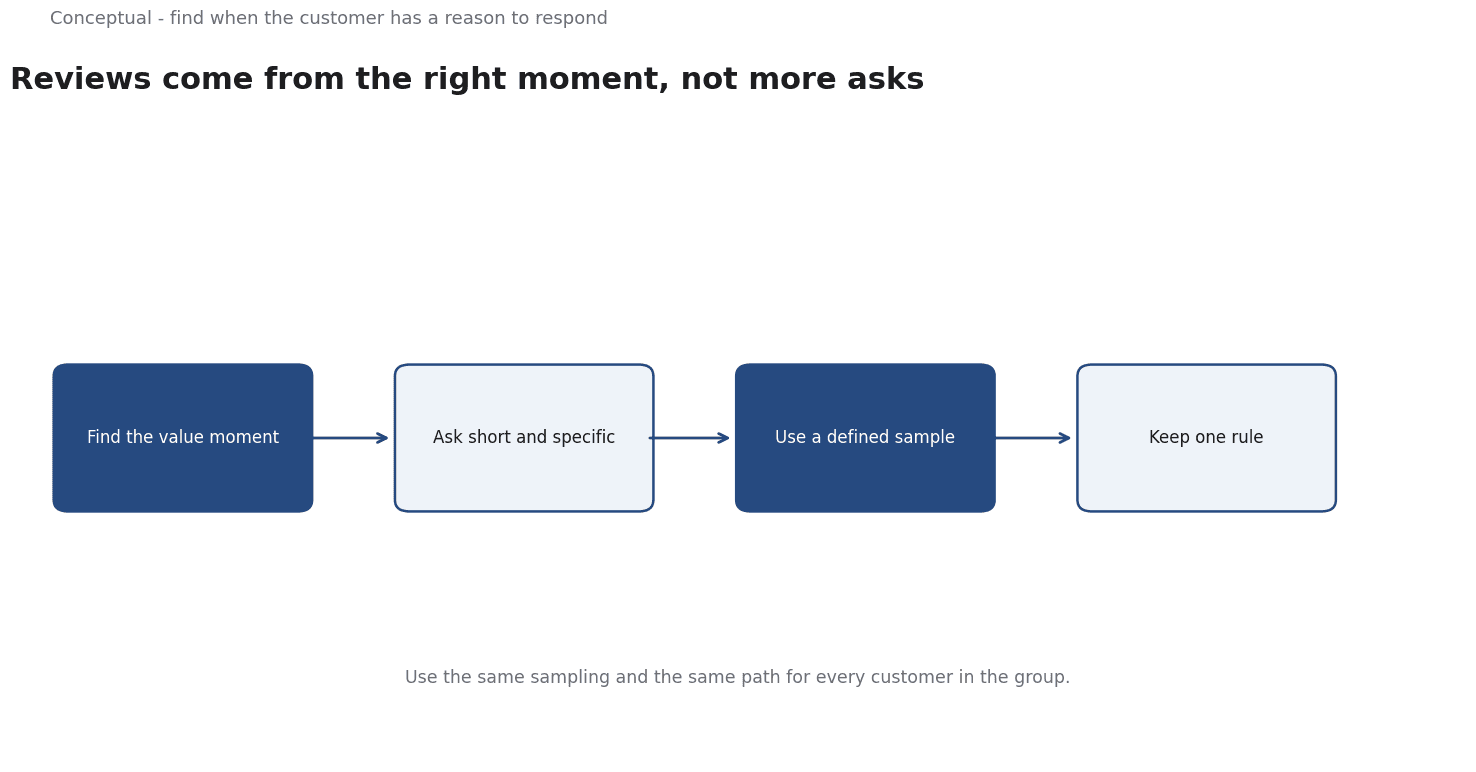
When to ask
After a value moment. The right time is when the customer has just achieved the outcome the product promises — completed a first report, resolved a ticket, finished a project. Asking at signup, before value, produces silence.
Not during a problem. A customer in the middle of a support issue should be helped, not surveyed. The request can follow after resolution.
Once per customer per cycle. Repeated requests annoy people and bias the sample toward those who respond to prompts.
Three frictions matter: the request should be one click where possible, it should be mobile-friendly, and it should not require a login the customer has forgotten.
A worked example of a review request
The following is hypothetical and illustrative.
An e-commerce store sends 10,000 order-completion emails a month. It wants more product reviews.
Current approach: a request in the shipping-confirmation email, sent before delivery. Response rate: 0.5%, or 50 reviews a month.
Revised approach: a request three days after confirmed delivery, with the product name in the subject and a one-click rating. Assume a 4% response rate — 400 reviews a month.
Three checks decide whether this is real:
- Is the sample representative? If only customers with a positive experience respond, the average rating will flatter the product. Track the response rate and compare reviewers with non-reviewers on observable fields such as order value and repeat purchase.
- Is the timing causing bias? A request three days after delivery captures first impressions, not durability. For products where long-term performance matters, a second request at 30 days may be more useful.
- Are reviews being suppressed? A programme that routes unhappy customers to a private form and happy ones to a public site produces a misleading public record. That is a manipulation of evidence, not a review strategy.
Three decisions follow:
- Move the ask to after value, with a stated reason.
- Measure representativeness, not only count.
- Use the same path for every customer in the sampled group, regardless of likely sentiment.
Where review requests belong in the workflow
Three placements are worth considering, each with a different purpose:
Transactional email after delivery or completion reaches a customer at a predictable moment with high open rates. It is the highest-volume channel and the one most susceptible to asking too early, so the timing rule matters more than the copy.
In-product after a value event reaches the customer when the product has just done something useful. It is more contextual than email and can be tied to the specific feature used, which produces more specific reviews. It also risks interrupting the workflow, so it should be small and dismissible.
Support follow-up after resolution reaches a customer whose problem was just fixed. This is a sensitive moment: a request for a public review before checking that the issue is truly resolved can turn a neutral experience into a negative one. Confirm resolution first, then ask.
A programme that uses all three should keep one rule across them: the same sampling and the same path for every customer in the group.
Different wording by channel is fine; different routing by likely sentiment is not.
What reviews cannot tell you
They are not a satisfaction survey. Reviewers self-select, and the reasons for reviewing are not the same as the reasons for being satisfied. A proper satisfaction measure uses a defined sample, as AAPOR's standards describe.
They are not proof of quality. A product with many five-star reviews may have a vocal early audience; one with fewer reviews may serve a niche. Compare within a category and read the distribution, not the average.
They are not a substitute for response. A negative review that receives a thoughtful, specific reply can build more trust than a page of unblemished praise. The way a company handles criticism is itself evidence for buyers.
A single, well-timed ask is normal customer communication; repeated prompts are not.
A decision test
- Identify the moment of value for your product.
- Ask once, shortly after that moment.
- Make the request one click and mobile-friendly.
- Use a defined sample and do not route by sentiment.
- Track response rate and representativeness.
- Respond to negative reviews with specifics, not scripts.
- Treat reviews as evidence of individual experience, not a satisfaction metric.
For the decision context, see Demand Generation vs Lead Generation; for the research standard, see AAPOR.
References & Further Reading
- American Association for Public Opinion Research, 2026. AAPOR — The professional association for public opinion and survey research; its standards and resources underpin the survey-design discussion.
- Wikipedia contributors, 2026. Demand generation - Wikipedia — An overview of demand generation as a marketing discipline distinct from lead generation; secondary reference used with the lead-generation entry.