How to Grow a Newsletter From Zero
A newsletter grows when the promise is specific and the distribution is repeatable. Read the first-1000-subscriber sequence with numbers.
Most newsletters stop growing because they are launched before anyone knows what they are for. The first thousand subscribers are not found through a growth hack; they come from a clear promise to a defined audience and a repeatable way of reaching that audience.
Direct answer: Start with a specific promise to a named reader, publish on a schedule you can keep, and recruit through channels where that reader already is. Gmail's sender guidelines govern deliverability as the list grows, and demand-generation principles explain why a newsletter serves a stage of a decision. The boundary: subscriber count is a vanity metric unless those subscribers read and act — engagement and retention matter more than size.
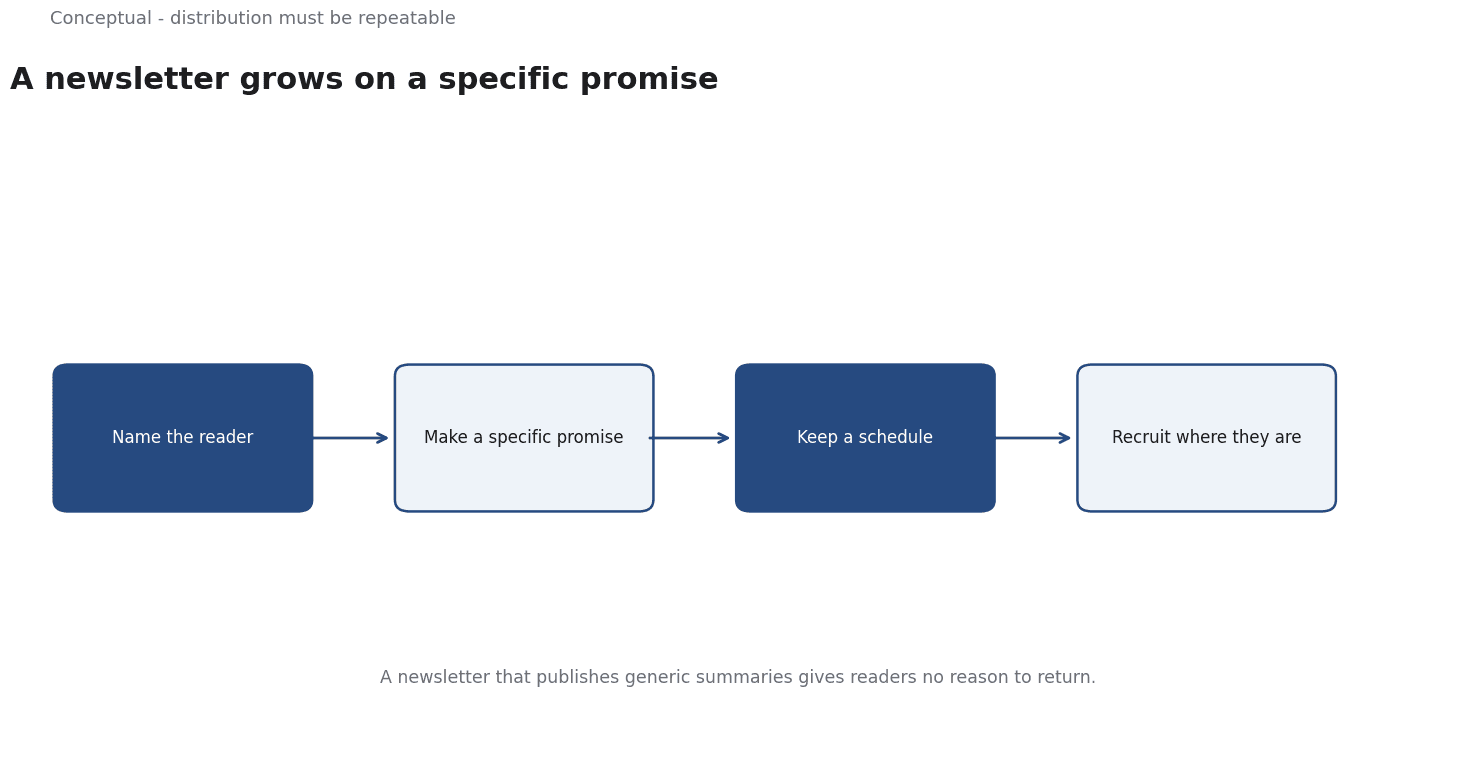
The first-thousand sequence
1. Define the reader and the promise. "A weekly note for operations managers on reducing manual reporting" is usable. "A newsletter about business" is not. The promise should be something a reader would want to receive next week.
2. Publish three issues before recruiting.
Three issues show what the reader gets.
3. Recruit from a channel you already control. Existing customers, colleagues, and a personal account are the first sources. The point is not scale; it is finding the first readers who match the promise.
4. Ask for referrals at the moment of value. A reader who just found an issue useful is the right person to ask. Make the ask specific: "forward this to one person who runs reporting".
5. Protect deliverability from the start. Use confirmed signups, make unsubscribing easy, and watch complaint rates as the list grows, as the sender guidelines advise.
A worked example of the arithmetic
The following numbers are hypothetical and illustrative.
A newsletter aims for 1,000 subscribers in six months with a weekly issue.
- Referrals from readers: 40 per month on average, if 20% of readers forward and each forward yields a small number of signups.
- Content upgrades on three articles: 60 per month combined.
- Direct promotion in an existing community: 60 per month.
Total: 160 per month, reaching 960 in six months — close to the goal. Three factors decide whether this holds:
- Churn. If 3% of the list unsubscribes each month, net growth falls. At 500 subscribers, that is 15 lost per month; by 1,000, it is 30. The recruiting rate must exceed churn, which rises with size.
- Engagement. If only 25% of subscribers open an issue, the promise is not landing with most of the list. A smaller, engaged list is more valuable than a large silent one, as the email-metrics article explains.
- Referral decay. As the most enthusiastic readers exhaust their networks, referrals slow. New sources are needed by month four, not after growth stops.
Three decisions follow:
- Track net growth, not signups — subtract unsubscribes every month.
- Measure engagement by cohort, so a decline in quality is visible early.
- Add a new acquisition source before referrals decay, not after.
What to write about
The promise should be tied to a decision the reader makes repeatedly. Four reliable sources:
A recurring problem — a task the reader does every week and would like to do better.
A change in the field — regulations, tools, or practices that affect their work, explained with a point of view.
Worked examples — a real problem solved with numbers and a method, which are more useful than opinions.
Curated evidence — a small number of sources worth reading, with a reason why each matters.
A newsletter that publishes generic summaries gives readers no reason to return.
Specificity is the moat.
What the numbers cannot show
A signup is not a reader. The metric that matters is whether people open, click, and reply over months, not the day they subscribed.
Referrals are not automatic. They follow from a reader feeling that forwarding an issue helps someone they know. A generic "share this" ask does less than a specific one.
Growth is not the goal. The goal is a reader who trusts the newsletter enough to act on it.
A list of 200 such readers can be more valuable than 10,000 who signed up for a template and forgot.
The counterargument — that a small list cannot sustain a business — is fair. The response is to grow from a base of engaged readers rather than buying a list, which damages deliverability and produces no audience.
A decision test
- Write the promise for a named reader in one sentence.
- Publish three issues before asking for signups.
- Recruit from a channel you control.
- Track net growth with unsubscribes subtracted.
- Measure engagement by cohort, not just list size.
- Ask for referrals at the moment of value.
- Protect deliverability with confirmed signups and easy unsubscribes.
For the metrics, see Email Marketing Metrics; for the acquisition frame, see Demand Generation vs Lead Generation.
References & Further Reading
- Wikipedia contributors, 2026. Demand generation - Wikipedia — An overview of demand generation as a marketing discipline distinct from lead generation; secondary reference used with the lead-generation entry.
- Google, 2026. Email sender guidelines - Gmail Help — A major mailbox provider's published sender requirements and bulk-sender recommendations.