How to Get Problem Solving Right
Problem solving fails when the problem is defined too narrowly. Read the method, a worked example, and why a fast fix can be the most expensive option.
Most problem-solving advice starts with generating solutions, which is premature when the problem itself is misdefined. A team asked to reduce late deliveries may optimise dispatch while the real constraint is upstream inventory, as the root-cause article treats a symptom as different from its cause, as Decision Memos That Survive Review requires a specific question, as the Program on Negotiation material treats interests as the thing to uncover.
Direct answer: Define the problem with evidence, separate symptoms from causes, generate options before choosing, and record why you chose. The Program on Negotiation at Harvard Law School provides reasoning methods, and the decision-making entry covers the structure of a choice. The boundary: no method guarantees the right answer, which the publication standard forbids claiming, as the risk-assessment article requires residual uncertainty, as Decision Memos That Survive Review requires a reversal condition.
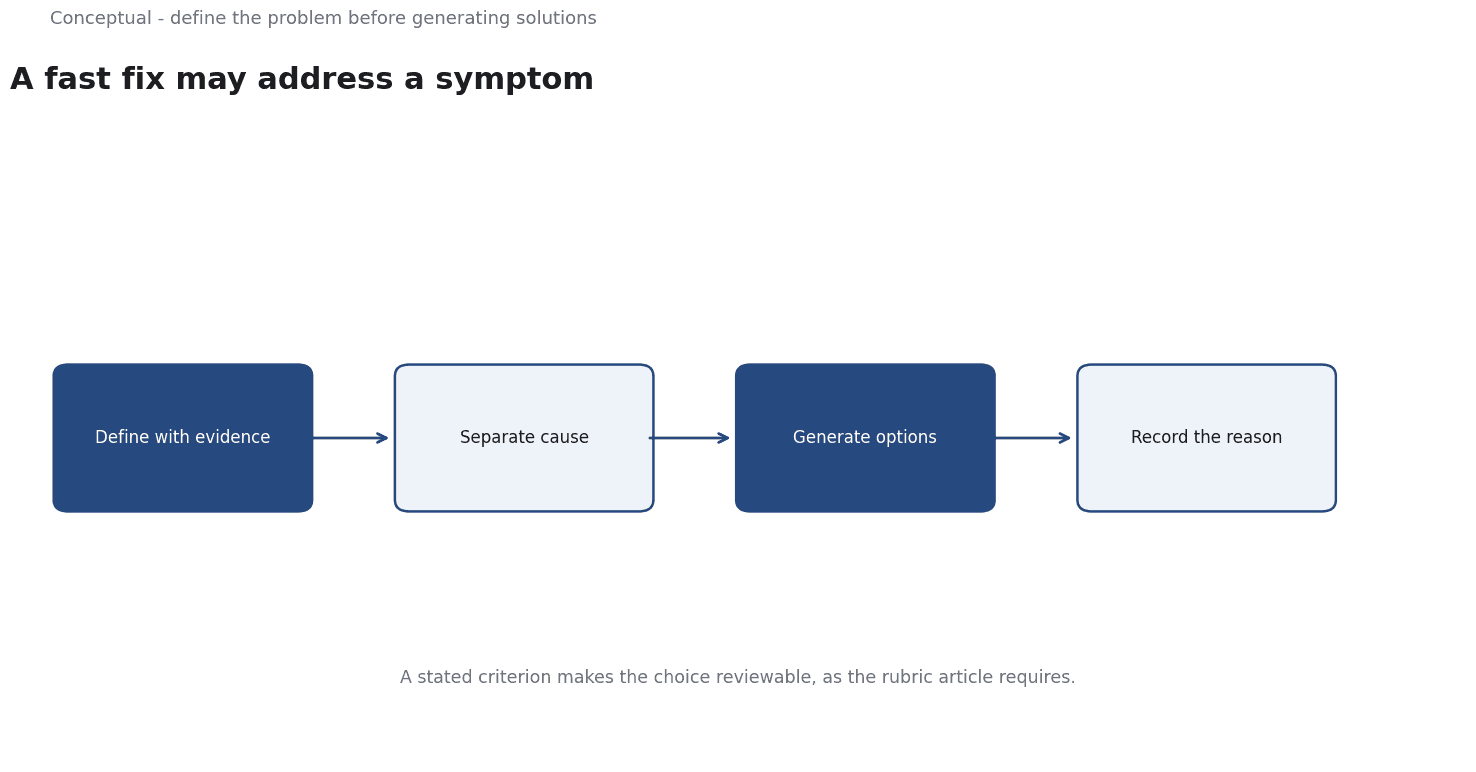
The method
Define the problem in one sentence. What is the gap between the current state and the desired state, with a measure and a window, which the evaluation-rubric article requires for concrete criteria, as Decision Memos That Survive Review requires a specific question? A vague goal produces a vague process, as the five-minute-update article treats a single ask.
Separate symptom from cause. A late delivery is a symptom; the cause may be inventory, staffing, or a supplier, which the root-cause article distinguishes, as the causal-inference article requires a different design to establish a cause, as the correlation article warns about acting on association.
Generate options before judging. A single proposed fix is usually a position, which the negotiation article treats as distinct from an interest, as the conflict article advises on interests, as the build-versus-buy article treats multiple options.
Choose with a criterion. What standard decides between options, which the rubric article requires, as the prioritisation article advises for ranking, as the dashboard article argues for metrics tied to decisions? A criterion should be stated before the options are compared, as Decision Memos That Survive Review requires for evidence.
Record and set a reversal condition. What would change your mind, which the decision-memo article treats as the mark of a falsifiable decision, as the monitoring article advises for a review trigger, as the documentation article advises on where to record it.
Three consequences follow. The process is slower at the start and faster overall, which the root-cause article argues, as the technical-debt article warns about repeated fixes. The criterion makes the choice defensible, as the rubric article requires, as the evaluation article advises for traces. And the record prevents reopening, as Decision Memos That Survive Review advises, as the small-team decision article requires for clarity.
A worked example
The following is hypothetical and illustrative. A team is told to reduce customer complaints about a product.
Three checks decide the approach. First, is the problem defined with a measure and window, as the rubric article requires, rather than "reduce complaints," as Decision Memos That Survive Review advises? Second, are symptoms separated from causes, as the root-cause article requires, with evidence rather than correlation, as the causal-inference and correlation articles advise? Third, were multiple options generated before choosing one, as the negotiation and build-versus-buy articles advise, with a criterion stated in advance, as the rubric article requires?
Three conclusions follow.
A stated criterion makes the choice reviewable, as the rubric article requires.
And the decision should be recorded with a reversal condition, as Decision Memos That Survive Review requires, as the monitoring article advises.
What problem solving cannot do
It cannot create information that is not available, which the risk-assessment article treats as uncertainty to be named, as the data-quality article warns about bad inputs. It does not guarantee a good outcome, which the publication standard forbids claiming, as the risk article requires residual risk. And it cannot replace authority to act, which the governance checklist treats as an accountability gap, as the small-team decision article advises.
The counterargument that a bias toward action is better than analysis is fair when the decision is cheap and reversible, which the build-versus-buy article treats as fit, as Decision Memos That Survive Review argues for proportionality, as the worked example shows for a costly choice.
A decision test
- Define the gap with a measure and a window, as the rubric article requires.
- Separate symptoms from causes with evidence, as the root-cause article advises.
- Generate options before judging, as the negotiation article recommends.
- State the criterion in advance, as the rubric article requires.
- Choose and record the reason, as Decision Memos That Survive Review requires.
- Set a reversal condition, as Decision Memos That Survive Review requires.
- Review on evidence, as the monitoring article advises.
For the written form, see Decision Memos; for the alternative view, see Problem Solving Without the Hype.
References & Further Reading
- Harvard Law School, 2026. Program on Negotiation at Harvard Law School — A university consortium dedicated to developing the theory and practice of negotiation and dispute resolution.
- Wikipedia contributors, 2026. Decision-making - Wikipedia — Overview of decision processes, trade-offs and the distinction between the decision and its outcome; secondary reference.