How to Get Product Management Right
Product management is not backlog administration. Read the decisions it owns, a worked example, and why shipping is not the outcome.
Product management is often described as the role between engineering and business, which sounds like coordination and misses the substance. The job is to decide what problems are worth solving, in what order, with what evidence — and to make those decisions legible to the people who must execute them.
Direct answer: Effective product management owns the problem definition, the evidence for prioritisation, and the measurement of outcomes, not the backlog itself. The product-management overview provides the discipline's context, and O*NET's task descriptions help ground the work in real activities. The boundary: a process cannot create a good product idea or a clear strategy, which the value-proposition article argues is the prior decision, and frameworks do not replace evidence, as the AI-product-management article treats use cases as hypotheses.
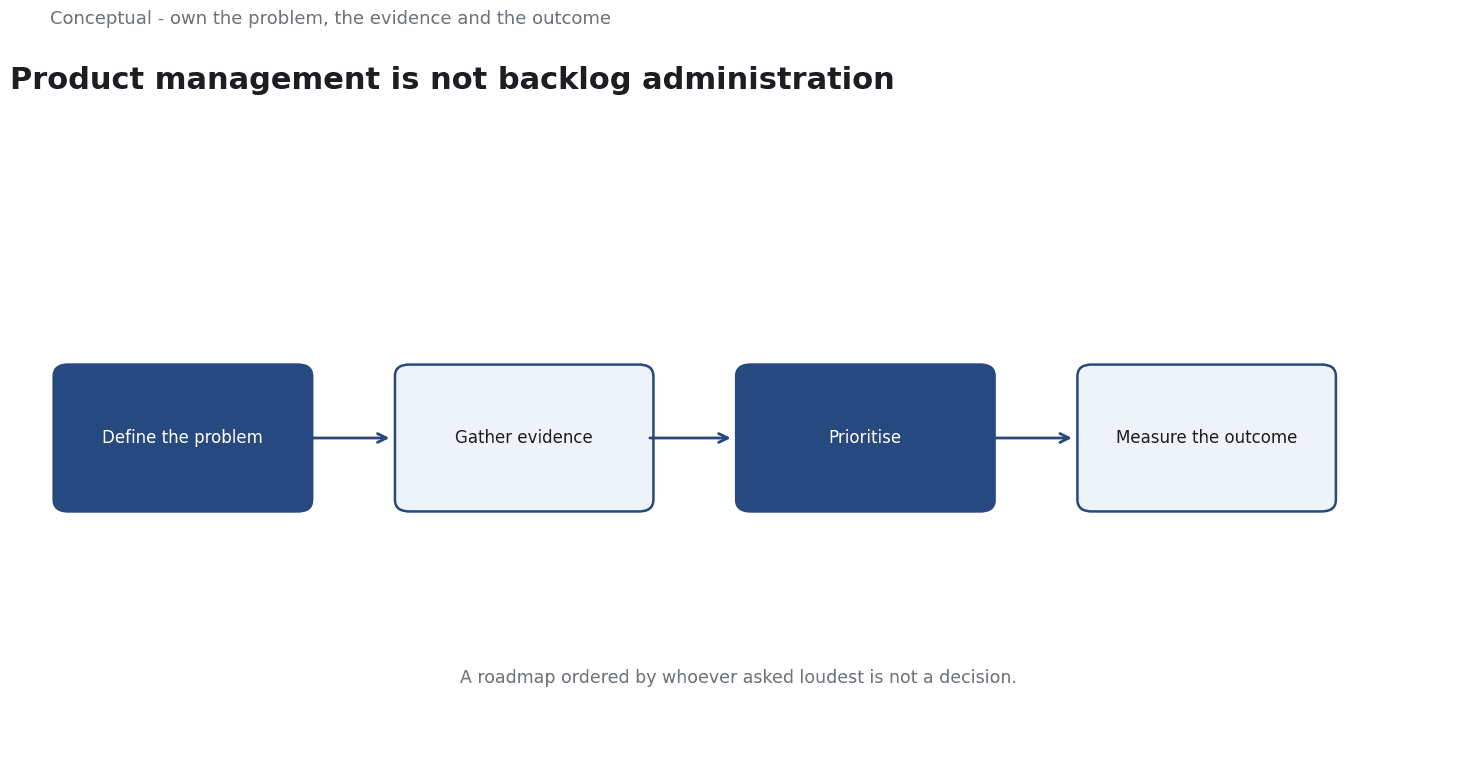
The decisions
What problem, for whom. A specific reader and a consequential question, which the publication standard requires for articles and applies here to products. The jobs-to-be-done article frames this as a situation the customer is in, not a demographic.
Why now. Prioritisation should reflect value, evidence, and cost, as the engineering-management article treats competing demands.
What would prove it worked. An outcome metric with a baseline and a window, which the evaluation-rubric article requires for concrete evidence. Shipping a feature is an activity; changing a customer behaviour is an outcome, as the funnel article distinguishes stages.
Three consequences follow.
The product manager needs evidence before a roadmap, which the market-research article covers for customer input.
The decisions must be communicated, as the internal-communications article argues for making trade-offs legible. And they must be revisited when evidence changes, which the monitoring article treats as a review trigger.
A worked example
The following is hypothetical and illustrative. A team has three candidate projects: a billing fix, a new onboarding flow, and a reporting feature requested by a large customer.
The product manager defines the problem for each with evidence: billing errors cause support contacts, as Voice of Customer: Turning Feedback into Decisions recommends for grouping feedback; onboarding stalls before first value, which the funnel article measures as activation; and the reporting request comes from one account, which the segmentation article treats as a question of representativeness. Three checks decide the order. First, what is the value and how concentrated, as the unit-economics article asks for margin and segment? Second, what evidence exists that the proposed solution helps, which the startup-validation article treats as a hypothesis to test? Third, what is the opportunity cost of each, as the engineering-management article frames capacity?
Three conclusions follow. The billing fix is justified by repeated contacts with a measurable cost, as Voice of Customer: Turning Feedback into Decisions advises. The onboarding flow is tested before full build, as the trial-design article recommends for a bounded experiment. The single-account request is logged rather than built, with the reasoning recorded, as the decision-memo article requires.
What product management cannot do
It cannot create demand by announcement, which the demand-generation article argues is preference built before capture. It cannot fix a weak product with a process, as the value-proposition article treats the offer as the buyer's real evaluation. And it is not the same as project management: delivery without the right problem is efficient irrelevance, which the strategy article warns about for operational effectiveness without position.
The counterargument that product management is just common sense is fair about the individual decisions and wrong about the discipline: doing them consistently, with evidence and recorded reasoning, is the work, as the decision-memo article argues for records that change behaviour.
A decision test
- Define the problem and the reader before the solution.
- Gather evidence from support, interviews, and behaviour, as Voice of Customer: Turning Feedback into Decisions recommends.
- Prioritise by value and evidence, not loudness, as the engineering-management article advises.
- Set an outcome metric with a baseline, as the evaluation-rubric article requires.
- Test the riskiest assumption before full build, as the startup-validation article recommends.
- Record the decision and the trade-off, as the decision-memo article requires.
- Revisit on new evidence, as the monitoring article advises.
For the role context, see AI Product Management; for the evidence, see Voice of Customer.
References & Further Reading
- Wikipedia contributors, 2026. Product management - Wikipedia — The discipline of discovering, defining and delivering product value.
- U.S. Department of Labor, 2026. O*NET OnLine — The standard occupational taxonomy used to compare roles across industries.