How to Run a Competitive Positioning Workshop
A positioning workshop should end with a decision and a test, not a wall of sticky notes. Read the agenda, a worked output, and the traps.
Positioning workshops often produce energy and no decision. Participants list competitors, debate adjectives, and leave with a word cloud. The problem is not the participants; it is an agenda that never asks the questions strategy requires — what the customer compares, what you can defend, and what you will deliberately not do.
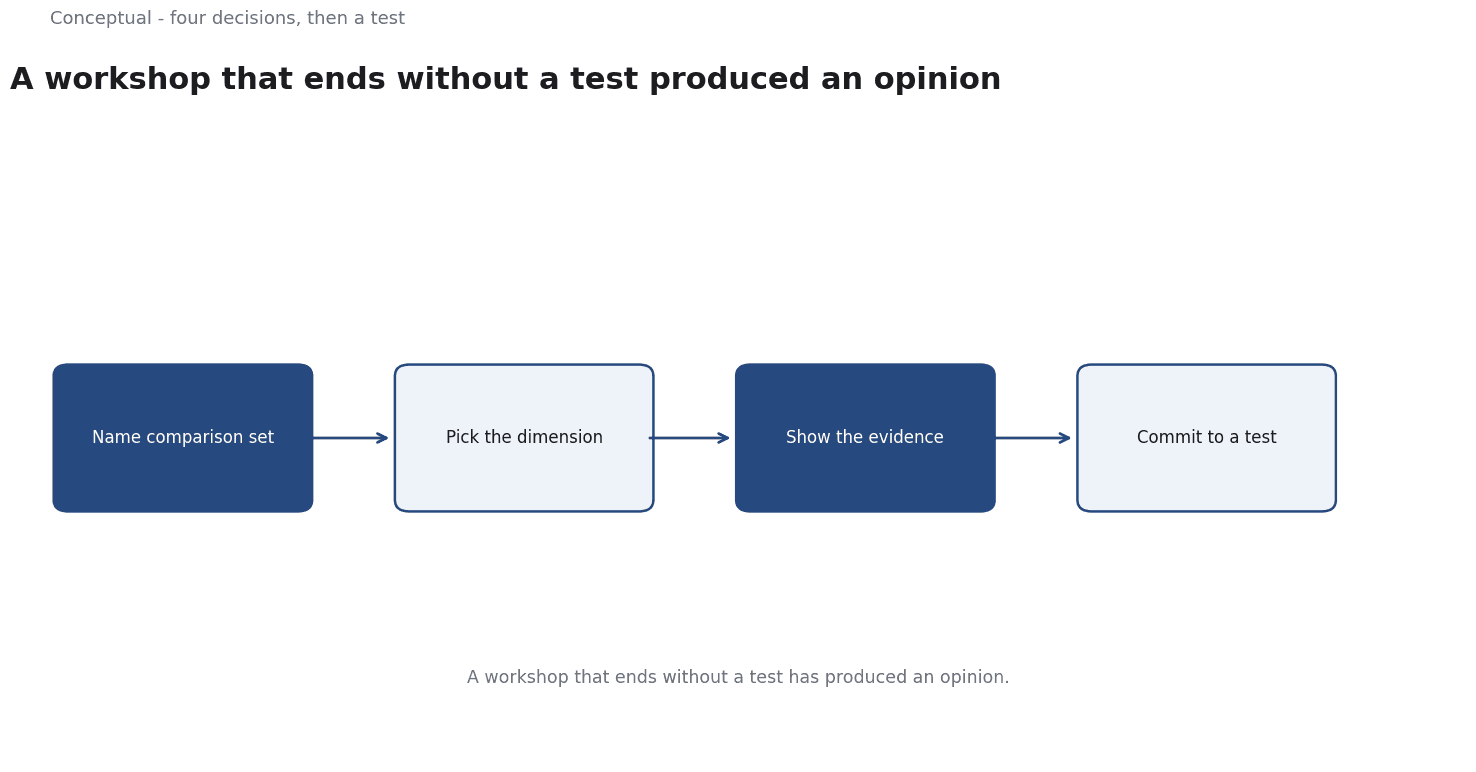
Direct answer: A useful workshop makes four decisions explicit: the comparison set, the dimension on which you compete, the evidence supporting the claim, and the activities that must change to support it. Porter's argument that operational effectiveness is not strategy is the right frame, and the blue-ocean question — whether the comparison set itself should change — belongs on the agenda. The boundary: a workshop produces a hypothesis; customer evidence and delivery confirm or reject it.
The agenda
1. Frame the decision. What choice is this workshop meant to resolve — a new market, a repositioning, a response to a competitor? Write it at the top.
2. Define the comparison set. Which alternatives does the customer actually consider? Include the status quo and non-consumption, which are often the real competitors.
3. Identify the criteria. What does the customer use to choose among those alternatives? Use customer language from interviews or reviews, not internal adjectives.
4. Find the defensible difference. Where can you make a claim that a competitor cannot copy without changing their business? This is where Porter's fit argument applies: a position is supported by activities, not by a slogan.
5. Choose the trade-off. What will you deliberately not do? A position without an exclusion is a list of ambitions.
6. Write the test. What evidence would confirm or reject the hypothesis, and who owns it?
A workshop that ends without a test has produced an opinion.
A worked output
The following is hypothetical and illustrative.
A logistics software company holds a workshop. The output is one page:
- Comparison set: spreadsheets, a large incumbent suite, and doing nothing.
- Customer criteria: time to a correct shipment plan, effort to reconcile exceptions, trust in the numbers.
- Defensible difference: the product recomputes a plan from live exceptions, while the incumbent updates nightly and spreadsheets require manual re-entry. The supporting activity is an event-driven data pipeline the competitors do not have.
- Trade-off: not competing on breadth of modules; not targeting enterprises that need a full ERP.
- Test: interview 15 customers who evaluated the incumbent, ask them to rank the three criteria, and measure whether the live-recompute claim changes their stated preference. Owner: the product lead. Date: six weeks.
Three properties make this usable:
- The difference is tied to an activity, not an adjective. A competitor cannot claim it without changing their architecture.
- The trade-off is specific. "Not a full ERP" tells sales which deals to decline.
- The test is falsifiable. If customers do not rank the criteria as assumed, the position needs revisiting.
Three cautions apply: the interview sample should represent the target segment, stated preference is weaker than behaviour, and the test result must be recorded alongside the decision.
Common failure modes
Four patterns derail these sessions, and each has a specific correction:
Debating adjectives instead of evidence. A room that argues about whether the brand is "bold" or "considered" has skipped the customer-evidence step. Bring interview quotes and lost-deal notes, and require each criterion to cite one.
Choosing a comparison set that flatters you.
Include the status quo and the alternative a buyer would actually choose, even when that alternative is unglamorous.
Refusing to name a trade-off. A position that includes every ambition has made no choice. The facilitator should ask directly what the company will not do, and record the answer even when it is uncomfortable.
Ending without a test. A position is a hypothesis about customer behaviour. If no one owns a falsifiable check with a date, the workshop has produced a story. The test is the smallest step that could prove the story wrong.
These corrections are procedural, which is why they belong in the agenda rather than in the facilitator's discretion.
What a workshop cannot do
It cannot invent a defensible difference. If none exists, the output is a preference, and the real work is building the activity that would support one. A workshop cannot substitute for product investment.
It cannot replace customer evidence. Internal debate about what customers value is a poor substitute for interviews, reviews, and lost-deal notes. Bring the evidence in; do not generate it in the room.
It cannot settle execution. A position is a choice about what to do. The workshop ends with a decision and a test; the subsequent roadmap, hiring, and pricing are separate work.
The counterargument — that positioning should emerge from data rather than a workshop — is partly fair.
The workshop is where a team interprets evidence and makes a choice.
It cannot manufacture the evidence, and it should not pretend to.
A decision test
- Write the decision the workshop must resolve.
- List the real alternatives, including doing nothing.
- Use customer language for the choice criteria.
- Tie the difference to an activity that is hard to copy.
- State the trade-off — what you will not do.
- Write a falsifiable test with an owner and a date.
- Record the result beside the position, whether it confirms or rejects it.
For the strategic frame, see Brand Positioning; for the broader question, see Category Design.
References & Further Reading
- Michael E. Porter, 1996. What Is Strategy? — The differentiation-versus-cost argument behind competitive-advantage analysis.
- Wikipedia contributors, 2026. Blue Ocean Strategy - Wikipedia — The strategy framing of creating uncontested market space rather than competing in an existing one; secondary reference.