Category Design: Create a Market Instead of Competing
Sometimes the winning move is to change what customers compare you against. Read how categories form, a worked positioning example, and the limits.
When a company describes itself as "a better X", it accepts the rules of the X category: the features customers compare, the price range they expect, and the competitors they name. Category design asks a different question — what if the company changed the frame so that X was no longer the right comparison? The idea is popular, and often misunderstood as inventing a word for a product you already have.
Direct answer:
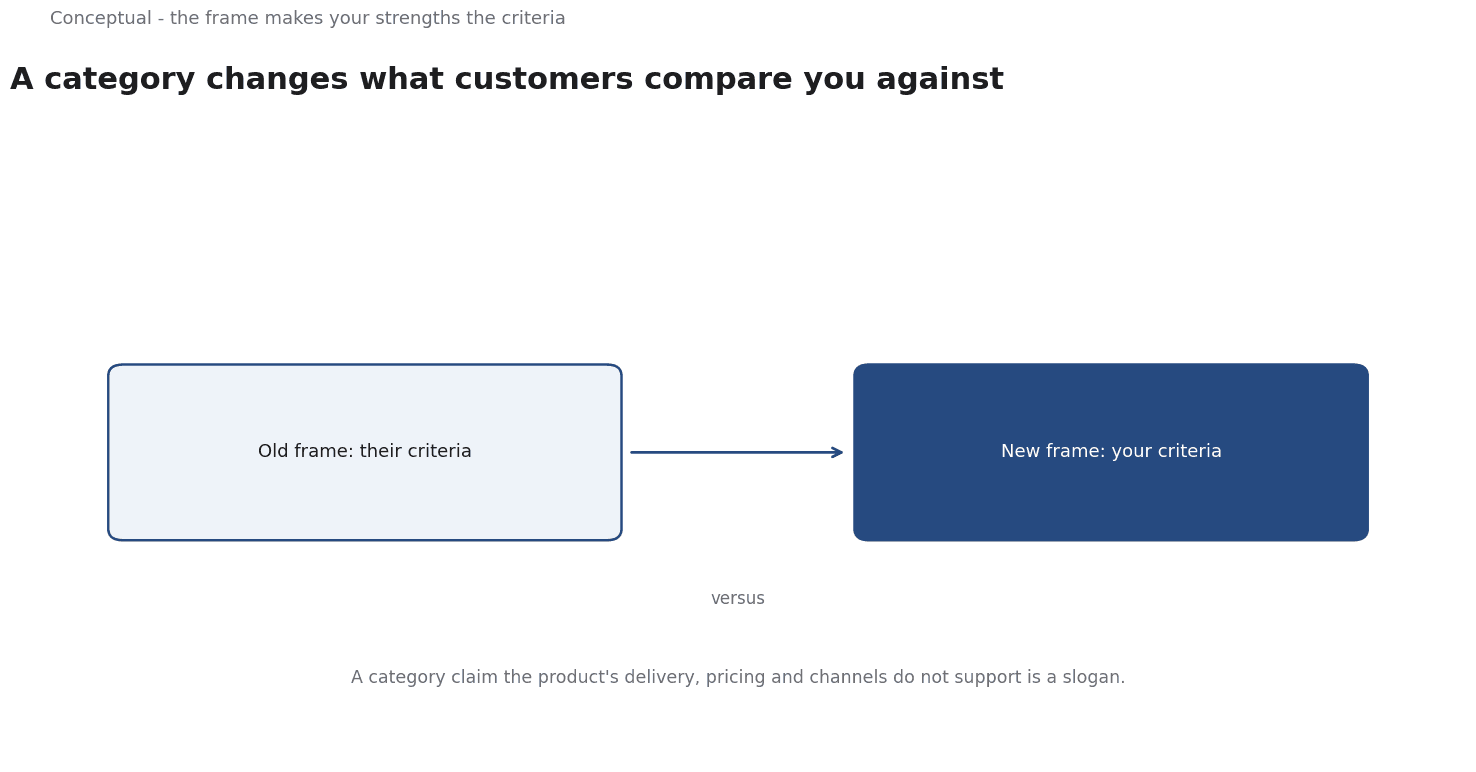
A product category groups substitutes and shapes how customers compare options; category design tries to establish a frame in which your offering's strengths become the criteria of comparison.
Wikipedia's overview of blue-ocean strategy frames this as creating "uncontested market space" rather than competing in an existing one, and Porter's strategy argument warns that operational effectiveness is not strategy. The boundary: renaming a product does not create a category; a category exists only when customers, competitors, and the economics around it behave differently.
What a category actually does
A category is a cognitive and commercial shortcut. It tells a buyer which alternatives to consider, which attributes matter, and what a reasonable price looks like. "Project management software" and "enterprise resource planning" create different comparison sets even when the products overlap.
Three effects follow:
It defines the competitor set. A company in the "email marketing" category competes with other email tools. One that frames itself as a "customer lifecycle platform" competes with a different set — and must earn the right to that frame.
It defines the criteria. If the category's criteria are delivery speed and price, a product whose advantage is reliability will struggle to be seen. Category design tries to make reliability a criterion.
It defines the budget line. Buyers allocate spend to categories. A product that is the only member of a new category may face the harder problem of finding any budget at all.
Porter's point about fit is relevant: a distinctive position is supported by a system of activities, not by a label.
How a category claim becomes real
Four things have to change together:
- Language. Give the new frame a name that describes the problem, not the product's features. Customers adopt language that helps them explain a choice to someone else.
- Criteria. Publish the measures by which the new frame should be judged, and make sure your product wins on them for a defensible reason.
- Proof. Show evidence — customer outcomes, comparisons, reference cases — that the frame is useful rather than flattering.
- Ecosystem. Competitors, analysts, and buyers have to use the frame. If only you use it, you have a tagline.
Wikipedia's blue-ocean overview describes the aim as making competition irrelevant by creating new market space. That is an outcome, not a step; the steps are the unglamorous work above.
A worked example of a frame decision
The following is hypothetical and illustrative.
A company sells software that monitors cloud infrastructure. In the "monitoring tools" category, buyers compare dashboard features, alerting rules, and cost per host. The company's actual strength is predicting incidents before they occur — something established monitoring tools do not emphasise.
Option A — compete in the existing category. Enter the monitoring comparison with better dashboards. The company must match incumbents on the criteria buyers already use, and its predictive strength becomes a footnote.
Option B — propose a new frame. Position around "incident prevention" with a different criterion: incidents avoided per month. The product's strength becomes the headline measure.
Three tests decide whether Option B is viable:
- Can the metric be measured credibly? "Incidents avoided" requires a counterfactual. If the company cannot show a defensible comparison, the criterion will be dismissed.
- Is the problem recognised? Buyers must already feel the pain of incidents strongly enough to care about prevention. If they do not, the company must educate the market before selling — a cost that belongs in the plan.
- Can the claim be delivered across the system? Support, documentation, and pricing must all reflect prevention. A "prevention" category with per-host pricing and reactive support will look like a rebrand.
If the answers are yes, Option B changes the comparison set. If the metric cannot be substantiated, Option A with a clearer proof point is the more honest strategy.
Reading the signs that a frame is working
A category claim is not proven by a launch video. Four observable signals suggest it has taken hold:
Customers use the language without prompting. When buyers describe their problem using your frame in support tickets or reviews, the vocabulary has entered their thinking. That is more meaningful than branded search volume, which can be bought.
Competitors respond to the frame. If rivals start emphasising the criteria you named — or adapt their messaging to counter it — the comparison set has shifted. They would not respond to a tagline.
Analysts and procurement use the category. When a category appears in evaluation templates or buying guides, it has crossed an institutional threshold. This is slow and hard to accelerate.
The economics change. A category that works often supports different pricing, because the comparison basis has changed. A product priced per host and one priced per incident avoided are not competing on the same scale.
The absence of these signals after a launch does not prove failure; category change is slow. It does mean the claim should remain a hypothesis in the plan, not a completed fact in the strategy deck.
What category design cannot do
It cannot substitute for a product difference. A new name around unchanged capabilities buys a short period of confusion, not durable advantage. Porter's warning about operational effectiveness applies: a frame that competitors can copy without changing anything is not a position.
It cannot create demand by itself. A new category has no established budget. The company may need to fund the education that an existing category provides for free.
It is not a legal or technical fact. A category is a shared belief. It changes when enough buyers and competitors behave as if it exists, which is not fully under one company's control.
The counterargument — that category creation is a luxury for well-funded companies — is largely fair. A small company usually benefits from an existing category because it reduces explanation cost.
The right question is whether the existing frame systematically hides what makes you different.
A decision test
- Name the category your buyer uses today and list its comparison criteria.
- Identify what you win on that the category does not value.
- Ask whether that difference is defensible — can a competitor copy the claim without changing the product?
- Define a measurable criterion for the new frame and test it.
- Check the budget question — where would this spend come from today?
- Align language, proof, product, pricing and support before announcing anything.
- Treat the category as a hypothesis and watch whether others adopt the language.
For the strategic foundation, see How Companies Build Competitive Advantages; for the messaging layer, see Brand Positioning.
References & Further Reading
- Wikipedia contributors, 2026. Blue Ocean Strategy - Wikipedia — The strategy framing of creating uncontested market space rather than competing in an existing one; secondary reference.
- Wikipedia contributors, 2026. Product category - Wikipedia — How product categories group substitutes and shape customer comparison; secondary reference.
- Michael E. Porter, 1996. What Is Strategy? — The differentiation-versus-cost argument behind competitive-advantage analysis.