How to Validate a Startup Idea Before Building the Product
Most startups fail because they build something nobody wants. Learn how to test demand, pricing, and willingness to pay before writing code.
Most startups do not fail because they cannot build the product. They fail because they build something nobody wants to pay for.
Direct answer: Validating a startup idea means testing whether customers have a real problem, care enough to pay for a solution, and will choose your solution over alternatives—before you invest in building the product.
The goal is to falsify the idea quickly and cheaply, not to confirm it.
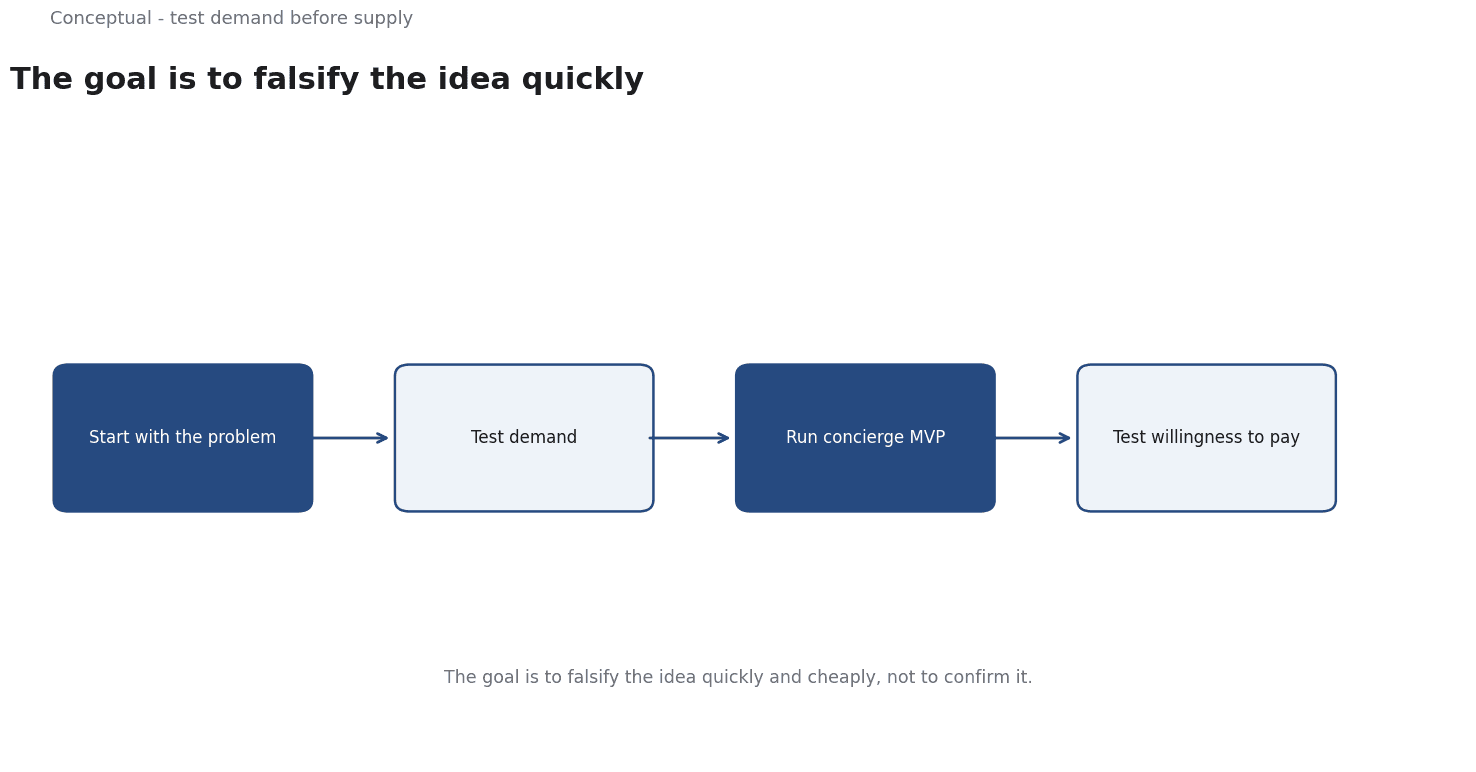
Start with the problem, not the solution
Founders often fall in love with their solution before confirming the problem exists. A good validation starts with the customer's situation:
- What is the painful situation? Not "people need AI" but "small retailers lose hours each week reconciling inventory across two systems."
- Who experiences it? Be specific: role, company size, industry, context.
- How do they cope today? Customers already solve the problem somehow—manual spreadsheets, hiring temporary staff, doing nothing. That current workaround is your real competitor.
- How much does it cost them? Time, money, stress, missed revenue. If the cost is low, they will not pay much to fix it.
If you cannot describe the problem in the customer's own words, you do not understand it well enough to build for it.
Test demand before supply
Build nothing that does not directly test a hypothesis about customer behavior. The strongest validation signals, in order:
- Letters of intent or pre-orders. A customer signs a document saying they will buy at a specific price when the product exists. Weak if non-binding, stronger if a deposit is involved.
- Paid pilots. A customer pays to try an early, manual version of the solution. Money is the only signal that does not lie.
- Letters of interest without commitment. Useful for direction, weak for demand.
- Survey responses saying "I would buy that." Hypothetical and unreliable. People are polite and bad at predicting their own behavior.
A landing page with an email capture tests interest, not demand. Interest is free; demand costs money.
The concierge MVP
Before writing code, deliver the service manually. If you are building inventory reconciliation software, do the reconciliation yourself using spreadsheets and email for one retailer. If you are building a meal-planning app, plan meals by hand for five customers via WhatsApp.
This concierge approach tells you:
- Whether customers value the outcome (not your technology).
- What the actual workflow looks like, which informs what to automate later.
- Where the real pain points are, which may differ from your assumptions.
If customers will not pay for the manual version, they will not pay for the automated version either.
Pricing and willingness to pay
Asking "how much would you pay?" produces unreliable answers. Better approaches:
- Show a price and ask if they would buy at that price. Binary yes/no is more honest than open-ended estimation.
- Compare to current costs. If the customer spends $500/month on the workaround, your solution must be meaningfully cheaper or more valuable.
- Offer a pre-order at a discount. Willingness to pay now, even at a discount, is stronger evidence than future promises.
Pricing validation also tests whether the problem is painful enough. If customers balk at a price that covers your costs, the problem may not be worth solving commercially.
Competition is not what you think
Your competitor is not the other startup building a similar product. It is whatever the customer does today: spreadsheets, paper, hiring an intern, doing nothing. Many "no market" failures happen because the founder underestimated the inertia of the status quo.
If customers are not actively trying to solve the problem, your product faces an uphill battle regardless of quality.
Decision framework: proceed, pivot, or kill
After validation, make an explicit decision:
- Proceed: Evidence of genuine willingness to pay, a reachable customer segment, and a problem worth solving.
- Pivot: The problem is real but the customer segment, pricing, or solution needs adjustment.
- Kill: No evidence of demand, or the cost of acquisition exceeds lifetime value.
Killing an idea early is not failure.
It is saving months of work and capital for something with actual demand.
For the related question of how subscription models create ongoing revenue, see Why Subscription Businesses Are So Attractive.
A worked example
The following is hypothetical and illustrative. Imagine a founder who believes small retailers lose hours each week reconciling inventory across two systems. Instead of building software, the founder describes the problem in a retailer's own words and offers to reconcile one store's records by hand using spreadsheets and email. The question is not whether the technology works, but whether the retailer will hand over real data and, eventually, real money.
If that retailer pays for the manual version, the founder has learned what a landing page cannot teach: the outcome is worth buying, and the workflow is now clear enough to decide what to automate. If the retailer hesitates, that is equally useful news before any code is written. The concierge approach turns validation into an observation of behavior rather than an argument about opinion.
Surveys have a narrower role. The standards promoted by the American Association for Public Opinion Research exist because wording, order, and framing change the answers people give; "would you buy this?" invites politeness, not prediction. Asking a customer to weigh a stated price against today's workaround is closer to a real decision. Working backwards, the method Bryar and Carr describe, starts from the customer outcome and asks what evidence would disprove it.
Where the reasoning breaks down
That is why validation aims to falsify the idea quickly, not confirm it. A pre-order with a deposit is harder to explain away than an enthusiastic survey answer, and a paid pilot harder still, because money is the one signal that does not flatter the founder.
The status quo is the other trap. The real competitor is whatever the customer does today - a spreadsheet, temporary staff, or nothing. Channel data of the kind the National Retail Federation publishes is a useful reminder that what ships through a pipeline and what a customer actually chooses are different questions. Inertia is not a lack of interest; it is the presence of a working alternative.
Even careful validation has a boundary. A concierge test shows that a few customers valued an outcome under specific conditions; it cannot prove a reachable segment exists at scale or that acquisition economics work. Hence the decision framework: proceed on genuine willingness to pay, pivot when the problem is real but the segment or price is wrong, and kill when demand is absent. Killing early preserves capital for an idea that survives contact with customers.
A counterargument
A fair objection is that the article treats money as a cleaner signal than its own caveats allow. A discounted pre-order, which the article recommends, measures response to a discount as much as willingness to pay, and a concierge test can reflect a founder's persuasion rather than durable demand. The 'Where the reasoning breaks down' section already admits that a few paying customers cannot prove a reachable segment or viable acquisition economics, which contradicts the earlier claim that money is the only signal that does not lie. Nor do the sources close the gap: AAPOR standards address survey wording, Bryar and Carr describe a working-backwards method, and NRF channel data is macro-level. The discipline of testing before building stands; the certainty attached to paid signals does not.
References & Further Reading
- Colin Bryar and Bill Carr, 2019. Amazon Company News — Primary company material on how the working-backwards method is applied.
- American Association for Public Opinion Research, 2026. AAPOR — The professional association for public opinion and survey research; its standards and resources underpin the survey-design discussion.
- National Retail Federation, 2026. NRF Press Releases | Latest Statements & Announcements | NRF — Primary retail-sales and channel data for sell-in versus sell-out definitions.