Inflation Adjustment Trade-Offs
Adjusting for inflation changes what a number means. Read the trade-offs, a worked example, and why the choice of index matters.
Inflation adjustment is often presented as a mechanical correction, which hides the choice of index and base period. The inflation entry describes the general rise in prices, and FRED provides dated series. The result of an adjustment depends on which series was used.
Direct answer:
State the index, the base period, and the purpose before adjusting a figure, then show the nominal and adjusted values side by side.
The sources provide the data; the disclosure rule is a synthesis.
Delta: This article adds a claim-status table and a worked example, separating the documented meaning of inflation from the local choice of index.
The mechanism
Three choices shape an adjustment:
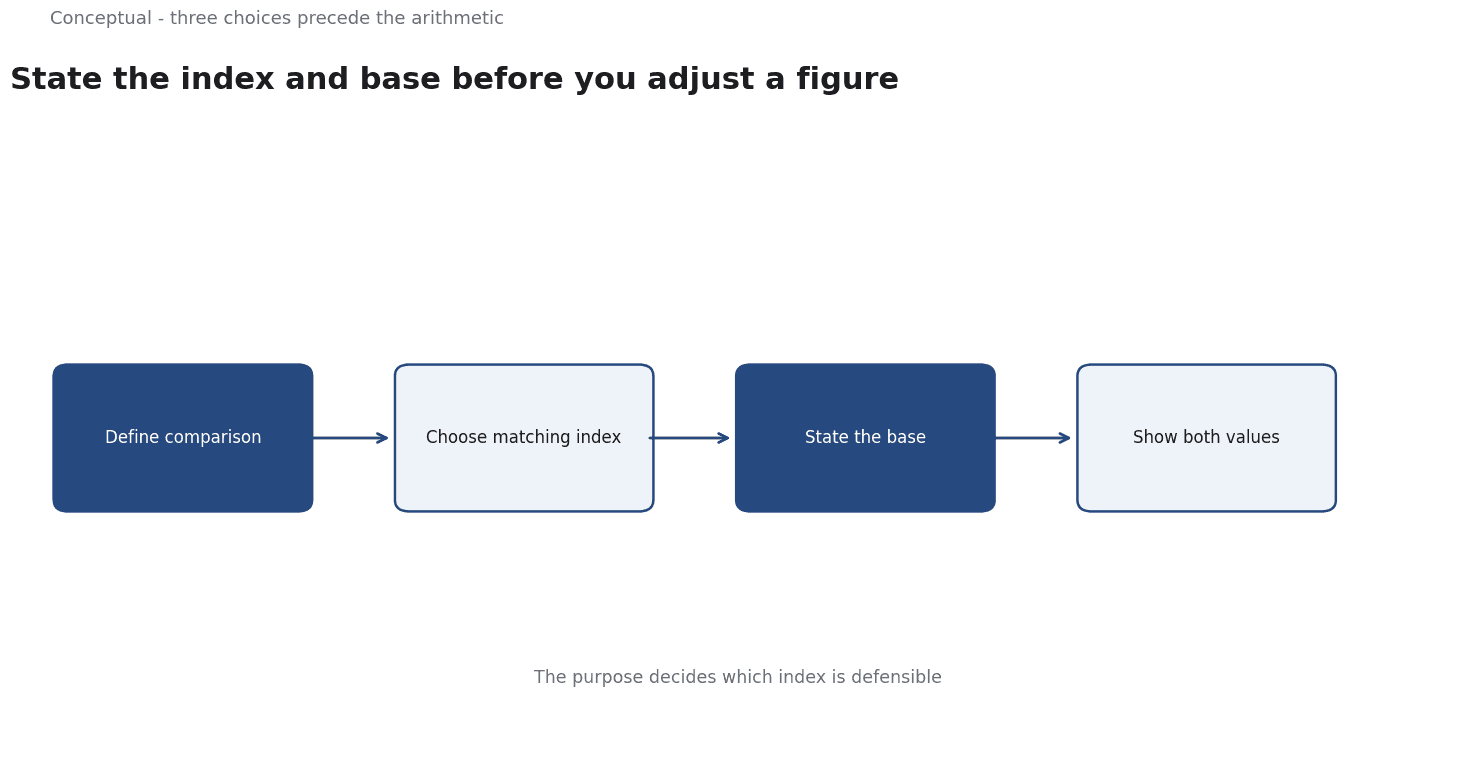
- The index. Different indices cover different baskets. A general price index may not match the good or service in question.
- The base period. An index is expressed relative to a base. Changing the base changes the numbers without changing the underlying prices.
- The purpose. Comparing purchasing power requires a different adjustment from comparing investment returns.
The sequence is: define the comparison, choose an index that matches it, state the base, then compute. Choosing the index is judgement, so it is inferred; the existence and meaning of indices are source-reported.
A worked example
Illustrative. A salary from five years ago is compared with a current offer.
Three checks decide. First, is the question about purchasing power or about relative position in a labour market? Second, which dated index matches the goods the salary buys, and what is its base period? Third, what is the conclusion if a different index is used — does the answer change?
The outcome is an adjusted figure with the index and base stated. The numbers are hypothetical; the disclosure method is the contribution.
Why the base period is part of the answer
An index number has no standalone meaning. It expresses a price level relative to a chosen base, so a figure quoted without that base is incomplete. Two analysts using the same series can report different adjusted values simply by choosing different base periods, and neither is wrong unless the choice is hidden.
The purpose of the comparison decides which index is defensible. A general consumer index is appropriate for purchasing power across a broad basket. It is a poor choice for a specific business input or a single category of spending. When the index does not match the question, the adjustment is precise arithmetic applied to the wrong quantity.
Showing both the nominal and the adjusted value is a useful discipline. It makes clear what was changed and allows a reader to apply a different index if they disagree. A single adjusted figure invites trust that it has not earned, while a pair of figures invites verification.
What changes the conclusion
The choice of index can change the answer. If two defensible series produce different conclusions, that disagreement is information rather than noise. It usually means the comparison is sensitive to the basket, and the article should say so rather than selecting the series that supports a preferred result.
Dated sources matter here. Series are revised, rebased, and occasionally discontinued. Recording the access date and the series identifier makes the adjustment reproducible, which is the difference between a calculation and an assertion.
Evidence status
| Claim | Status | Source | Verified | Recheck when |
|---|---|---|---|---|
| Inflation describes a rise in the general price level | source-reported | Wikipedia, Inflation | 2026-11-18 | Definition revised |
| Dated price series are available from public sources | source-reported | FRED | 2026-11-18 | Series discontinued |
| State the index and base before comparing | inferred | Derived from measurement practice | 2026-11-18 | Comparison purpose changes |
Why the index matters
A mismatched index can reverse a conclusion. An index that tracks consumer goods is not a good measure for a business input, and a broad index is not a good measure for a single category.
The base period matters for the same reason. A number expressed in a recent base is not directly comparable with one expressed in an older base, even when both use the same index. Stating the base turns an apparently arbitrary number into a reproducible one.
What it cannot do
It cannot make two different baskets identical. It does not remove the need to state the purpose of the comparison. And it cannot guarantee that the chosen index is the only defensible one.
The counterargument that any adjustment is better than none is fair for rough comparisons and incomplete when the index does not match the question.
A decision test
- Define the comparison.
- Choose a matching index.
- State the base period.
- Show nominal and adjusted values.
- Check whether another index would change the answer.
- Record the source and verification date.
For the related rates, see Real Interest Rates.
References & Further Reading
- Wikipedia contributors, 2026. Inflation - Wikipedia — The definition of inflation, its measurement and its effect on nominal versus real quantities; secondary reference.
- Federal Reserve Bank of St. Louis, 2026. FRED economic data — The primary time-series database used for macro indicators.