Influence in Practice
Influence changes decisions through social signals and framing. Read the mechanisms, a worked example, and why persuasion is not the same as agreement.
Influence is often treated as a technique for getting a yes, which misses the mechanism: people use social signals and framing to decide under uncertainty. The social-influence entry describes how attitudes and behaviour are shaped by others, as the negotiation material treats interests as the thing to uncover, as the pricing-psychology article treats framing and fairness, as the decision-memo article requires for a recorded judgement, as the responsible-AI article treats manipulation as a risk.
Direct answer:
Practise influence by making a credible case, showing relevant evidence, and reducing uncertainty — not by manufacturing signals.
The social-influence entry provides the mechanisms, and the negotiation resources provide the method. The boundary: influence should not replace consent or a genuine decision, which the privacy and HR articles treat formal rights, as the publication standard forbids guaranteed outcomes, as the risk-assessment article requires residual risk.
The mechanisms
Social proof. People look to others when uncertain, which the social-influence entry describes, as the online-reviews article treats reputation as a public record, as the influencer-marketing article treats credibility as the basis, as the advocacy article argues for genuine voices, as the fraud article warns about manufactured signals.
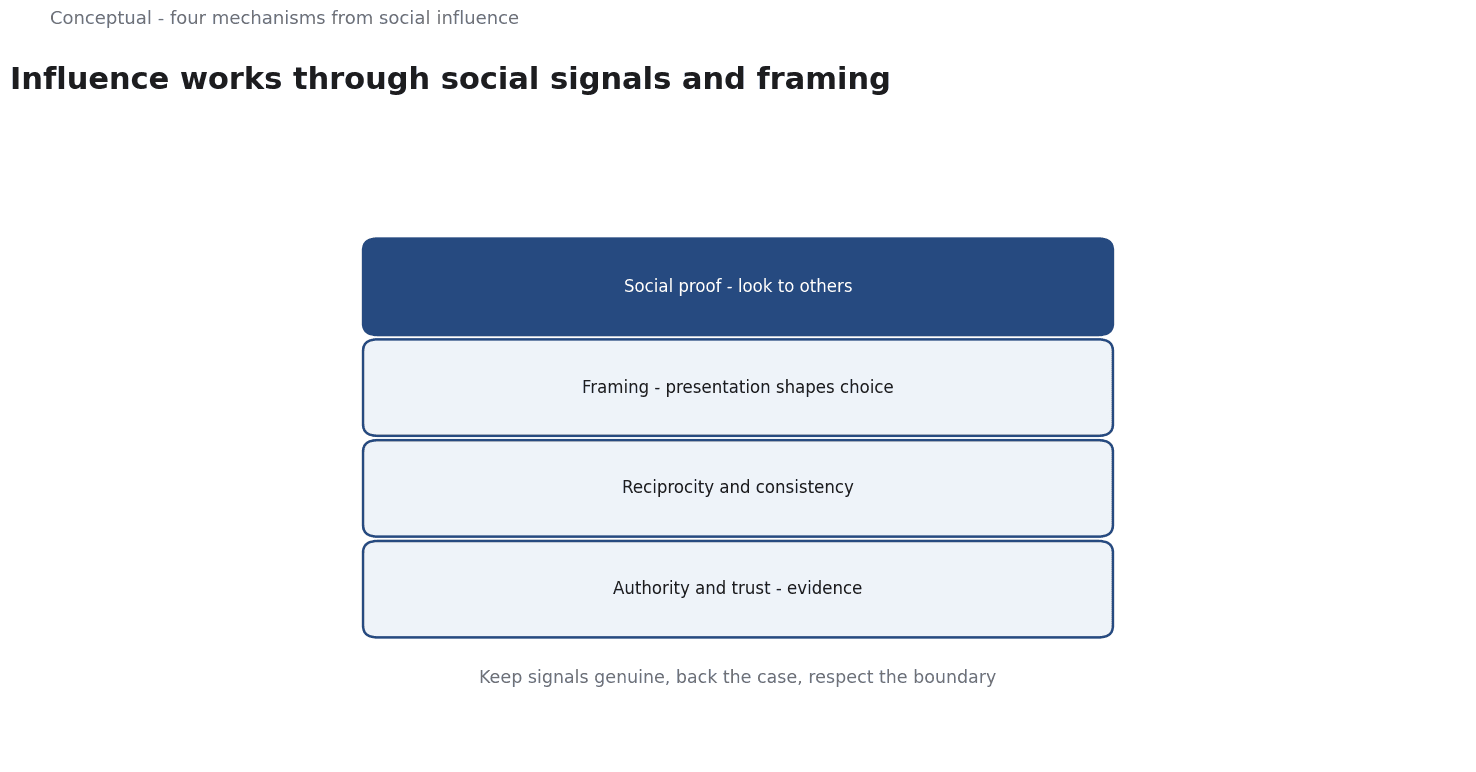
Framing. How a choice is presented changes the choice, which the pricing-psychology article treats, as the value-proposition article argues for a specific buyer evaluation, as the decision-memo article requires for a specific question, as the evaluation-rubric article requires for concrete criteria, as the responsible-AI article treats manipulation as a boundary.
Reciprocity and consistency. A small commitment can shape later behaviour, which the social-influence entry describes, as the loyalty article treats habit, as the discount article warns about incentives that train customers, as the monitoring article advises for review, as the risk article requires residual risk.
Authority and trust. Credibility comes from evidence, which the E-E-A-T article treats, as the data-governance article requires for provenance, as the legal-research article treats citation checks, as the hallucination article warns about confident wrong detail, as the governance checklist requires an accountable owner.
Three consequences follow. The signals should be genuine, as the advocacy and fraud articles advise, as the social-influence entry describes mechanisms, as the E-E-A-T article treats trust. The case should be evidence-based, as the data-governance and rubric articles require, as the decision-memo article requires. And the boundary should be respected, as the privacy and HR articles require, as the risk article requires residual risk.
A worked example
The following is hypothetical and illustrative. A team wants more customers to adopt a new feature.
Three checks decide the approach. First, is the social evidence genuine, as the social-influence entry and advocacy article require, with no manufactured signals, as the fraud article warns? Second, is the framing honest, as the pricing-psychology and value-proposition articles advise, with a specific claim, as the rubric article requires, as the E-E-A-T article treats credibility? Third, is the decision left to the customer, as the privacy and HR articles require, with a record, as the decision-memo article requires, as the risk article requires residual risk?
Three conclusions follow.
Honest framing is more durable, as the value-proposition and E-E-A-T articles advise. And the result should be recorded with its limits, as the decision-memo and risk articles require.
What influence cannot do
It cannot create value that is not there, which the value-proposition article treats as prior, as the publication standard forbids guaranteed outcomes. It does not replace consent, which the privacy and HR articles require, as the governance checklist requires an owner. And it cannot guarantee agreement, which the negotiation article treats as a process, as the risk article requires residual risk, as the monitoring article advises for review.
The counterargument that influence is manipulation is fair when signals are manufactured and incomplete when a credible case reduces uncertainty, which the worked example shows, as the advocacy and E-E-A-T articles advise.
A decision test
- Use genuine social evidence, as the advocacy and fraud articles advise.
- Frame the claim honestly, as the pricing-psychology article advises.
- Back it with sources, as data governance requires.
- Leave the decision to the other party, as the privacy and HR articles require.
- Check the ethical boundary, as the governance article advises.
- Record the decision, as the decision-memo article requires.
- State residual risk, as the risk article requires.
For the method, see Negotiation: a Decision Framework; for the trust basis, see E-E-A-T in Practice.
References & Further Reading
- Wikipedia contributors, 2026. Social influence - Wikipedia — How attitudes and behaviour are shaped by others.
- Harvard Law School, 2026. Program on Negotiation at Harvard Law School — A university consortium dedicated to developing the theory and practice of negotiation and dispute resolution.