Real Interest Rates without the Hype
The real interest rate strips inflation from the quoted rate. Read how it is derived, a worked example, and why the approximation can mislead at high inflation.
Real interest rates are often quoted as the single number that reveals whether saving or borrowing is truly attractive. The trouble is that the conversion from a nominal rate to a real one depends on which inflation measure and which time horizon you use. Without those choices made explicit, a real rate can sound authoritative while encoding an assumption that will not hold, and the decision built on it inherits that hidden assumption.
Direct answer: The real interest rate is the nominal interest rate adjusted for inflation, intended to reflect the change in purchasing power rather than the headline return. Wikipedia's real interest rate entry gives the relationship, and the inflation entry explains how price levels are measured. Use it as an estimate of purchasing-power return, and state the inflation measure and horizon behind it, because the simple subtraction is only an approximation.
Delta: This article adds a measurement-discipline framing beyond the sources: it maps the nominal-to-real relationship to the specific decision of whether a quoted real rate supports a saving or borrowing choice, with claim status made explicit.
The mechanism
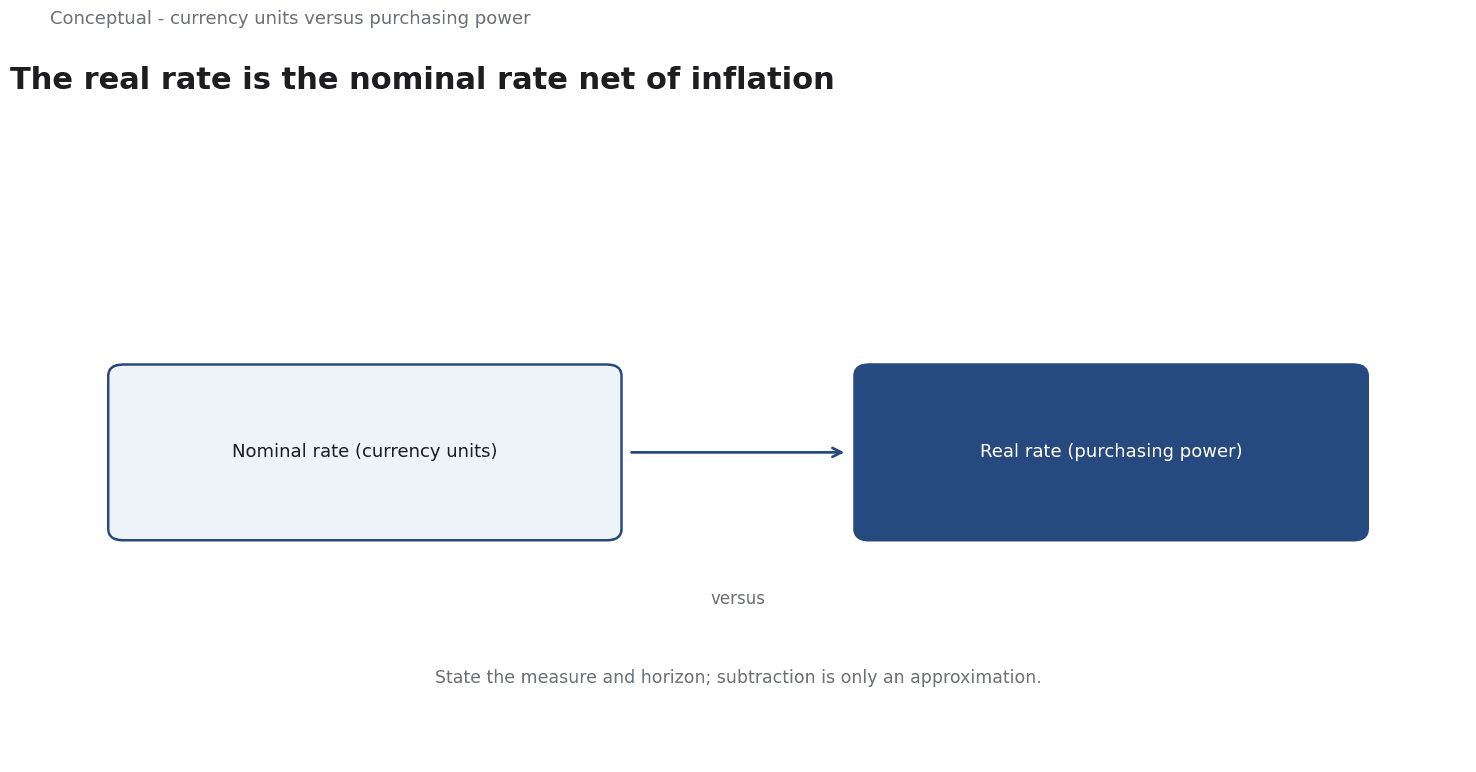
The core concept is the real interest rate, which the Wikipedia entry defines as the nominal rate adjusted for inflation, representing the return in terms of purchasing power. The intuition is straightforward: a deposit earning five percent is not a five percent gain in what the money can buy if prices rise at the same time. The practical consequence is that the nominal rate answers a different question from the real one.
Nominal tells you how many currency units you will have; real tells you roughly what those units will purchase, which is the figure that actually matters for a long-term decision.
The second concept is inflation, which the Wikipedia entry describes as a rise in the general price level of goods and services over time. The rate you subtract or divide by is not a single fact. It can be measured by a consumer price index, a producer index, or a deflator, and it can be read as a past rate or an expected future one. The practical consequence is that the real rate inherits every choice made about the inflation input. A domestic consumer index may be irrelevant for an investor whose costs track imported goods, so the measure must fit the exposure rather than simply be the most familiar published figure.
A third idea is the difference between the simple approximation and the exact relationship. Subtracting inflation from the nominal rate is convenient and close when both numbers are small, but the exact relationship is multiplicative, so the gap grows when rates or inflation are high. The practical consequence is that the familiar subtraction is a shortcut with a domain of validity. Outside that domain, it can overstate or understate the true purchasing-power return, and the error is largest precisely in the high-inflation environments where getting the answer right matters most.
Finally, there is a distinction between expected and realised real rates. Borrowing and saving decisions are made using expected inflation, while the realised real rate is known only after the fact. If inflation surprises in either direction, the outcome differs from the rate used to justify the decision. The mechanism therefore ends with a question about horizon and surprise: is the quoted real rate based on a forecast, and how sensitive is the decision to being wrong about inflation? A figure that ignores that sensitivity is incomplete even if its arithmetic is correct.
A worked example
The following is hypothetical and illustrative. A saver is comparing a one-year deposit with a quoted nominal rate against the expected rise in consumer prices, and is asking whether the deposit grows purchasing power. Three checks decide the reading. First, the inflation measure: does the consumer index used reflect the saver's actual spending, or are major costs such as housing or imports weighted differently? Second, approximation versus exact: at the quotes involved, is simple subtraction close enough, or does the multiplicative relationship change the answer? Third, expectation versus outcome: is the inflation figure a forecast, and how much would a surprise change the realised real rate? The outcome is conditional. If the measure fits the exposure and the margin survives the exact calculation and a plausible surprise, the deposit plausibly preserves purchasing power; otherwise the headline real rate is not a decision-grade figure.
Evidence status
| Claim | Status | Source | Verified | Recheck when |
|---|---|---|---|---|
| The real interest rate adjusts the nominal rate for inflation | source-reported | Real interest rate - Wikipedia | 2026-11-18 | Definition or formula presentation changes |
| Inflation is a rise in the general price level over time | source-reported | Inflation - Wikipedia | 2026-11-18 | Measurement methodology or index definition changes |
| Simple subtraction is an approximation that degrades at high rates | inferred | Derived from the sources | 2026-11-18 | New material on approximation error at high inflation |
The two definitional claims are reported from the reference entries and are stable. The approximation claim is an inference from combining the relationship with how inflation is measured, and it deserves periodic checking. If guidance changes on which index or horizon to use, or if rates move into a range where the shortcut is unreliable, the real-rate figure should be recomputed rather than quoted forward unchanged.
What it cannot do
The first limit is that a real interest rate is an estimate of purchasing power, not a guarantee of it. It adjusts one headline number by another, and both inputs carry measurement uncertainty. Inflation indexes are revised, they differ in what they cover, and the rate that actually matters to a person or firm may track a basket unlike the published one. The concept cannot deliver a precise personal purchasing-power figure, so presenting a real rate to several decimal places suggests an accuracy the inputs do not support. The number is a useful direction, not a measured outcome.
A hidden cost is the choice of inflation measure. Consumer prices, producer prices, and economy-wide deflators can move differently over the same period. Selecting one that flatters the conclusion is easy, and the resulting real rate will look rigorous while resting on an arbitrary input. The cost is not the subtraction but the unexamined selection: an investor whose costs rise faster than the chosen index will see a positive real return that does not exist in their own budget. The error only appears later, when the purchasing power fails to materialise as implied.
A common failure mode is confusing expected and realised real rates. Decisions are justified with an expected inflation figure, but the outcome is determined by realised inflation, which can diverge sharply when supply shocks or policy changes catch forecasters off guard. The measure fails at exactly this seam. A positive expected real return can become a negative realised one, and no amount of precision in the original calculation protects against a surprise that was never in the inputs.
There are boundaries where the real-rate framing should not lead the analysis. For very short horizons, inflation moves too little to dominate the decision, and transaction costs or taxes matter more. For decisions with costs denominated in a different currency, a domestic real rate may be the wrong benchmark entirely. And in high-inflation settings the simple subtraction breaks down, so relying on the familiar shortcut gives a misleading answer. In each case the real rate is a background condition rather than the deciding number, and elevating it to the lead role distorts the comparison.
Finally, the real rate needs review because its inputs are revised and its relevance changes with circumstances. Inflation figures are updated, expectations shift, and a horizon that was reasonable at the start of a loan may no longer fit. The practical requirement is to record which index and which horizon produced the figure, to recompute with the exact relationship when rates are large, and to revisit the estimate when the inflation outlook changes. Without that discipline, a real rate becomes a slogan repeated without its assumptions, and the decision quietly drifts away from the evidence that originally supported it.
The counterargument that real rates add needless complexity is fair for short horizons and small price changes and incomplete for long commitments, where inflation quietly determines whether a nominal gain is a real gain at all.
A decision test
- State the decision and the horizon over which it matters.
- Choose an inflation measure that matches the actual exposure.
- Decide whether the inflation figure is expected or realised.
- Use the exact relationship when rates or inflation are large.
- Test how a plausible inflation surprise changes the answer.
- Check whether taxes or transaction costs dominate the real adjustment.
- Record the index and horizon used and set a review point.
A real interest rate is a disciplined estimate, not a revelation. Its value comes from the assumed measure and horizon being visible and from the decision being tested against a plausible surprise. When those conditions hold, the figure clarifies a tradeoff that a nominal rate hides. For further reading, see Fixed Income Markets.
References & Further Reading
- Wikipedia contributors, 2026. Real interest rate - Wikipedia — Interest adjusted for inflation.
- Wikipedia contributors, 2026. Inflation - Wikipedia — The definition of inflation, its measurement and its effect on nominal versus real quantities; secondary reference.