How Inflation Affects Valuation Multiples
A higher multiple is not always optimism. Read how inflation flows through margins, nominal rates and accounting numbers — with a worked P/E example.
A price-to-earnings ratio rises. The easy interpretation is that investors have become more optimistic. But if inflation has pushed nominal earnings down while discount rates rose, the same multiple may reflect distorted accounting rather than changed expectations. Inflation enters a valuation through several channels at once, and the multiple is where they collide.
Direct answer:
Valuation multiples relate a price to an accounting measure such as earnings or book value; inflation affects both the denominator — through replacement costs, depreciation and inventory valuation — and the discount rate used to justify the multiple.
Wikipedia's valuation overview distinguishes absolute and relative approaches, and the P/E entry separates trailing from forward measures. The boundary: a multiple is a summary of several assumptions, not a measure of inflation by itself — comparing multiples across different inflation regimes without adjustment invites a wrong conclusion.
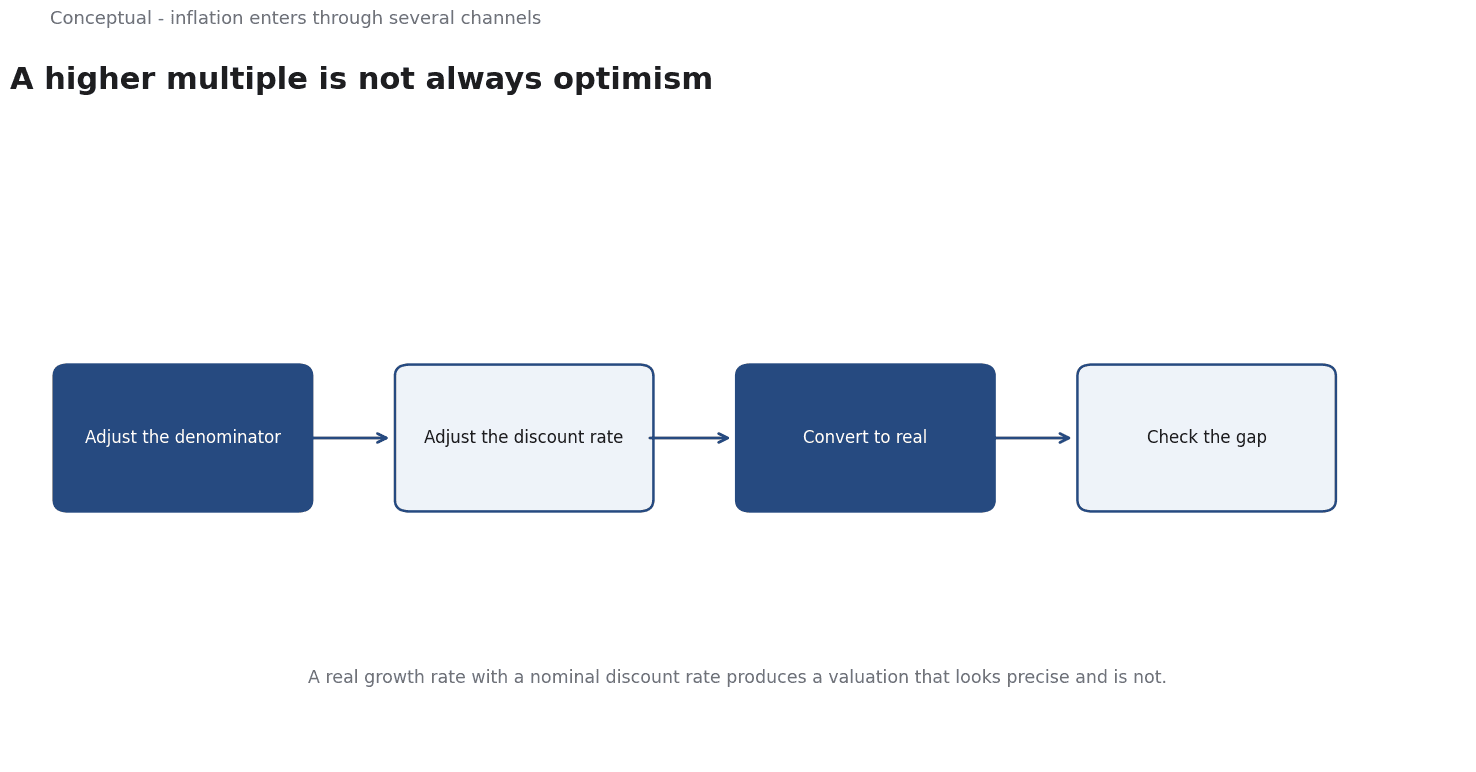
Three channels
The denominator. Historical-cost accounting records assets at their purchase price. When prices rise, depreciation based on old, lower costs understates the true cost of replacing the asset. Reported earnings are overstated, and the P/E ratio falls — not because the company became cheaper but because the earnings number is flattering.
Inventory. A company using FIFO will report lower cost of goods sold when prices rise, because it expenses older, cheaper inventory first. Reported margins look stronger, and again the P/E falls. The effect reverses when prices fall.
The discount rate. Higher expected inflation tends to push nominal risk-free rates upward. A higher discount rate lowers the present value of future cash flows, which should reduce a justified multiple. This works in the opposite direction to the accounting effect: the denominator is inflated while the numerator should be compressed.
The two effects can offset, which is why a stable-looking multiple can conceal significant underlying change.
A worked example of a nominal P/E trap
The following numbers are hypothetical and illustrative.
A company reports earnings of 10 million and has a market value of 150 million, giving a trailing P/E of 15×.
Now assume inflation raises the replacement cost of its equipment. Its depreciation charge, based on historical cost, remains 4 million a year, but the economic cost of replacing the assets is 6 million. Reported earnings are overstated by roughly 2 million:
Adjusted earnings ≈ 10 − 2 = 8 million.
At the same market value, the adjusted P/E is 150 / 8 = 18.75×.
Three interpretations follow:
- The 15× was not cheap. Once the accounting distortion is removed, the multiple is materially higher. A screen based on reported P/E would have misclassified the company.
- The rate effect may push it higher still. If higher inflation lifted nominal discount rates, the justified multiple should fall, making 18.75× look expensive rather than reasonable. The reported 15× was wrong in two directions at once.
- The comparison must be like-for-like. Comparing this company's reported P/E with another that uses different inventory or depreciation methods produces a number with no clear meaning.
The point is not that P/E is useless. It is that a multiple is an accounting quantity divided by a market price, and both sides carry assumptions that inflation changes.
Nominal versus real
A useful habit is to ask which quantities are nominal and which are real:
- Share prices and market values are nominal — stated in current money.
- Historical-cost earnings are a mixture: current prices for revenue, old prices for some costs.
- Discount rates are nominal when applied to nominal cash flows, real when applied to real ones. Mixing them is a basic error with large consequences.
Damodaran's valuation discipline is helpful here because it insists the assumptions be stated: the currency, the basis, and the consistency between the growth rate and the discount rate.
How to adjust in practice
Three adjustments make a comparison more honest, even when perfect data is unavailable:
Use forward estimates alongside trailing ones. Forward earnings incorporate current input prices and expectations, so the forward P/E is less contaminated by historical-cost depreciation. A wide gap between trailing and forward P/E is a signal to investigate the difference, not to average them.
Compare within an accounting regime. If two companies use different inventory methods, restate one or treat the comparison as unreliable. The effort is modest relative to a bad valuation conclusion.
Express growth and discount rates in the same basis. A nominal earnings growth rate with a real discount rate, or vice versa, creates a spurious result. This is the most common error in a spreadsheet built quickly. Write the basis next to each input.
A fourth adjustment — normalising earnings for replacement cost — is the most informative and the most labour-intensive. It is worth doing for capital-intensive businesses where historical-cost depreciation materially understates the true cost of staying in business.
What multiples do not tell you
They do not separate causes. A rising multiple can reflect higher expected growth, lower risk, lower inflation, or an accounting change. Without decomposition, the number is a label for a question.
Trailing and forward differ. The P/E entry distinguishes measures based on past earnings from those based on forecasts. In an inflationary period, trailing earnings are more distorted by historical costs, so the two can diverge sharply.
Cross-country comparisons are harder. Inflation rates, accounting standards, and tax treatments differ. A low multiple in one market may be a currency or accounting artefact rather than a bargain.
The counterargument — that analysts already adjust for inflation — is true for careful analysts and not for a screen.
The practical response is to treat a multiple as a starting point and ask which assumptions built it.
A decision test
- State the basis — nominal or real — for every input in the comparison.
- Check depreciation and inventory methods for the companies being compared.
- Compare trailing and forward multiples and investigate a large gap.
- Ask whether the discount rate moved with inflation expectations.
- Use replacement-cost reasoning when historical-cost accounting distorts earnings.
- Compare within a regime where possible, not across decades of different inflation.
- Treat a multiple as a summary of assumptions, not a verdict on value.
For the valuation framework, see Corporate Finance Essentials; for the macro context, see Macroeconomics for Business Leaders.
References & Further Reading
- Wikipedia contributors, 2026. Valuation (finance) - Wikipedia — Overview of absolute and relative valuation approaches; secondary reference.
- Wikipedia contributors, 2026. Price–earnings ratio - Wikipedia — The P/E multiple, its determinants and the distinction between trailing and forward measures.
- Wikipedia contributors, 2026. Inflation - Wikipedia — The definition of inflation, its measurement and its effect on nominal versus real quantities; secondary reference.
- Federal Reserve Bank of St. Louis, 2026. FRED economic data — The primary time-series database used for macro indicators.