Macroeconomics for Business Leaders: Inflation, GDP, and Monetary Policy
Macro conditions set the environment a business operates in. Read how to read the published indicators without pretending to forecast them.
Business leaders are often asked to comment on the macroeconomic outlook, and most should decline the implied expertise. What a leader can do — and what is genuinely useful — is understand how the published indicators constrain the business: what its costs depend on, what its customers can afford, and what the price of money is likely to be when the next financing decision arrives.
Direct answer:
Macroeconomics is an input to planning, not a forecast that planning depends on.
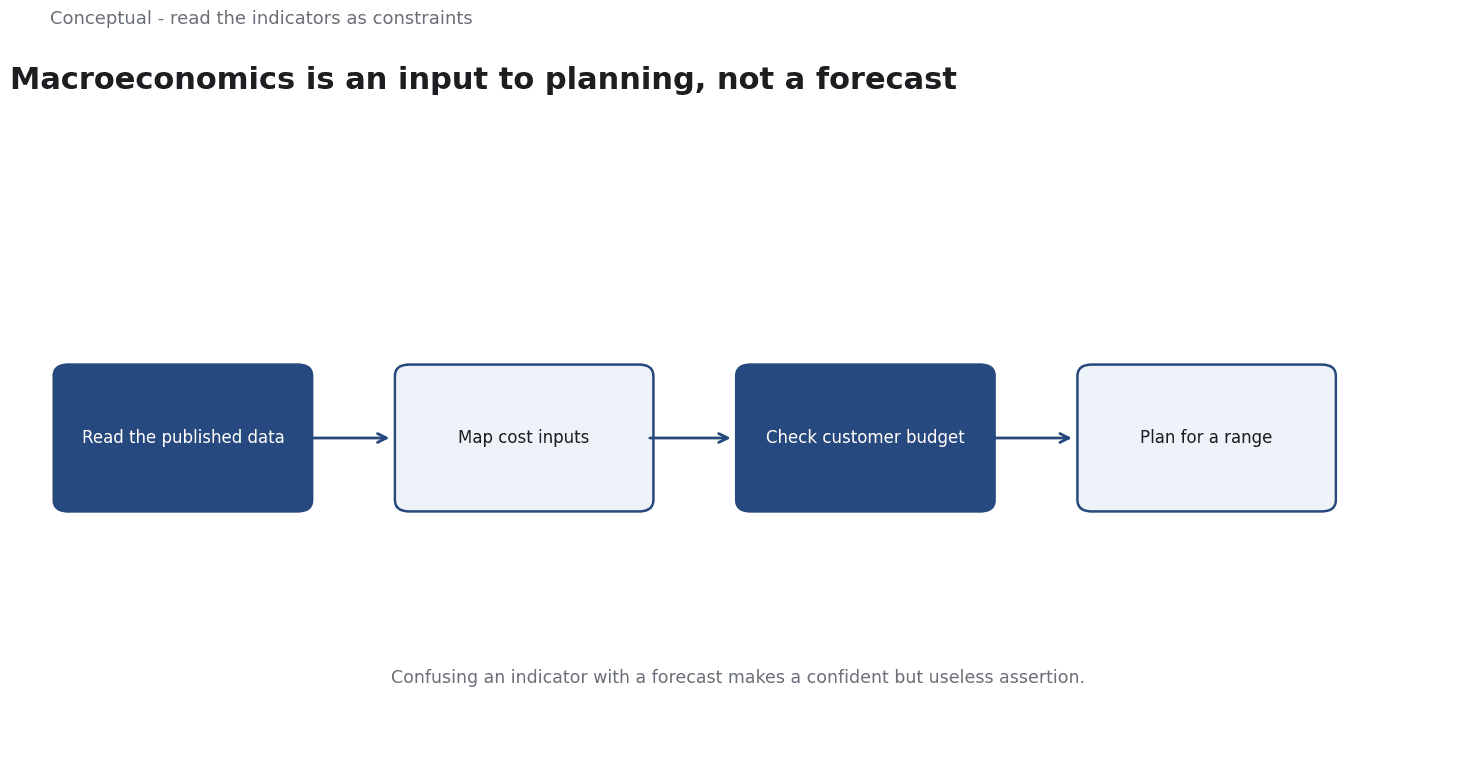
The useful practice is to know which published series actually drive your costs and demand, to read them with their release dates and revision history, and to build decisions that work across a range of outcomes rather than around one macroeconomic prediction. The Federal Reserve publishes its framework, tools, and reporting, and the BIS publishes international monetary and financial statistics — both are primary sources that are more useful than a summary of them.
What the central bank actually publishes
The Federal Reserve's monetary policy pages list the machinery: the Federal Open Market Committee, "Monetary Policy Principles and Practice", policy implementation and normalisation, the policy tools, and recurring reports including the "Monetary Policy Report" and the "Beige Book". The "Selected Interest Rates — H.15" release provides the daily rate series that anchors cost-of-capital work.
A leader does not need to predict the next rate decision. They need to know where to look, when the data was published, and which part of it affects them. The Beige Book is a qualitative account of regional conditions — useful for demand ahead of hard numbers. The H.15 series is a measured price of money — useful for financing and valuation.
The Bank for International Settlements describes its purpose as supporting "central banks' pursuit of monetary and financial stability through international cooperation", and its research focuses on "policy issues of core interest to the central bank and financial supervisory community". Its statistics and working papers are the right source when the question crosses borders — exchange rates, cross-border credit, and financial-stability conditions.
Inflation is a change in your inputs, not a headline
The business consequence of inflation is specific: it changes the price of the things you buy, the wages you must pay, and the prices your customers will tolerate, and it does not change them all at once.
The practical response is to decompose rather than react. Which inputs are indexed, which are contracted for a fixed period, and which are renegotiated annually? A business with half its costs fixed for twelve months and half indexed monthly has a very different exposure to a headline inflation number than one where all costs reprice quarterly. The aggregate figure is a starting point for that question, not the answer.
The same applies on the revenue side. A published price index is not your customers' willingness to pay, and a business that raises prices because the index rose will discover the difference. Elasticity — how quantity responds to price — remains the decision-relevant number, and it is specific to your market.
GDP, demand, and the composition problem
Gross domestic product is an aggregate, and an aggregate is usually the wrong unit for a business decision. What matters is the component your customers belong to: consumer spending in your category, business investment in the sector you sell to, government procurement if that is your market.
The Federal Reserve Bank of St. Louis's FRED database is the practical tool here, because it exposes the component series with their release dates attached. The discipline of using it is to choose the series that matches your demand before looking at the result — otherwise the temptation is to find the series that supports the forecast you already made.
Revisions matter too. An initial estimate of output or employment is later revised, and a plan built on the first print may be built on a number that changes. Record the vintage, as you would record the date of an interest-rate observation.
Building a plan that survives the range
The right output of a macroeconomic review is not a forecast. It is a set of scenarios and the conditions under which each becomes the plan.
- Base case: the range of input costs and demand you currently observe, with a stated as-of date.
- Downside: a specific combination — higher input costs with weaker demand — and what you would cut or delay.
- Upside: what you would hire or invest in if demand exceeds the base case.
- Triggers: the observable signals that switch you from one plan to another. A series, a threshold, and a date — not a feeling.
This is more useful than a single predicted number because it converts uncertainty into decisions made in advance, when you have time to think, rather than under pressure.
A checklist for the next planning cycle
- List the macro variables your business actually touches — rates, wages, energy, exchange rates, category demand.
- Find the primary published series for each, with release dates and revision history.
- Distinguish what is indexed from what is renegotiated on the cost side.
- Use a component series, not the aggregate, for demand.
- Record the vintage of every external number in the plan.
- Write scenarios with triggers, not a single forecast.
- Separate the macro review from the pricing decision. Elasticity and value decide price; macro informs the range.
For the pricing side, see Microeconomics for Decision Makers; for how the central bank sets the rate that feeds these scenarios, see Central Banking; for the rate-driven valuation side, see Corporate Finance Essentials.
A counterargument
Reasonable critics could argue that refusing to forecast is less neutral than presented: a scenario set with triggers still assigns, implicitly, a likelihood to each case, and declining to weight them is a choice that leaves the business as exposed as a bad prediction. The article warns that a manager may pick the FRED series that supports a prior view, yet its own remedy - choose the matching component before looking at the result - assumes a clean mapping from series to demand many businesses lack. The recommended sources are official publications with release dates and revision histories, which is sound discipline, but they are backward-looking by construction.
A leader who follows the checklist may be well informed about the last print and still late to a turning point.
References & Further Reading
- Federal Reserve Bank of St. Louis, 2026. FRED economic data — The primary time-series database used for macro indicators.
- U.S. Bureau of Labor Statistics, 2026. Schedule of Selected Releases — Official release dates matter for any backtest that uses macro data.
- European Central Bank, 2026. Evaluating our strategy — Primary material on the inflation-targeting framework.
- Bank for International Settlements, 2026. Statistics | Bank for International Settlements — The BIS assessment of financial-market structure and systemic vulnerabilities.