Influencer Contracts Mistakes to Avoid
An influencer contract is a measurement and disclosure instrument. Read the mistakes, a worked example, and why deliverables are not outcomes.
An influencer contract often specifies what will be posted and when, then omits the parts that decide whether the spend was worthwhile: disclosure, usage rights, measurement, and what happens when the content underperforms. The influencer-marketing overview describes a channel whose value depends on credibility, which the measurement article treats as difficult to attribute, as Referral Programs without the Hype argues for honest reward structures.
Direct answer:
Write contracts that define the deliverable, the disclosure obligation, the measurement method, and the exit terms.
The influencer-marketing overview provides channel context, and geo-experiment guidance offers a comparison design for the effect. The boundary: this is educational orientation, not legal advice — disclosure rules are jurisdiction-specific and change, as the copyright article treats current law as requiring a dated check, as the term-sheet article treats formal terms as consequential.
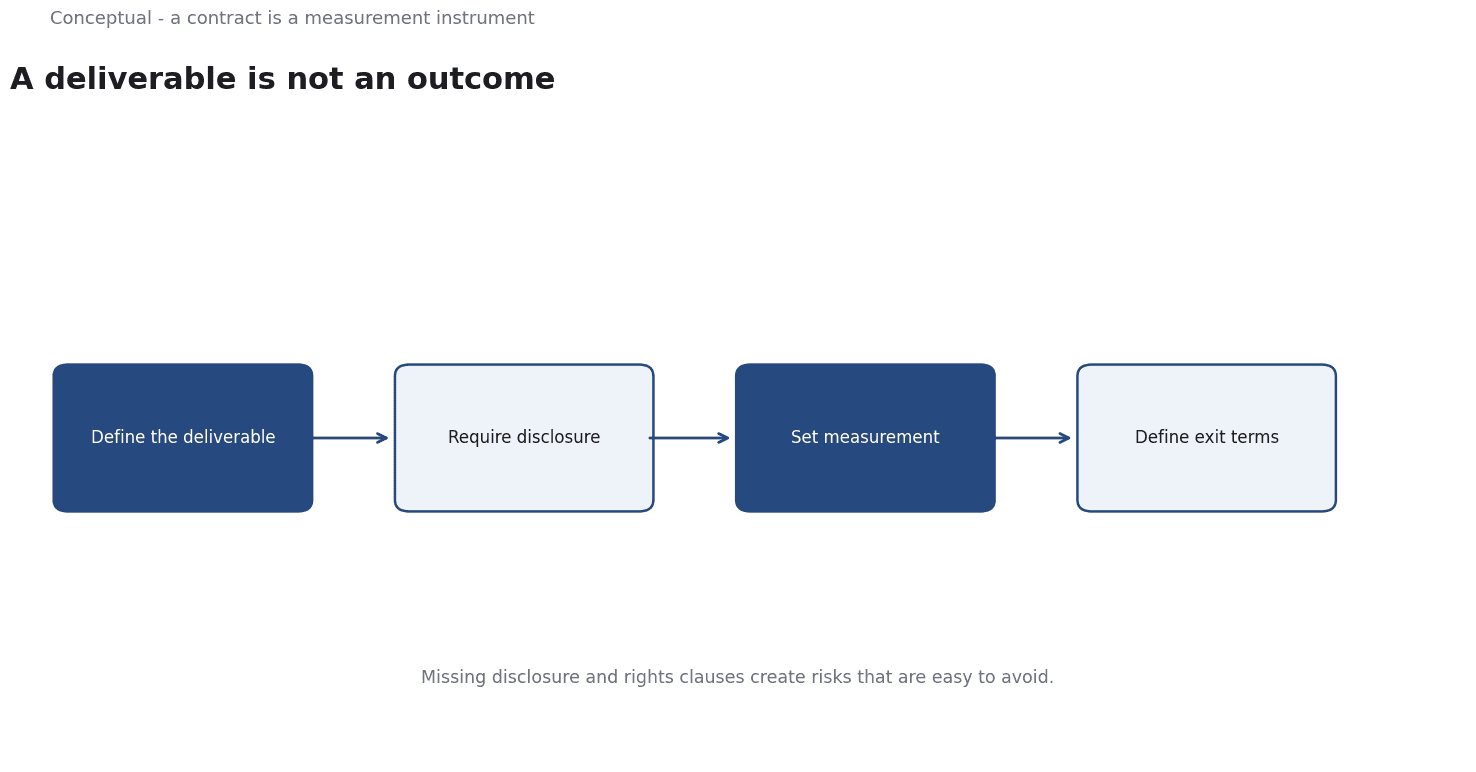
The mistakes
Buying deliverables, not outcomes. A contract that pays for a post measures activity, which the email-metrics article treats as an intermediate signal, as the funnel article advises for stage transitions. The business question is whether the content changed a decision, which the geo-experiment guidance tests with a comparison.
No disclosure clause. A partnership that is not disclosed damages the credibility the channel depends on, which the influencer-measurement article treats as an ethics and measurement question, as the online-reviews article warns about incentives that distort public evidence.
Unclear usage rights. Repurposing content without the right to do so creates a legal and brand risk, which the licensing discussion in the open-source article analogises to rights that must be explicit, as the term-sheet article treats terms as the substance of a deal.
No measurement plan. If the contract does not define how the effect will be assessed, the report will be platform-reported numbers, which the attribution article treats as credit rules, as the influencer-measurement article advises for a holdout.
Three consequences follow. The contract should name a measurement window and a baseline, as the evaluation-rubric article requires for concrete criteria, as the decision-memo article requires for a recorded judgement. It should include disclosure and rights, as the legal context requires. And it should be reviewed after the campaign, as the monitoring article advises for any maintained process.
A worked example
The following is hypothetical and illustrative. A brand contracts an influencer for a post and a story, with no disclosure clause and a payment tied only to publication.
Three checks decide what to change. First, measurement: can the brand estimate incremental effect, as the geo-experiment guidance recommends, or will it rely on platform numbers, as the attribution article warns? Second, disclosure: does the contract require a clear partnership notice, as the influencer-measurement article advises, with wording checked against current rules, as the legal article requires? Third, rights: can the brand reuse the content in its own channels, which the contract should state, as the licensing analogy in the open-source article supports?
Three conclusions follow. Payment on publication measures delivery, not effect, which the funnel article explains for stage metrics.
And the revised contract should be recorded with its rationale, as the decision-memo article requires.
What influencer contracts cannot do
They cannot guarantee credibility, which the influencer-marketing overview treats as the channel's basis, as the advocacy article argues for genuine voices. They cannot prove incrementality from a tracked link, which the attribution article treats as a credit rule, as the geo-experiment guidance recommends a comparison. And they do not remove legal obligations, which the current rules define, as the legal article requires a dated check.
The counterargument that standard templates are enough misses the fit question, which the worked example shows: the clauses that matter are the ones tied to the specific measurement and rights of the campaign, as the term-sheet article argues for reading terms rather than labels.
A decision test
- Define the outcome and the measurement window, as the rubric article requires.
- Include a disclosure clause checked against current rules, as the legal article advises.
- State usage rights and any exclusivity, as the licensing analogy supports.
- Define the exit and remediation terms, as the term-sheet article advises.
- Use a comparison for effect claims, as the geo-experiment guidance recommends.
- Treat platform reports as credit rules, as the attribution article warns.
- Record the decision and review after the campaign, as the decision-memo article requires.
For the channel, see Influencer Marketing Measurement; for the incentive design, see Referral Programs.
References & Further Reading
- Wikipedia contributors, 2026. Influencer marketing - Wikipedia — An overview of influencer marketing formats, platforms and measurement challenges; secondary reference.
- American Association for Public Opinion Research, 2026. AAPOR — The professional association for public opinion and survey research; its standards and resources underpin the survey-design discussion.