Internal Linking Mistakes to Avoid
Internal links are the most controllable structural signal a site has, yet most sites add them by habit. Read the mistakes, their structural cost, and a decision test.
Internal links are the most controllable signal a site owner has, yet most sites treat them as an afterthought. Links accumulate from templates and editor habits rather than from a plan, so important pages end up buried and navigation serves the site map instead of the reader. The result is a structure that is hard to crawl and harder to understand.
Direct answer: An internal link connects one page of a domain to another, and the distinction from an external link matters because search engines read both as signals about structure and relevance. Wikipedia's entry on internal and external links frames links as the mechanism that gives a site its hierarchy, while Google's SEO Starter Guide treats internal linking as a way to help both users and crawlers find important pages. The boundary is that a link is a signal, not a command: more links do not rescue a weak page.
Delta: This article adds a decision map beyond the sources: it maps each common linking mistake to the specific structural decision it corrupts, with claim status explicit.
The mechanism
Wikipedia's "Internal and external links" entry defines an internal link as a hyperlink that points to another page within the same website, distinct from an external link that leaves the domain. This is not a cosmetic distinction. Internal links are the edges of the site graph; they determine which pages are reachable from which other pages and, by extension, how a crawler can traverse the site. When an editor adds a link, they are making a claim about the relationship between two pages. The practical consequence is that link placement should follow a deliberate model of which pages matter, rather than whatever the editor happens to remember in the moment.
Google's SEO Starter Guide advises that links should be descriptive and help users understand what they will find, which implies that the anchor text carries meaning for both readers and search engines. The mechanism is straightforward: a link is a short description of its destination embedded in the source page. If the description is vague, the signal is weak and the user gains no expectation of the destination. The practical consequence is that anchor text is a compact naming decision, and naming decisions compound across hundreds of links. A site full of generic anchors has made hundreds of weak naming decisions at once.
The same body of guidance explains that links establish a hierarchy: pages linked from many places, especially from high-level pages, are treated as more important than pages that sit deep in the structure. The mechanism here is reachability and depth. A page that requires many clicks from the home page is harder to discover and may receive less crawling attention. The practical consequence is that linking mistakes are structural, not cosmetic: a page with no inbound internal links is effectively invisible regardless of how good its content is. Fixing that requires changing the graph, not the prose.
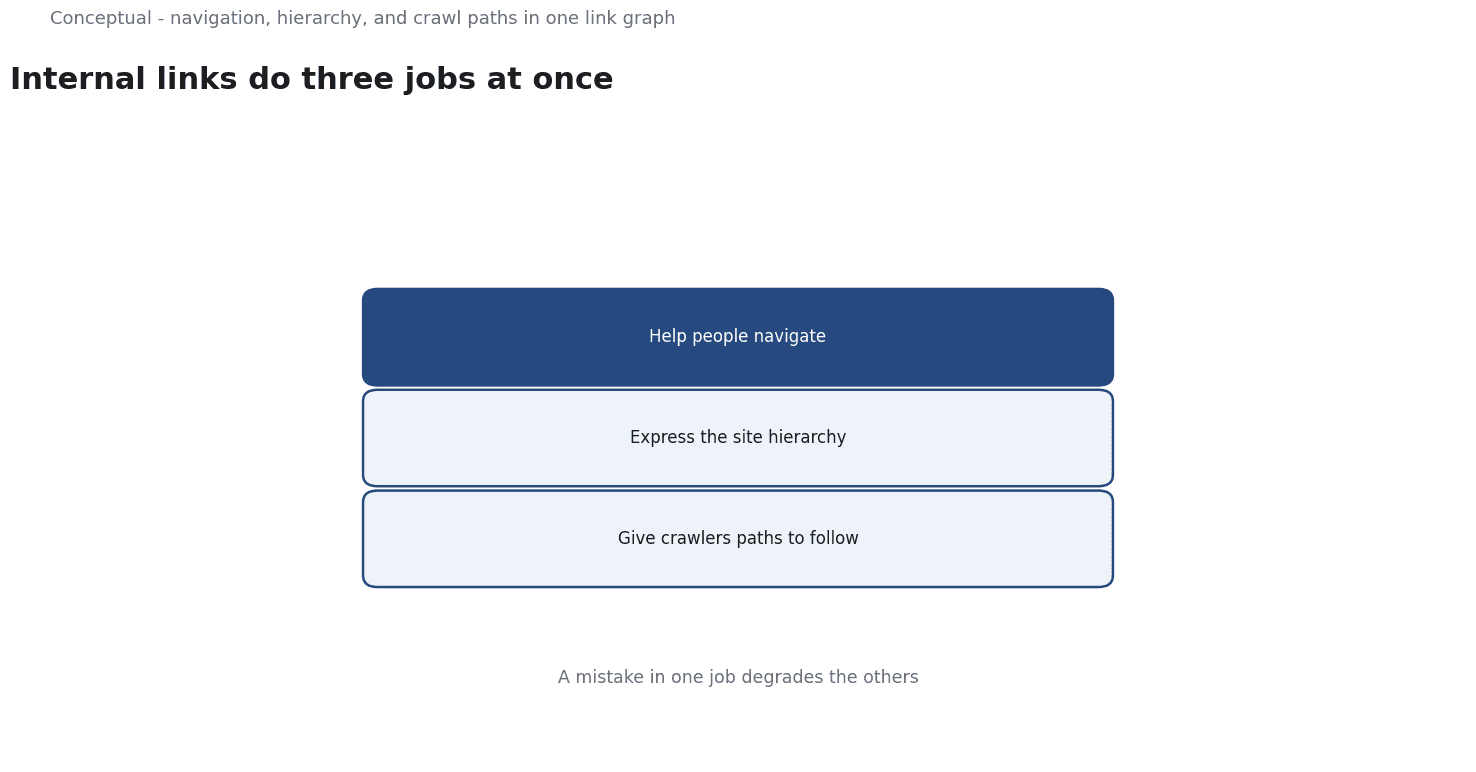
Taken together, the two sources describe a system in which internal links do three jobs at once: they help people navigate, they express a hierarchy, and they give crawlers paths to follow. A mistake in any one of these jobs degrades the others.
The practical consequence is that internal linking cannot be fixed by simply adding more links; it has to be fixed by linking the right pages with descriptive text in a shape that reflects real importance.
A worked example
The following is hypothetical and illustrative. A mid-size site has a documentation section, a pricing page, and a set of quarterly reports. An editor notices that the pricing page ranks poorly and that several documentation pages receive no organic visits. Three checks are run. First, the inbound internal links to the pricing page are counted and found to come only from a footer on every page, with descriptive anchor text missing. Second, the link depth of the quarterly reports is measured: they sit four clicks from the home page and have no links from the documentation hub. Third, anchor text across the section is sampled and found to rely heavily on generic labels. The outcome is a rewrite: the pricing page gains contextual links from the documentation pages that discuss cost, the reports are linked from the hub with dated descriptive anchors, and generic labels are replaced. The limiting condition is that these changes alter discoverability signals only; they do not change the underlying content.
Evidence status
| Claim | Status | Source | Verified | Recheck when |
|---|---|---|---|---|
| Internal links connect pages within the same domain and differ from external links | source-reported | Wikipedia: Internal and external links | 2026-11-18 | when the entry's definition is revised |
| Descriptive links help users and crawlers find important pages | source-reported | Google: SEO Starter Guide | 2026-11-18 | when the guide's linking guidance changes |
| Link depth and anchor wording affect how a site's hierarchy is interpreted | inferred | Derived from the sources | 2026-11-18 | when search behavior guidance is updated |
The first two rows restate claims the sources make directly and can be checked against the cited pages. The third row is an inference from the idea that links express hierarchy: it follows from the sources but is not stated by them as a standalone rule. Recheck intervals are tied to the sources themselves, not to any measurement of a live site.
What it cannot do
Internal linking cannot rescue weak content. A perfectly structured site with descriptive links pointing to thin pages will still struggle, because links express relationships rather than quality. The sources describe links as signals about structure and navigation; neither claims that a link can manufacture value in the destination. The limit matters because teams often reach for linking as a quick fix when the real problem is the page itself. A site can be impeccably connected and still fail to satisfy a reader who arrives and finds nothing useful.
There is a hidden maintenance cost. Links are easy to add and hard to keep correct. Pages move, URLs change, and templates drift; a link structure that was coherent at launch decays as the site grows. Every content migration leaves behind links that point to redirects or stale pages. The cost is not the act of linking but the ongoing audit required to keep the structure honest. Teams that budget only for the initial linking pass will find that the structure quietly degrades between reviews, and the degradation is invisible until a crawl report surfaces it.
When every page links to every other page, the signal that was supposed to express importance becomes noise. The SEO Starter Guide warns against excessive links that add no value to users. A structure where nothing is emphasized is functionally the same as no structure. The practical symptom is a site where editors add links reflexively because a checklist told them to, without asking which page deserves the emphasis. At that point the link graph is large but uninformative, and the crawler gains little from it.
The boundary of the mechanism is influence, not control. Google's guide describes what helps crawlers and users; it does not promise that any given link will produce a ranking outcome. Internal links are one input among many, and the sources stop short of claiming causation. Treating them as a guarantee leads to brittle strategies that break when search behavior changes. A team that expects a fixed return from a fixed number of links will misread normal variation as failure and may overcorrect in ways that make the structure worse.
Because the guidance is general, review is required. The two sources describe principles, not a site-specific plan. What counts as an important page, how deep is too deep, and which anchor text is descriptive are decisions that depend on the site's content and audience. A team that treats the sources as a fixed recipe will misapply them; a team that uses them as a frame for its own decisions will get durable value. The discipline is in revisiting the structure as the site changes, not in perfecting it once.
The counterargument that adding more internal links is fair for improving discovery is incomplete for deciding importance: without a model of which pages matter, extra links spread emphasis evenly and help no page specifically.
A decision test
- List the pages that should be reachable in one or two clicks from the home page.
- Audit inbound internal links to each important page and note where descriptive anchors are missing.
- Measure link depth for pages that receive no organic visits and flag those beyond the intended depth.
- Check anchor text for generic labels and replace them with text that names the destination.
- Remove or reduce links that add no navigational value and dilute emphasis.
- Verify that no internal link points to a redirect or a retired URL after a migration.
- Recheck the structure when the source guidance changes or the site's page set shifts.
The steps turn a vague goal about improving internal linking into a set of checks that can be performed and reviewed. They work because each one connects a link-level detail to a structural decision, which is the mapping this article adds. The point is not to optimize a number but to keep the link graph truthful about what matters.
For further reading, see What AI Search Actually Measures.
References & Further Reading
- Wikipedia contributors, 2026. Internal and external links - Wikipedia — Links within a site and their structure.
- Google, 2026. SEO Starter Guide: The Basics — The search engine's own description of what it needs from a site.