International SEO: Common Questions
International SEO is often reduced to translation. Read how localized versions map to search decisions, a worked example, and what hreflang cannot fix.
International SEO questions usually begin with translation: should a page be copied into another language, and will it rank? The real problem is that search engines must decide which version of a page to show to which reader, and translation alone does not answer that question. A localized site can be complete and still fail because the signals that connect its versions are missing or contradictory.
Direct answer: Treat each localized version as a distinct page that search engines must match to a query and a region, and give them consistent signals about their relationship. Google's guidance describes how to mark localized versions; the SEO entry describes the discipline. The decision rule, about which version to build and how to connect them, is a synthesis.
Delta: This article adds a claim-status table and a worked example beyond the sources: it maps localization signals to a site-structure decision, with claim status explicit.
The mechanism
The Google documentation on localized versions addresses a concrete problem: a site may have several versions of the same content in different languages or regions, and search engines need help understanding that they are alternatives rather than duplicates. The practical consequence is structural. Each version needs a stable address, and the relationship among versions must be expressed in a way a crawler can follow. When that relationship is ambiguous, the engine may choose the wrong version for a reader or treat the pages as competing copies.
The SEO entry describes search engine optimization as the practice of improving a site's visibility in search results. That framing matters because it sets the goal: not publishing more pages, but making the right page eligible for the right query. Localization adds a dimension to that goal. A page can be well optimized in the abstract and still be the wrong answer for a reader in a particular market, because intent, currency, and terminology differ.
The mechanism is therefore about matching, not merely about volume.
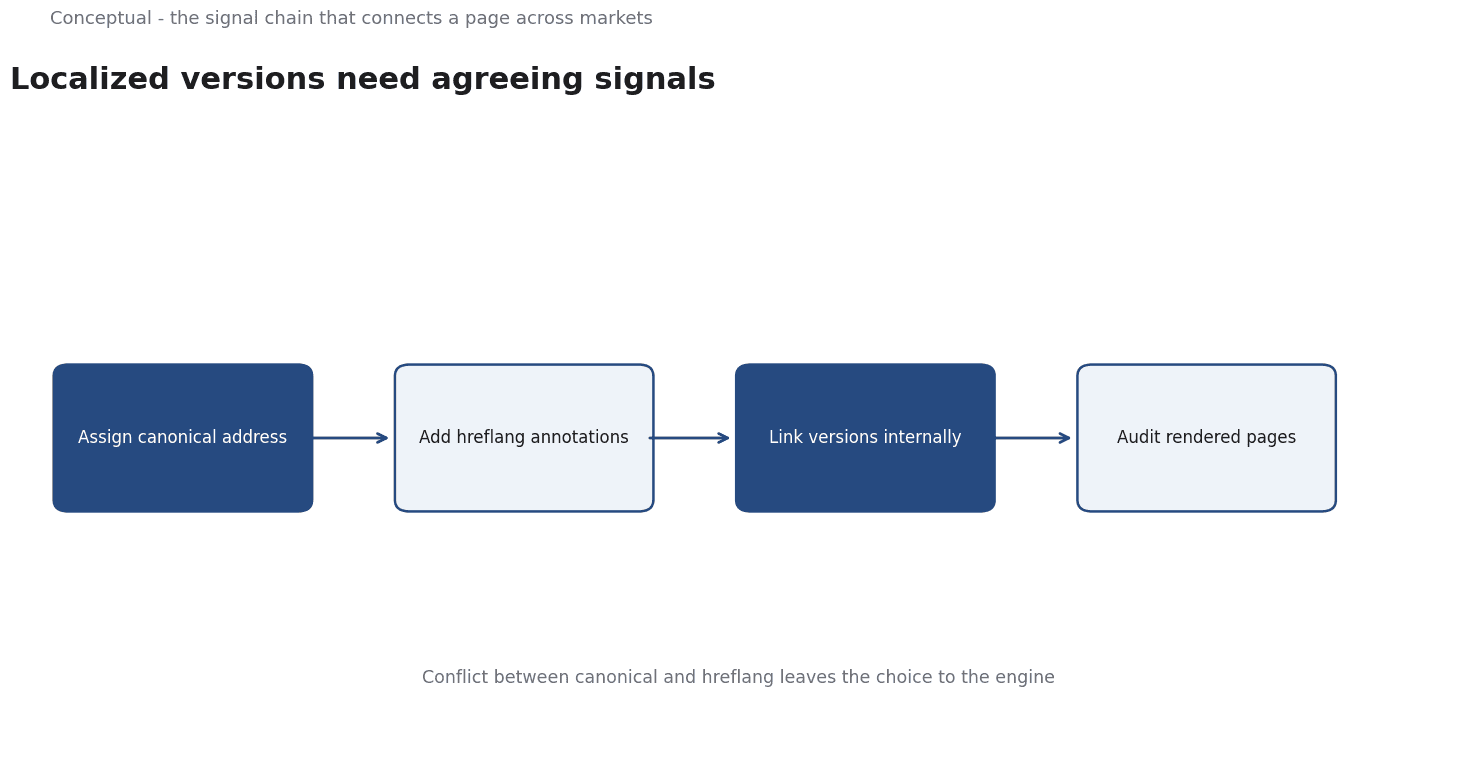
The signals themselves are a chain. A canonical address tells a crawler which version is authoritative for a given language or region. Hreflang annotations tell it which other versions exist and for whom. Consistent internal linking lets a crawler discover them. Each signal is documented in the Google guidance; the practical consequence is that they must agree. A conflict between canonical tags and hreflang annotations produces ambiguity, and ambiguity is resolved by the engine, not by the site owner.
The local contribution is the decision mapping. Given a market and a language, a team must decide whether a separate version is warranted, which version is canonical, and how the alternatives are linked. The sources describe the mechanism and the discipline but do not make that decision for a specific site. That is why the mapping is marked inferred.
A worked example
The following is hypothetical and illustrative. A retailer sells in two markets and plans to publish a second-language version of its product pages. Three checks decide the structure. First, does the new version serve a distinct query set, or is it a translation that will compete with the original for the same searches? Second, are the canonical and hreflang signals consistent, so that each version points to itself and lists the other as an alternative? Third, can a crawler reach every version through internal links without relying on a JavaScript-only menu? The outcome is a decision: publish the separate version with consistent signals if the query sets differ, or consolidate into one page if they do not. No measurements here are real; the sequence is the contribution.
Evidence status
| Claim | Status | Source | Verified | Recheck when |
|---|---|---|---|---|
| Search engines need help relating localized page versions | source-reported | Google, Localized Versions | 2026-11-18 | Guidance updated |
| SEO aims to improve visibility in search results | source-reported | Wikipedia, Search engine optimization | 2026-11-18 | Definition revised |
| Map localization signals to a site-structure decision | inferred | Derived from the sources | 2026-11-18 | Site architecture changes |
The two source-reported rows describe a crawler problem and a discipline. Neither tells a particular site which pages to build. The inferred row is the local addition, connecting the documented signals to a structure decision. Recheck when the site changes its URL scheme, adds a market, or restructures navigation, because the signals must be revalidated whenever the pages they describe move.
What it cannot do
Localized versions cannot manufacture demand that does not exist. Marking a page as an alternative version tells a search engine that the pages are related; it does not make the content useful to a reader. If the translated page is thin, inaccurate, or mismatched to local intent, the signals will only help the engine choose among weak options. The Google guidance describes how to express relationships between versions, not how to write content that deserves to rank. Treating annotations as a substitute for research in the target market inverts the proper order.
There is a maintenance cost that is easy to underestimate. Every localized version must stay in sync with the original: prices, specifications, and availability change, and each change has to propagate across versions. Hreflang annotations must be updated when a version is added or removed, and a stale annotation points to a page that no longer exists. The cost is not in the initial setup but in the ongoing discipline, and it grows with the number of versions. A team that funds translation but not maintenance will accumulate contradictions that quietly erode the structure.
A canonical tag may point to one version while hreflang lists another as the alternative for the same region, leaving the engine to guess. Another failure is returning annotations only in one language, so a crawler that discovers the other version first never sees the relationship. These are configuration errors, not conceptual disagreements, and they are invisible in a ranking report until traffic shifts. The practical defence is an audit that reads the rendered pages as a crawler would, rather than trusting the content management system's settings screen.
The sources also set a boundary. They describe how search engines should be told about localized versions and what optimization means in general. They do not supply a rule that says a given market requires a separate version, nor do they promise a ranking benefit from doing so. Any threshold of that kind is a local business decision based on query data and cost. Presenting it as guidance from the sources would overstate what the documentation supports and weaken the claim table's distinction.
Finally, the decision needs review. Search features change, markets change, and a version that was justified last year may now compete with the original for the same queries. A review does not require rebuilding the site; it requires checking that the pages still serve distinct intents and that their signals still agree. When they no longer do, consolidating versions can be better than maintaining a structure that has become contradictory. The recheck condition in the table exists for that reason.
The counterargument that translating every page maximizes reach is fair for a catalogue with identical intent across markets and incomplete for pages where local terminology, currency, and availability change the query.
A decision test
- Identify the query set each market actually uses.
- Decide whether a separate version serves a distinct intent.
- Assign a canonical address to each version.
- Add consistent hreflang annotations in both directions.
- Make every version reachable through internal links.
- Audit the rendered pages as a crawler sees them.
- Record the claim status and the condition for recheck.
A decision test keeps localization from becoming a mechanical exercise. It forces the team to state which queries a version serves, how the versions relate, and what would make the structure invalid. Running it before publishing avoids the common mistake of translating first and discovering contradictions later. The audit step is the one most often skipped, and it is the one that catches configuration errors that a settings screen hides.
For further reading, see What AI Search Actually Measures.
References & Further Reading
- Google, 2026. Localized Versions of your Pages — How hreflang, canonicals, and locale variants are supposed to work together.
- Wikipedia contributors, 2026. Search engine optimization - Wikipedia — Practice of improving search visibility.