International Expansion: Localization, GTM Adaptation, and Compliance
Entering a new market is a decision under institutional distance. Read what actually must change, a market-entry worked example, and why averages mislead.
Companies often enter a new country by translating the website and appointing a local reseller. That works occasionally, which is why the mistake persists. The deeper task is to identify which parts of the business are genuinely universal and which depend on institutions, customer behaviour, and law — a problem of institutional distance rather than language.
Direct answer: International expansion requires adapting the value proposition, go-to-market, and compliance posture to a specific market while preserving what made the product work at home. Amazon's company news is primary material for how one large firm describes its own expansion choices, and Investor.gov provides general investor education relevant to cross-border rules. The boundary: a company's own account of its expansion is a claim about itself, not evidence that the same path generalizes, and the relevant rules are jurisdiction-specific and change.
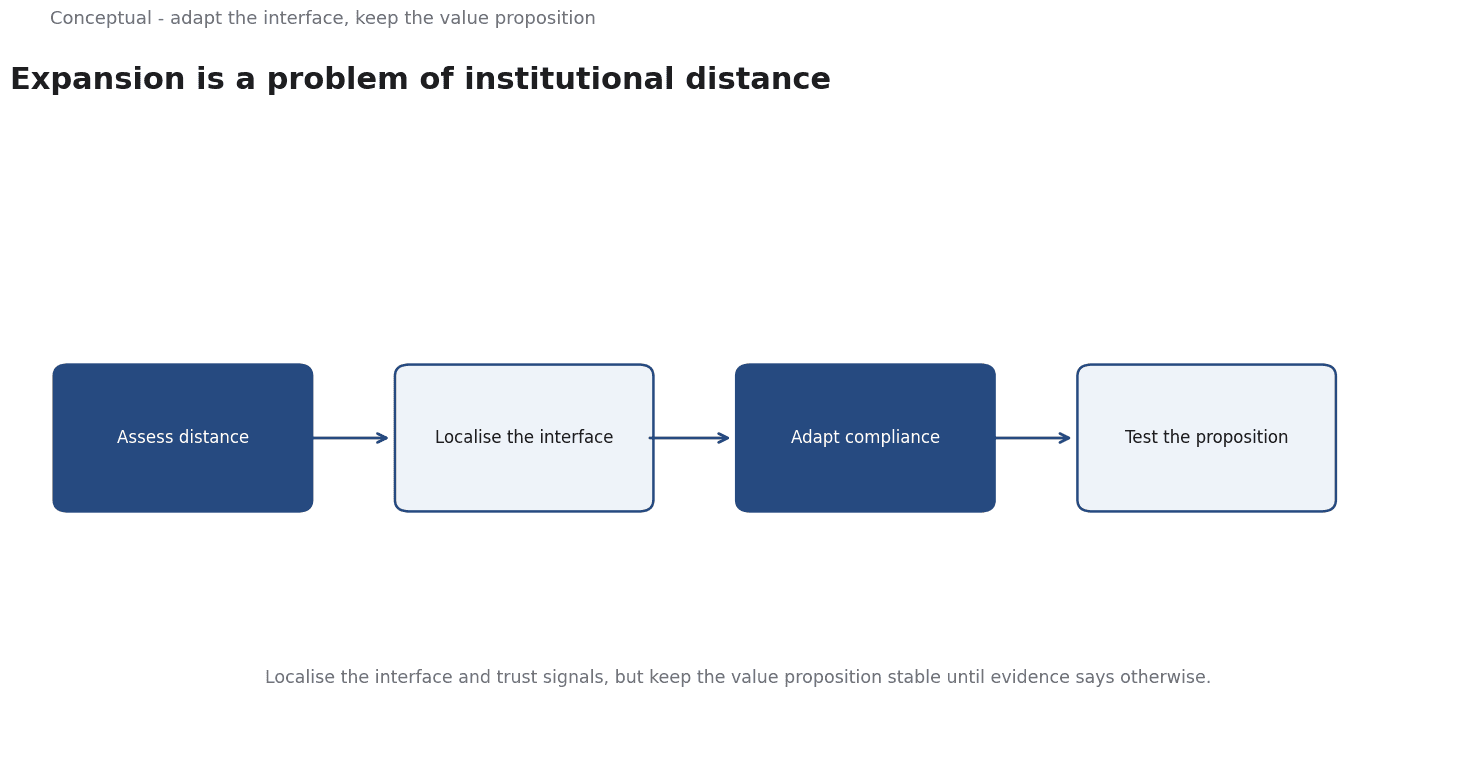
The three layers of adaptation
Product and language. Translation is the visible layer, but localisation also includes formats, payment methods, units, and the examples used in onboarding. A product whose first-run example assumes a local address format may fail before the user reaches the value moment.
Go-to-market. Channels that work in one market may be absent or structurally different in another. A search-driven acquisition motion depends on a search market; a partner-led motion depends on a partner ecosystem with matching incentives. O*NET's occupation descriptions are a useful reminder that roles and skills are defined in institutional contexts — the "same" sales role can mean different work in different labour markets.
Compliance and institutions. Data rules, consumer protection, taxation, and product standards differ by jurisdiction. The EU's GDPR, for example, imposes breach-notification obligations with a 72-hour clock.
The layers interact. A localisation change that introduces a new data flow may create a compliance obligation; a channel choice may determine what customer data the company receives in the first place.
A worked example of a market-entry decision
The following numbers are hypothetical and illustrative.
A software company with 1 million in annual revenue at home considers two markets:
| Market A | Market B | |
|---|---|---|
| Estimated addressable revenue | 400,000 | 900,000 |
| Localisation cost | 50,000 | 150,000 |
| Compliance and setup | 30,000 | 120,000 |
| Local sales cost per year | 80,000 | 100,000 |
| Time to first revenue | 4 months | 12 months |
Simple two-year view:
- Market A: costs 50,000 + 30,000 + (2 × 80,000) = 240,000. If it captures 15% of 400,000 per year = 60,000 annually, two-year revenue is 120,000 — a loss of 120,000.
- Market B: costs 150,000 + 120,000 + (2 × 100,000) = 470,000. At 15% of 900,000 = 135,000 annually, two-year revenue is 270,000 — a loss of 200,000.
Neither looks attractive on these assumptions, and the larger market is the worse bet because its setup costs and time-to-revenue are much higher. Three questions decide whether to proceed:
- Is 15% plausible? Without evidence about local competition and channel access, the capture assumption is the whole answer. A market-entry estimate built from the home market's share is a guess.
- What is the option value? If success in Market A produces a reference customer that makes Market B cheaper later, the first loss buys information and credibility, not just revenue.
- What is the cost of waiting? Delaying a year avoids the loss but leaves a competitor to establish the position. That is a strategic judgement, not a calculation from the table.
The method matters more than the numbers: make the assumptions explicit, compute the sensitivity, and decide which assumption deserves research before committing capital.
What must be localised, and what must not
A useful rule is to localise the interface and the trust signals, but keep the underlying value proposition stable until evidence says otherwise.
Localise the surface. Currency, date formats, address fields, payment methods, and the examples in onboarding are all visible and immediately consequential. A customer who cannot enter a valid address or pay with a familiar method will not reach the product's value moment.
Localise the proof. Trust signals differ. In one market, a recognised local payment brand is the decisive signal; in another, a local-language support line is. These are not cosmetic differences — they determine whether a buyer believes the transaction is safe.
Keep the mechanism until tested. The reason customers buy the product — the core problem it solves — often transfers more readily than teams expect. Changing it at the same time as the surface makes it impossible to know which change mattered. A staged entry lets you learn.
The counterargument is that some products are culturally specific and must change fundamentally.
That is true for content, fashion, and food, and it is a reason to treat those categories as a portfolio of local products rather than a single product translated badly.
The test is whether the same value proposition can be stated without reference to the home market's assumptions.
What the evidence does not give you
Three limits apply.
A company case is not a base rate. Amazon's own account of its expansion is useful primary material for what the company chose and why it says it chose it. It is not evidence that a smaller firm should follow the same sequence, and it omits the expansions that did not work.
Market size is not addressable revenue. A large national market can be practically inaccessible because of distribution, regulation, or incumbent relationships. The relevant figure is what your product can realistically capture, not the country's total spending.
Averages hide institutional differences. Labour rules, payment preferences, and trust norms vary within regions as well as between them. An "EMEA strategy" is usually a category error.
Survivorship bias is especially strong here: the international expansions that are written up are the successful ones. The larger number of quiet withdrawals are less visible, so the advice drawn from the visible cases overstates the typical success rate.
A decision test
- Name the institutional differences that affect your product and channels, not just the language.
- Check the current rules in the target jurisdiction with a qualified local source.
- Estimate addressable revenue from local evidence, not home-market share.
- Compute the full setup and operating cost with a time-to-revenue assumption.
- Identify the option value — what a first market makes possible later.
- Run the smallest reversible test before committing to a full entity.
- Set a review date with an explicit condition for stopping.
For the regulatory comparison, see Data Privacy; for the strategic framing, see The Anatomy of a Successful Digital Business.
References & Further Reading
- Econlib, 2026. Core Econ: The Economy — A complete free economics textbook covering supply, demand, and elasticity.
- U.S. Securities and Exchange Commission (Investor.gov), 2026. Introduction to Investing — Primary regulator guidance on market mechanics and investor protection.
- Colin Bryar and Bill Carr, 2019. Amazon Company News — Primary company material on how the working-backwards method is applied.